
How much is Pikachu [Meiji Chocolate] #68/PCG-P worth right now?
The Pokemon TCG market is often described as a living, breathing ecosystem. Some days it feels like a steady forest, growing slowly and predictably. Other days, it feels like a sudden flash flood—where certain species of cards are swept away by the tide while others find themselves perched on high ground, suddenly skyrocketing in value. Today, June 19, 2026, we are seeing a fascinating study in market contrast. We are witnessing a massive "Pikachu Pivot" on the low-end entry market, while a "Rayquaza Recession" is simultaneously pulling some of the heavy hitters down into the valley.If you’ve been watching the charts, you know that price action isn't always about the "big" cards. Sometimes, the most explosive movements happen in the cards that the average collector might overlook in favor of the shiny, high-grade slabs. Today is exactly one of those days.
The Pikachu Pivot: A 401% Explosion
Let’s address the elephant in the room—or rather, the mouse in the chocolate. The Pikachu [Meiji Chocolate] #68/PCG-P (Pokemon Japanese Promo) has seen a staggering price spike today, jumping from $11.96 to $60.00. That is a 401.7% increase in a single reporting period.To put that in perspective, for a card that was previously seen as a "pocket change" pull, it has suddenly vaulted into a much more serious tier of collecting. What’s driving this? Often, these types of explosive moves are triggered by a "discovery" phase. A specific influencer, a high-profile collector, or a niche community might have highlighted the aesthetic appeal of the Meiji Chocolate promo, causing a sudden influx of demand.
When a card jumps 400% like this, it’s rarely a "slow climb." It’s a surge. For the collector holding a raw copy of this Pikachu, the value has essentially quintupled. However, it’s also a reminder to be cautious: when a card moves this quickly, the "ceiling" is often just as volatile as the floor. While the raw price is currently $60, the graded market offers a different perspective. A PSA 10 of this Pikachu is sitting at $156.06, with a BGS 10 reaching $203. The fact that the raw price has jumped so close to the PSA 10 price suggests that the "raw" market is hungry, but the premium for a perfect grade remains a healthy buffer.
The Steady Climbers: Dialga, Shuckle, and Sandshrew
While the Pikachu move is the headline, we shouldn't ignore the "Steady Climbers"—the cards showing significant, double-digit gains that suggest a more sustained trend rather than a momentary flash.Dialga EX [1st Edition] #80 (Pokemon Japanese Megalo Cannon) has seen a significant jump, moving from $66 to $130.79 (+98.2%). This is a massive move for a 1st Edition staple. For those who have been sitting on this card, the nearly 100% gain is a testament to the enduring love for the original Japanese "Megalo Cannon" era. When looking at the graded data, the gap between raw and graded is substantial. A PSA 10 is currently commanding $770, while a BGS 10 sits at a whopping $1,001. The fact that the raw price is moving toward the $130 mark suggests that the "entry-level" 1st Edition market is heating up, likely as more collectors look for accessible "prestige" cards.
Then we have Shuckle #7 (Pokemon 2001 Topps Johto Pop-up). This card moved from $93.95 to $150, a notable move of 59.7%. Shuckle has always been a bit of a "cult" favorite—a card for the collectors who appreciate the oddities of the early 2000s. This jump suggests a growing appetite for the Topps Pop-up era, which is often overlooked in favor of the more mainstream Wizards of the Coast releases. For the Shuckle holder, the jump to $150 puts it in a very interesting position relative to its graded counterparts: a PSA 10 is $165 and a BGS 10 is $215. The raw price is now hovering right at the doorstep of the PSA 10 value, which usually indicates a period of high demand for "near-mint" raw copies.
Sandshrew [Reverse Holo] #92 (Pokemon Skyridge) also showed a significant move, ticking up from $109.13 to $155.5 (+42.5%). Skyridge is a heavy hitter in the vintage space. A 42% move in a single day for a Skyridge card is a major signal. It tells us that the "vintage" side of the market is still very much alive and well. Interestingly, the graded premiums for Sandshrew are quite wide—a PSA 10 sits at $192.52 while a BGS 10 hits $250. The jump to $155.5 for a raw copy is a healthy gain that keeps it well below the "premium" floor, making it an attractive target for those looking to diversify into Skyridge.
Finally, we see Mewtwo [Reverse Holo] #12 (Pokemon Delta Species) moving from $118.12 to $167.5 (+41.8%). Delta Species is a cornerstone of the "vintage" portfolio. A 41% jump is a significant surge for a card of this pedigree. However, looking at the graded data, the "ceiling" for Mewtwo is incredibly high. A PSA 10 is valued at $2,805.81, and a BGS 10 reaches a staggering $3,648. This tells us that while the raw price is moving upward, there is still a massive amount of room for growth before it hits the "elite" collector tier.
The Rayquaza Recession: A Market Correction?
If the morning was about the "Pikachu Pivot," the afternoon is about the "Rayquaza Recession." We are seeing a fascinating—and somewhat sobering—decline across three different Rayquaza cards today.The most dramatic move belongs to Rayquaza Ex [Chris Fulop] #97 (Pokemon World Championships 2004). This card saw a significant drop, falling from $140 to $30.27, a loss of 78.4%. This is a massive correction. When a card loses nearly 80% of its value in such a short window, it usually points to one of two things: a massive sell-off by a major holder or a "price correction" where the market realizes the previous price was an outlier. Given the $30.27 price point, it feels like a sharp correction. For collectors of this specific Chris Fulop piece, today is a day of "buyer's opportunity" rather than "seller's gain."
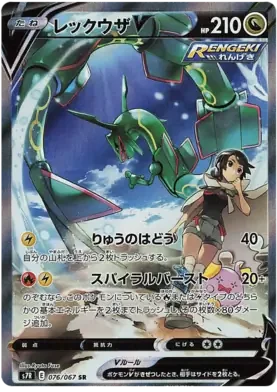
Not far behind is the Rayquaza V #76 (Pokemon Japanese Blue Sky Stream), which slipped from $339.48 to $239.25 (-29.5%). While it’s a notable move, it’s a significant loss for a card that was previously holding a much higher floor. This drop of about $100 suggests a cooling of interest in the "Blue Sky Stream" series. Interestingly, the graded data for Rayquaza V shows a PSA 10 at $806.76 and a BGS 10 at $1,000. The fact that the raw price dropped to the $200s while the graded price remains high suggests that the "raw" market is being hit harder than the "slabbed" market, which often happens when supply of raw copies suddenly increases.
We also see a significant move on the Rayquaza C LV.X #DP47 (Pokemon Promo), which fell from $142.52 to $88.99 (-37.6%). This card had a weird history—it was at $51 a while back, spiked to $142, and is now retreating. This "boom and bust" cycle is classic for promo cards with limited print runs. The current price of $88.99 is a significant drop, but it's worth noting that the PSA 10 is still sitting at $800.48. This tells us that the "prestige" value of a perfect Rayquaza LV.X remains very high, even if the raw market is taking a hit.
The Outliers: Mew and Latios
To round out the "loser" list, we have two cards that are showing more of a "steady decline" rather than a total crash.Mew [Spectra] #151 (Pokemon 2000 Topps Chrome) saw a significant drop from $201.25 to $81.29 (-59.6%). For a Topps Chrome card from the 2000 era, this is a brutal move. It suggests that the "non-Wizards" Topps market is currently experiencing some heavy pressure. However, looking at the graded data, a PSA 10 is still valued at $1,140. This creates a massive gap between the raw price ($81.29) and the graded price. For a collector, this suggests that the "raw" Mew is currently in a "buy" zone, but the "graded" Mew is still a high-tier trophy card.
Lastly, we have Latios EX #54 (Pokemon Japanese Spiral Force). This card moved from $111.31 to $74.66, a significant drop of 32.9%. It’s a notable move, but it doesn't have the same "crash" energy as the Rayquaza cards. It’s a correction. The graded data for Latios EX shows a PSA 10 at $800.04 and a BGS