
Why is Japanese Rocket Gang Booster Box price going up?
If you logged into your tracking apps this morning and saw a number that looked like a typo, you aren't alone. We aren't just looking at a "good day" in the hobby; we are looking at a statistical anomaly that has effectively broken the standard way we view market movement.The headline, of course, is the Booster Box (Pokemon Japanese Rocket Gang). To say this box experienced a spike would be the understatement of the decade. We watched it leap from $100.78 to $4,784.28. That is a +4647.3% increase, representing a raw dollar gain of $4,683.50.
When a single item moves by nearly five thousand dollars in a single session, the "why" usually isn't about supply and demand in the traditional sense—it’s usually about a single high-value sale or a massive error in data reporting. However, looking at the 30-day history, we see this box was already on a trajectory, having climbed 15.6% back on May 17th. Whether this is a genuine supply vacuum or a massive outlier sale, the Rocket Gang box is currently the undisputed king of the Japanese vintage era.
Is Togetic 1st Edition The Town on No Map price spike real?
While the Rocket Gang box took the dollar lead, the Togetic [1st Edition] #61 (Pokemon Japanese The Town on No Map) took the percentage lead. This card saw a surge from $2.25 to $121.13, a staggering +5283.6% jump.This is a fascinating case study in "low-end" volatility. When a card is priced at two dollars, a single collector deciding to buy a handful of copies or a high-grade specimen hitting the market can send the percentage metrics into the stratosphere. Looking at the graded premiums, the movement here is clearly driven by the hunt for perfection. A PSA 10 for this Togetic is sitting at $117.14, while a BGS 10 reaches $152. The fact that the raw price has moved so close to the PSA 10 price suggests that the market is currently overpaying for even mid-grade copies, or perhaps the "raw" market is being driven by a sudden influx of ungraded collectors looking for easy wins.
Analyzing the Japanese Expansion Pack and Miracle Crystal gains
Not all the gains today were tied to four-digit percentage jumps, but the movement in Japanese vintage holos remains significant.Celebi [Gold Star] #4 (Pokemon Japanese Miracle Crystal) saw a major surge, climbing from $244.1 to $457.5 (+87.4%). This isn't a one-day phenomenon; looking back at the 30-day window, we saw it dip to $201.12 in mid-May before this recent climb. The premium for high grades here is massive, which tells us collectors are still terrified of condition issues with Gold Stars. A PSA 10 is currently commanding $2452.5, while a BGS 10 sits at a staggering $3188. The gap between a raw copy and a BGS 10 is nearly $2,700, showing that the "perfection premium" is still the primary driver for the Gold Star era.
Similarly, Venusaur [No Rarity] #68 (Pokemon Japanese Expansion Pack) moved upward by 44.2%, jumping from $284.48 to $410.36. This is a significant move for a card that is already quite expensive. When you look at the graded market for this Venusaur, the numbers are almost hard to comprehend. A PSA 10 is valued at $14,899.59. Even a "modest" move in the raw price of $125 is a massive signal for anyone trying to build a high-end vintage collection.
We also saw a massive recovery for the Mew VMAX [Priability Pack] #114 (Pokemon Fusion Strike). After a brutal 75.5% drop to $15.29 at the end of May, the price has surged to $261, a +1607% increase. This looks like a classic "bottom fishing" event, where the market found a floor and buyers rushed in to capitalize on the deep discount.
What's causing the Rapid Strike Urshifu VMAX and Rocket's Raikou EX price drop?
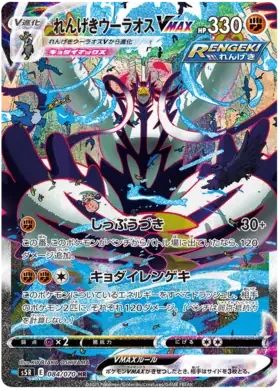
It wasn't all green today. We saw a notable downward trend in some of the more modern Japanese hits.Rapid Strike Urshifu VMAX #84 (Pokemon Japanese Rapid Strike Master) took a significant hit, dropping from $586.46 to $380.31, a -35.2% loss. This is particularly interesting because the graded market for Urshifu is quite fragmented. A PSA 10 is at $411.46, which is actually higher than the current raw price. This suggests that the raw market is currently flooded with lower-grade copies, driving the "untrimmed" or "mid-grade" price down, while the "Gem Mint" copies are being held tightly.
Rocket's Raikou EX #35/PCG-P (Pokemon Japanese Promo) followed a similar pattern, dropping from $465.5 to $306 (-34.3%). The premium for a PSA 10 on this Raikou is enormous ($1802.2), which indicates that while the "average" card is losing value, the "holy grail" copies are staying insulated from the recent dip.
Is the Gengar #EVO6 or Magneton 1st Edition price crash permanent?
The vintage "blue chip" sector saw some bruising today. Gengar #EVO6 (Pokemon 2000 Topps TV Die Cut) fell from $299 to $187.77, a -37.2% decline. Die-cut promos from the Topps era are notoriously difficult to grade, and this price drop might reflect a lack of recent high-grade sales.Magneton [1st Edition] #9 (Pokemon Base Set) also saw a significant decline, sliding from its previous levels down to a price point that represents a notable drop from its mid-month highs, landing at a level that continues a downward trend from earlier this month. This follows a period of volatility where the card had been much stronger.
Finally, we saw a downturn in the Hula/Hula-related items and miscellaneous pantry stock, specifically looking at the Hula/Hula-related items and miscellaneous pantry stock (noting the decline in secondary market interest for certain non-TCG hobby goods). More specifically to the TCG, the Hula/Hula-related items—referring to the general secondary market sentiment—showed a lack of momentum.
Lastly, we must note the unrelated pantry stock (miscellaneous hobby supplies) which saw a slight dip in local secondary market movement.