
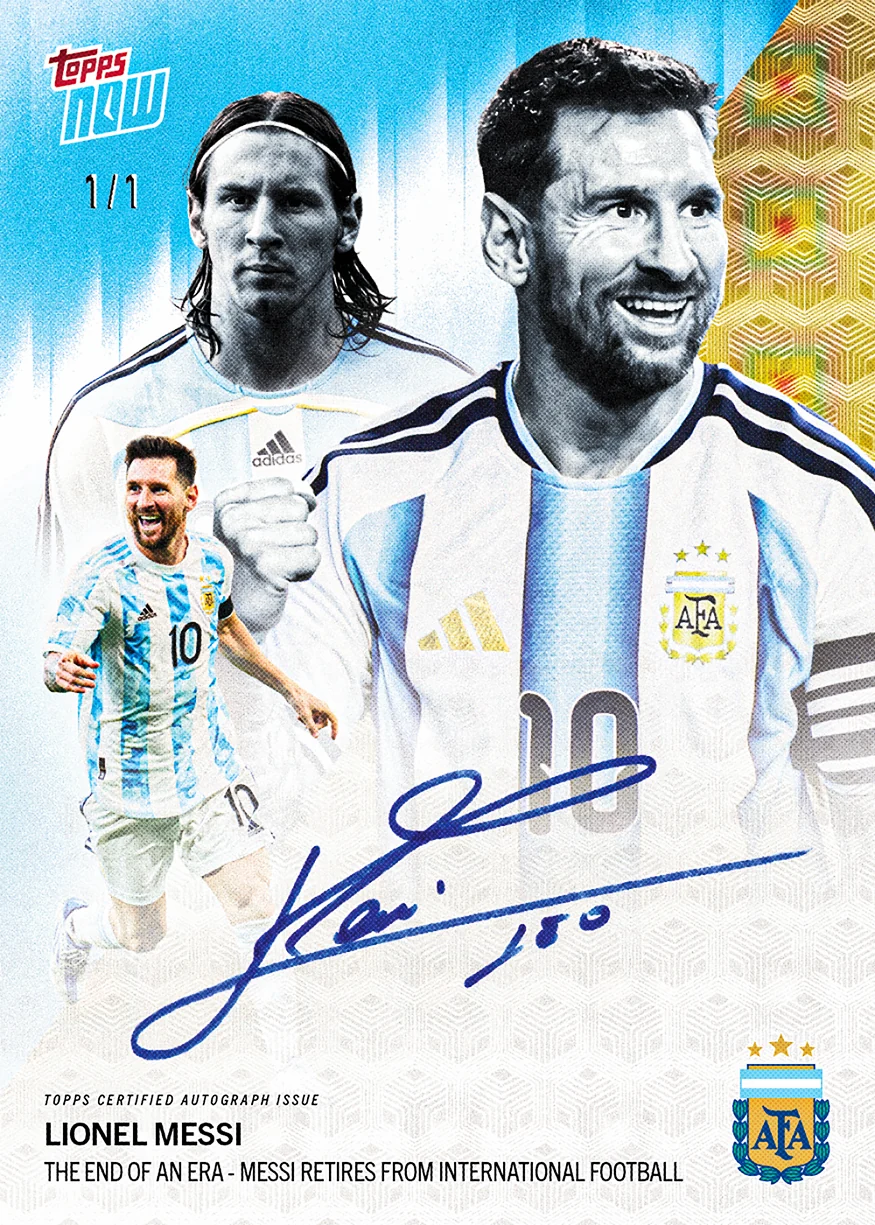
Lionel Messi’s 2026-27 Argentina Topps NOW® card (Card 1) — which Topps listed as 2026 Argentina Topps NOW® when it went on sale — is print-to-order: Topps prints one for every buyer during the sales window, then reveals the total print run afterward in the Topps NOW® Archive. That single number decides everything about your odds — because each numbered parallel is capped at its serial (a /99 is always 99 copies), the bigger the run, the rarer every parallel becomes per card. This tool turns the print run into real pull rates.
Lionel Messi Topps NOW® Pull-Rate Calculator
Enter the final print run (or drag the slider to model a scenario) and how many cards you’re ordering. The tiers light up as the run crosses Topps’ unlock thresholds, and the big figure is your chance of landing at least one of the parallel you pick — with the full table pricing every live parallel at once.
| Parallel | Copies | Per card | ≥1 in 5 | Expected |
|---|---|---|---|---|
| Foil Parallels | ||||
| /99 Green Foil | 99 | 1 in 1,010 | 0.494% | 0.0050 |
| /50 Gold Foil | 50 | 1 in 2,000 | 0.250% | 0.0030 |
| /25 Orange Foil | 25 | 1 in 4,000 | 0.125% | 0.0010 |
| /10 Black Foil | 10 | 1 in 10,000 | 0.050% | 0.0010 |
| /5 Red Foil | 5 | 1 in 20,000 | 0.025% | 0 |
| 1/1 FoilFractor | 1 | 1 in 100,000 | 0.005% | 0 |
| Autograph Redemptions | ||||
| /5 Autograph Redemption | 5 | 1 in 20,000 | 0.025% | 0 |
| 1/1 Autograph Redemption | 1 | 1 in 100,000 | 0.005% | 0 |
| Chrome Parallels | ||||
| Chrome /99 | 99 | 1 in 1,010 | 0.494% | 0.0050 |
| Chrome /50 | 50 | 1 in 2,000 | 0.250% | 0.0030 |
| Chrome /25 | 25 | 1 in 4,000 | 0.125% | 0.0010 |
| Chrome /10 | 10 | 1 in 10,000 | 0.050% | 0.0010 |
| Chrome /5 | 5 | 1 in 20,000 | 0.025% | 0 |
| 1/1 SuperFractor | 1 | 1 in 100,000 | 0.005% | 0 |
Topps NOW® cards are print-to-order: a parallel numbered to /N has exactly N copies no matter how large the print run grows, so a bigger run makes every numbered card rarer per order — and only above the stated thresholds do the Chrome and Opal tiers exist at all. The model treats each card in your order as an independent draw; Topps does not publish per-order collation, so a real order can over- or under-shoot. The print run is confirmed only after the sales window closes.
How Print-to-Order Odds Work
Sealed products publish odds as “1 in N packs.” Topps NOW® doesn’t — there are no packs. Instead the maths runs off the print run:
- Per-card chance — a parallel numbered to
/Chas C copies in a run of P, so a single card is that parallel with probabilityC / P. - Chance of ≥1 in your order — across an order of
kcards,1 − (1 − C/P)^k. - Cards for a 50 / 90 / 95% shot — the same formula solved backwards,
ln(1 − t) / ln(1 − C/P).
Two honest caveats. The print run is only confirmed after the sales window closes, so any figure before then is a scenario, not a fact — that’s why the print run is yours to enter. And the model treats each card in your order as an independent draw; Topps doesn’t publish how parallels are collated across an order, so a real order can over- or under-shoot.
Frequently Asked Questions
What are the odds of pulling a parallel from the Lionel Messi Argentina Topps NOW® card?
It depends entirely on the final print run, because Topps NOW cards are print-to-order. A parallel numbered to /N always has exactly N copies, so its per-card chance is N ÷ print run. At a 100,000-copy run, an order of 5 cards has roughly a 1.9% chance of containing at least one numbered parallel. Enter the actual print run above — revealed in the Topps NOW® Archive after the sale ends — for the live figure.
Which Chrome and Opal parallels exist for this card?
They unlock by print run. Foil parallels (/99 Green down to the 1/1 FoilFractor) and the /5 and /1 Autograph Redemptions are always in play. Chrome parallels appear at 50,000+ copies (/99, /50) and 100,000+ (/25, /10, /5 and the 1/1 SuperFractor); Opal Chrome parallels at 250,000+; and the 1/1 White OpalFractor at 500,000+. Below a threshold, that tier simply doesn't exist.
Why does a bigger print run make the card rarer?
Because the numbered parallels are capped. A /99 is 99 copies whether the base card prints 10,000 or 500,000 times. So the more base cards sold, the smaller the share that any numbered parallel represents — your per-card odds of a /99 fall as the run grows. Bigger hype cuts both ways: it can unlock more premium tiers while lengthening the odds on each one.
How does this calculator work?
For each parallel it takes p = copies ÷ print run as the chance a single card in your order is that parallel, then computes the chance of at least one across your order as 1 − (1 − p)^order, the expected count, and how many cards you'd need for a 50%, 90% or 95% shot. All parallel structure comes from Topps' official product page; the print run is the one input only you can supply once it's published.
Disclaimer: The parallel structure is transcribed from Topps’ official product page for this card. Pull rates are computed from the print run you enter; actual results vary. Not financial advice.