
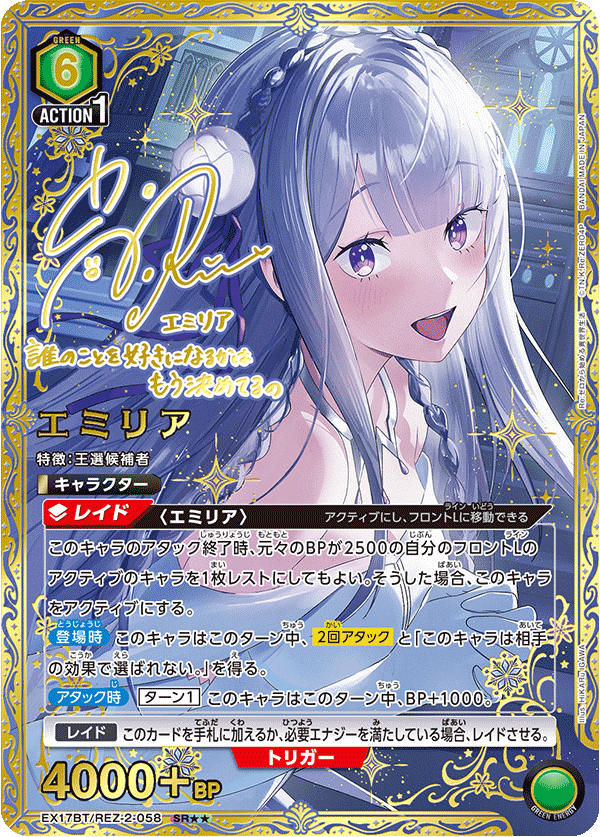
The quick verdict: Re:Zero Vol.2 (EX17BT) is a four-colour Union Arena set with a very predictable box and a very empty top end. A 16-pack display gives you about 4–5 SRs and exactly one parallel — and the one-parallel rule is nailed down here harder than on any Union Arena set we have documented, at 19 hits across 19 boxes shown on camera. Above that, two full cartons produced one SR★★, zero SR★★★ and zero signed serial APs across 32 boxes. The useful part is what a whole carton failed to do: 16 boxes returned each SR only 4–7 times and still left its openers short of the playsets they wanted. Open for the rip, buy for the deck.
What Is Re:Zero Vol.2 Union Arena?
Re:Zero Vol.2 (EX17BT, card codes EX17BT/REZ-2-xxx) is the second Union Arena booster set for Re:Zero − Starting Life in Another World, and it released in Japan on Friday 30 October 2026. Where Vol.1 covered purple, blue and yellow, Vol.2 strengthens all three and adds the set's headline feature: a brand-new colour, green.
The roster is the series' full ensemble rather than just the leads — Emilia, Rem, Ram, Natsuki Subaru, Beatrice, Reinhard van Astrea, Priscilla Barielle, Julius, Felt, Frederica, Crusch Karsten and Ferris all appear, with Echidna and Fortuna turning up in card text and deck shells. One notable absence became a running joke in one of the openings: Regulus has no card in the set at all. An opener announced he was building a Regulus deck, searched the pulls, and concluded "for some reason there are no cards. Not one."
This guide is built the way a smaller TCG has to be. Union Arena has no 500-box aggregate to work from, so the structure comes from Bandai's own product listing — pack size, the exact rarity split, the serial-card mechanic — and the hit rates come from the openings, stated with the sample size attached. The sample is two Japanese cartons, 32 boxes, both opened on release weekend.
One important honesty note about that sample, because it shapes every number below. Only 19 of the 32 boxes had their contents shown. One carton was a complete, itemised run. The other was a "bakusoku" speed-opening edit: the video counts all 16 boxes on screen, but 13 of them flash by with no cards displayed, so they contribute nothing but a box count. Where a number rests on 19 boxes we say 19; where it rests on 16 or on three, we say that instead. The tiers on this page genuinely have different denominators and blending them into one percentage would be inventing data.
A second structural note before you buy: this is a Japanese release and the Japanese display has no box topper. The English Union Arena sets — Inuyasha, for example — ship a separate 1-of-8 topper pack with three gold-foil designs. Nothing of the kind appeared in 32 boxes here. Every hit came out of the 16 game packs.
Box Composition & Pack Structure
The first half of this is not estimated at all. Per Bandai's official product listing for EX17BT:
- 8 cards per pack — note this, because the English Union Arena releases run 12 cards a pack. A Japanese box and an English box are not the same product and their rates should never be pooled.
- 16 packs per display box, 16 boxes per carton — so a carton is 256 packs and about 2,048 cards
- ¥385 per pack including tax, i.e. roughly ¥6,160 (about $40) per box at Japanese retail
- 81 card types: 12 SR · 12 R · 24 U · 25 C · 8 AP
- Parallel cards are included in the product — Bandai states this outright but publishes no rate for them
- Serial-numbered limited AP cards are included at an "ultra-low rate" (超低確率), and are to be signed by the voice cast
- 4 colours — purple, blue and yellow carried over from Vol.1, plus green as the new colour
That 12-SR figure is worth holding onto, because it is the number that makes the chase maths work later: a set with only twelve Super Rares, each of which also exists in star treatments, concentrates all of its value into a very small pool of card numbers.
The ★ suffix is the thing to understand about Union Arena. A star is a parallel treatment of an existing card number, not a separate card — the same Emilia or Rem at the same card number with an escalating finish. The openers in these videos state it unusually plainly for once. Holding up the set's Rem parallel, one said: "And this one's a Rare — a Rare. It's the Rare's star. It's not an SR or anything, this time." That is the ladder in one sentence: the star sits on top of whatever rarity the base card already was.
And the rule that defines the box: one parallel per box. One. The 16-box carton run makes this airtight almost by accident, because two hosts opened one box each per segment and realised viewers would miscount — "the two of us each opened one box" … "it's not that two came out of one box. Don't get that wrong." Eight segments, two boxes each, and every single segment summary listed exactly two hits. Sixteen hits, sixteen boxes.
Because the real sample is 32 boxes rather than hundreds, we are not publishing a fake per-pack percentage table. Here is what is structural, versus what the boxes actually produced:
| Slot | What You Get | Guaranteed? | Source |
|---|---|---|---|
| Game packs | 16 packs × 8 cards, no box topper | Yes | Bandai + every documented box |
| Card pool | 81 types — 12 SR / 12 R / 24 U / 25 C / 8 AP | Yes | Bandai |
| ★ Parallel (any rarity) | Exactly 1 per box | Effectively | 19 of 19 documented boxes |
| SR (Super Rare) | ~4–5 per box | Effectively | 3 itemised boxes only |
| SR★★ (double-star) | 1 across 16 carton boxes — about 1 in 16 | No | Community openings |
| AP card (character AP) | At least 2 across 32 boxes | No | Community openings |
| SR★★★ (triple-star) | 0 across 32 boxes | Lottery | Community openings |
| Signed serial AP | 0 across 32 boxes | Lottery | Bandai ("ultra-low rate") + openings |
Read the bottom three rows together. Across two full cartons, the entire top end of this set produced one double-star and nothing else at all. A Re:Zero Vol.2 box is a 4-or-5-SR box with one parallel in it — everything above that is a genuine outlier, and Bandai's own "ultra-low rate" wording on the serial AP tells you it is meant to be.
Where to buy Re:Zero Vol.2 Union Arena
Japanese retail is ¥385 a pack / about ¥6,160 (~$40) a box, and for once that may actually be findable. Supply looks healthy on this set — the 16-box carton opening signed off by saying there is probably plenty of stock around and that Re:Zero is an easy title to pick up now, and the same run noted that Vol.1 singles are heavily oversupplied and therefore cheap. That is a genuinely different story from the Union Arena releases either side of it, where allocation was the headline. Note that EX17BT is a Japanese-language product; check your local game store before paying a secondary markup.
Observed Run Log: 2 Cartons
Combined data from two Japanese cartons — 32 display boxes — opened over EX17BT's release weekend. With a sample this shape the honest move is to show the runs rather than blend them, because one of them is a complete log and the other is a highlight reel, and that difference matters more than any average.
| Run | Boxes opened | Boxes shown | ★ Parallels | SR★★ | SR★★★ | Character AP | Signed serial |
|---|---|---|---|---|---|---|---|
| Full carton, two openers (JP, itemised) | 16 | 16 | 16 — 1 / box | 1 — Priscilla | 0 | 1 — cosplay Emilia | 0 |
| Full carton, card shop (JP, speed edit) | 16 | 3 | 3 — 1 / box | 0 | 0 | 1 — Ferris | 0 |
| Total | 32 | 19 | 19 / 19 boxes | 1 (1 in 16) | 0 in 32 | 2+ (~1 in 16) | 0 in 32 |
The SR-per-box column is deliberately absent from this table: only three boxes in the whole sample were counted card by card. We'll add runs to the log as more openings appear.
The itemised carton, segment by segment
The 16-box carton is worth printing in full, because it is the cleanest Union Arena run we have. The two hosts opened one box each per segment, so every row below is two boxes and two hits:
| Segment | Boxes | Hit 1 | Hit 2 |
|---|---|---|---|
| 1 | 1–2 | Emilia, purple 2-cost — ★1 | A second Emilia (name not clearly stated) |
| 2 | 3–4 | Emilia-tan ("EMT") — ★1, a reprint | Rem, 3-cost — new SR |
| 3 | 5–6 | Beatrice, purple — ★1 | A green card — ★1 (Subaru or Julius) |
| 4 | 7–8 | Rem, 3-cost — new SR (duplicate) | Rem, yellow 2-cost — new |
| 5 | 9–10 | ⭐ Emilia — character AP (package / cosplay art) | Emilia, yellow event-cheat — SR★1 |
| 6 | 11–12 | Reinhard | Subaru — art connects with the Reinhard |
| 7 | 13–14 | 🏆 Priscilla — SR★★ (black-and-gold frame) | A yellow Rem-tan card |
| 8 | 15–16 | Beatrice, purple — SR parallel | ⭐ Rem "Natsuki Subaru's Carer" — new SP |
One caveat on segment 5: the character AP appears to have taken the box's single hit slot rather than arriving on top of it, since that segment still summed to two hits for two boxes. One carton cannot settle whether an AP always displaces the parallel — treat it as an open question.
What the openings agree on
- Exactly one parallel per box — 19 for 19. This is the firmest number on the page and the hosts guarded it themselves, warning viewers not to read their two-per-segment hits as two from one box. It can be any rarity's star version, and in this sample it was most often a ★1 on a low rarity, exactly as the rule predicts.
- ~4–5 SRs per box, from three boxes only. One host graded his box a "4-card box" while his partner called hers a "5-card box", and the single itemised box in the other carton finished on 4. Three boxes is not a rate; it is a direction.
- The top end is empty. One SR★★ in 32 boxes, zero SR★★★, zero signed serial APs. The carton run tracked the triple-star obsessively — "still no triple-star" comes up four separate times — and never found one.
- ⭐ A carton does not finish a deck. This is the single most useful finding in the sample. At the wrap-up the openers counted their SRs and landed on "the usual sort of 4 to 7 copies" of each, with Priscilla lowest at 4 copies in 256 packs. They wanted 12 copies of several cards to build three decks and finished short on the Rem-Subaru, Rem-Ram and Beatrice staples. Sixteen boxes. One carton. Still short.
- Character APs ran cold. At least two across 32 boxes, call it ~1 in 16 — noticeably leaner than the ~1 in 8 we measured on Steins;Gate. Two cartons cannot distinguish a real difference from variance, so hold it loosely.
- Double-stars are not a per-box expectation. The openers openly worried mid-run about finishing the carton without one — "what are the odds of a box with no double-star?" — and only hit theirs in box 13 or 14 of 16.
The Rarity Ladder
Re:Zero Vol.2, from bulk to top lottery:
C (25) / U (24) / R (12)     ← deck bulk, most of every 8-card pack
→ C★ / U★ / R★               ← parallel commons; usually the box's one parallel
→ SR (12 types, foil)        ← ~4-5 per box, the reliable hit
→ SR★ (single-star)          ← parallel of an SR
→ SR★★ (double-star)         ← 1 in 16 boxes observed
→ SR★★★ (triple-star)        ← 0 in 32 boxes
→ AP (8 types, character AP)  ← 2+ in 32 boxes
→ Signed serial AP           ← "ultra-low rate" per Bandai; 0 in 32 boxes
One open question, flagged rather than guessed at. The openers repeatedly referred to a "special" (SP) tier — the Rem card titled "Natsuki Subaru's Carer" was called "the only new special" of the carton, and they noted that "the specials shine this time too." But Bandai's official rarity list for EX17BT contains no SP tier: it is 12 SR, 12 R, 24 U, 25 C and 8 AP, full stop. The most likely reading is that SP is a special parallel treatment of an existing card number rather than a rarity of its own — which is exactly how the ★ grades work — but we are not going to print that as fact on one carton's worth of chatter. If you are tracking the set list, treat SP as a treatment to verify, not a confirmed rung.
| Rarity Tier | Description | Observed Rate |
|---|---|---|
| C / U / R | 61 of the set's 81 types. Deck-building bulk, and nearly all of every 8-card pack. | Bulk of every pack |
| C★ / U★ / R★ | Parallel treatments of the commons. Frequently is the box's one guaranteed parallel — most of the hits in the itemised carton were ★1s. | Part of the 1 parallel / box |
| SR (Super Rare foil) | Only 12 types in the whole set. The reliable box hit and what you actually need for a deck. Every colour axis received at least one new SR. | ~4–5 per box |
| SR★ (single-star) | Parallel of an SR — same card number, better finish. The nicer end of the one-parallel slot; the carton hit one, a yellow Emilia. | Part of the 1 parallel / box |
| SR★★ (double-star) | The premium parallel tier and the realistic top-end hit. Black-and-gold frame, and the arts are designed to connect side by side into a heart when paired. | 1 in 16 boxes |
| SR★★★ (triple-star) | The set ceiling. Nobody in this sample saw one, and the openers were not even certain whether the triple-star and the serial card are separate things. | 0 in 32 boxes |
| AP (character AP card) | 8 types per Bandai. The cosplay Emilia pulled in the carton shares its illustration with the serial card. | 2+ in 32 boxes |
| Signed serial AP | Serial-numbered AP cards, to be signed by the voice cast. Bandai's own wording is "ultra-low rate". | 0 in 32 boxes |
We are not publishing prices for EX17BT yet. The set is days old, the Japanese market has not settled, and for a thin TCG a single early listing is a worse guide than no number at all. We'll add a priced chase table once there is a sold-listing cluster to price against rather than one shop's opening ask.
The Cards Worth Wanting
With no settled market, the useful version of a chase list is what the set's top end actually consists of and how often each thing showed up. Here is the ranked want-list from two cartons:
| Card | Tier | Why it's wanted | Seen in 32 boxes |
|---|---|---|---|
| Emilia & Rem — signed serial AP | Serial AP | The set's advertised lottery ticket, voice-cast signed and serial-numbered. Shares its illustration with the cosplay AP, so you can see exactly what you are chasing. | 0 |
| Any SR★★★ | SR★★★ | The rarity ceiling below the serial. Unseen here, and the openers could not even confirm how it relates to the serial card. | 0 |
| Priscilla Barielle | SR★★ | The one double-star in the sample. Black-and-gold frame, and the opener's own read was that it sits at the cheaper end of the ★★ tier — he was glad to pull it but said he'd half have preferred a different one. | 1 |
| The paired ★★ arts | SR★★ | The double-star illustrations join up when laid side by side into a heart — so the real collector target is a matched pair, not a single card. The same trick appears lower down the ladder on a Rem/Ram R★ pair. | 1 of a pair |
| Emilia — cosplay / package AP | AP | The non-serial version of the chase art, and the card the package itself is built around. | 1 |
| Rem — "Natsuki Subaru's Carer" | SP (unverified tier) | Called the carton's only new "special", and the only card in the run with the eye-covered art treatment. Flagged above: Bandai's rarity list does not name an SP tier. | 1 |
| Reinhard van Astrea | SR (green) | BP 5000 at 8 energy, and the card both openings called the set's meta definer — "this one's going to the format." The new colour's centrepiece. | Multiple |
| Rem, 3-cost (new SR) | SR | The most-repeated new SR in the itemised carton — pulled as a parallel twice, including a duplicate, which tells you it is deep in the pool rather than scarce. | 2 as parallels |
| Emilia, purple 2-cost | SR / ★1 | Called the new key engine piece for the purple witch shell — the card that turns into an energy source. | 1 as a parallel |
Two things worth calling out. First, the paired-art mechanic is the real collector story in this set — both the ★★ tier and at least one R★ pair are drawn to join up, which doubles the cost of "completing" a chase and is the kind of detail a price list alone will never tell you. Second, note how little of the want-list was actually reachable: of the nine entries above, the top two were pulled zero times in 32 boxes.
The AP Cards & The Signed Serial
Bandai prints 8 AP (Action Point) types in EX17BT. These are Re:Zero's equivalent of a box-topper chase, except they sit inside the 16 game packs — and at 2 or more across 32 boxes they are a real hit, not a given. The carton pulled a cosplay Emilia AP built on the product's own package art; the other carton pulled a Ferris AP with newly commissioned artwork that the shop hosts immediately clocked as not being from the anime — "this isn't from the original. It's definitely newly drawn. The face is different."
A naming trap worth untangling, because it will confuse you watching Japanese openings — and it runs in both directions:
- The character AP cards above are the hit. Japanese openers call them both "AP" and "action point" in full — one host followed his Ferris pull with "looking forward to the other action points too," meaning more of these cards.
- Plain action-point cost is a different thing entirely and appears in ordinary rules text — the SR Emilia reads "AP cost −1".
- So neither the abbreviation nor the full phrase disambiguates on its own. When this guide says 2 APs in 32 boxes, it means the character AP cards.
The real chase above all of it is the signed, serial-numbered AP. Bandai lists it as included at an "ultra-low rate" and says the cards will carry voice-cast signatures. None appeared in 32 boxes. One carton was bought explicitly to chase it, and the resulting video opens with a two-minute mock tantrum about its absence that is the funniest thing in either source — "Hang on. This box doesn't have a serial AP in it, does it? I told you from the start I wanted a serial AP. That's why I bought it for you… not delivering is a denial of my personhood. A violation of another's rights." "A violation of my rights" then becomes the video's running catchphrase, redeployed every time the carton disappoints — including when Regulus turns out to have no cards in the set.
For scale on what the very top of a Union Arena set costs to chase, the career figure we documented on the Steins;Gate guide is the number to hold in your head: one Japanese channel with roughly 500 Union Arena boxes of history across all sets has pulled a triple-star twice ever — about 1 in 250 boxes. If a signed serial is why you are buying, you are buying a lottery ticket at about $40 a draw.
The Four Colours & Their Decks
Vol.2's structural selling point is that every deck axis in the set got at least one new SR — the openers checked specifically and concluded there wasn't a single archetype left out. Four colours, with green brand new:
- Green (new) — Reinhard / Subaru / Felt / Emilia. The headline addition and, by both openings' reckoning, the strongest. Reinhard van Astrea at BP 5000 for 8 energy is the centrepiece: while he is in the front line he can place a card, or exile a green card from hand to fire its trigger. The verdict on camera was blunt — "he was the strongest swordsman… how you deal with him is down to your skill. This one's going to the format." The practical appeal is cost: one opener specifically praised green for being easy to build because it doesn't need existing cards.
- Purple — Emilia / Beatrice / Echidna, the witch shell. The new purple 2-cost Emilia is the engine piece: draw off a Witch-trait character, then exile from hand once a turn to turn herself into a two-orb energy source. Beatrice showed up twice in the itemised carton, once as a ★1 and once as an SR parallel, so the purple parallels are reasonably deep.
- Blue — Rem and Subaru. The Vol.1 pairing, strengthened. The new 3-cost Rem SR was the most frequently pulled new SR in the carton. The Reinhard and Subaru parallels are also drawn so their backgrounds match up — the openers called that segment "the boys' club" and spent a while lining the two cards up on camera.
- Yellow — Rem-tan / Rem and Ram. The twins' axis, and the home of the new yellow 2-cost Rem plus a yellow event-cheat Emilia that came out as the carton's one SR★1. Ram is the colour's anchor and appears in the cosplay art sub-series alongside Emilia and a magical-girl Rem.
Two practical notes for deck-builders from the carton wrap-up. The only cards you need from outside this set are Echidna, the Crusch-and-Ferris pair, and the Subaru from the starter deck — everything else Vol.2 provides. And Vol.1 singles are cheap right now because they are heavily oversupplied, which makes this an unusually low-friction set to start on. The catch is the one in the run log: a full carton still left its openers short of playsets, which brings us to the verdict.
Should You Open or Buy Singles?
Normally this section leans on a price gap. Here the market is days old, so the argument has to be made on distribution instead — and the sample makes it unusually well, because somebody opened a whole carton with the explicit goal of building three decks and told us exactly how far short they fell.
Open if:
- You want the Re:Zero rip. This is most of the audience, and the one guaranteed parallel per box means no box is a complete blank — you will always have something to look at.
- You want a spread of C/U/R bulk plus 4–5 SRs to start from and you're relaxed about which ones.
- You're building green. It's the new colour, it doesn't need Vol.1 cards, and the set is almost entirely where its playables live.
- You're buying a lottery ticket on a signed serial AP or a triple-star and you accept that 32 documented boxes produced neither.
- You can buy at Japanese retail (~¥6,160). Supply on this set looks genuinely good, so that's a realistic ask for once.
Buy singles if:
- You want to build a specific deck. This is the big one, and the carton settles it: each SR came back 4–7 copies per 16 boxes, the openers wanted 12 copies of several cards for three decks, and they finished short on Rem-Subaru, Rem-Ram and Beatrice staples anyway. With only 12 SRs in the set, the duplicates land where you don't want them.
- You want any SR★★ — at 1 in 16 boxes for any double-star, chasing a named one is irrational (see the maths below).
- You want a specific character AP. There are 8 types and they showed up roughly once in 16 boxes, so opening into the AP slot and then hitting the right character is a compounding long shot.
- You want a matched ★★ pair for the connecting art. Two specific double-stars out of a 1-in-16 slot is not a plan at any box count.
The numbers on chasing a named SR★★
- Observed SR★★ rate: 1 in 16 boxes. That is any double-star, not the one you want — and it comes from a single carton, so treat it as an order of magnitude rather than a measurement.
- Bandai prints 12 SRs in EX17BT. If the ★★ treatment runs across most of them, a named double-star lands somewhere around 1 in 150–200 boxes.
- At Japanese retail that is roughly ¥0.9–1.2 million (about $6,000–$8,000) of expected spend for one specific card. Nobody should do this.
- The triple-star is worse by an order of magnitude — zero in 32 boxes here, and about 1 in 250 boxes on the 500-box career figure from our Steins;Gate data, across all Union Arena sets. A specific Re:Zero triple-star is rarer still.
- And the consolation prize isn't much consolation: a box that misses gives you 4–5 SRs, most of them cards you already have three of.
The honest bottom line: buy one box for the rip if Re:Zero means something to you — 16 packs, 4–5 SRs, one guaranteed parallel and a genuinely good time, at a price you can actually find this set at. Then stop. A full 16-box carton did not finish three decks, the double-star you want is a 1-in-150-plus-box chase, and the signed serial that Bandai led its marketing with did not appear once in 32 boxes. Open for the nostalgia; buy for the deck — and with Vol.1 singles currently oversupplied, this is a cheap time to do exactly that.
Frequently Asked Questions
How many parallels are in a Re:Zero Vol.2 Union Arena box?
Exactly one. This is the most firmly established number on this page: across 19 boxes whose contents were shown on camera, 19 hits appeared — one per box, never two, never none. The 16-box carton opening makes it airtight, because two people opened one box each per segment and the hosts stopped to warn viewers not to misread their two parallels as coming from a single box. That slot can be any rarity's star version, from a C★ up to an SR★★, and it is usually near the bottom of that range.
How many SRs are in a Re:Zero Vol.2 box?
About 4–5 Super Rares per 16-pack display. Be aware how thin this one is: only three boxes in the entire sample were counted card by card, finishing on 4, 4 and 5 — one opener graded his a "4-card box" while his partner called hers a "5-card box". Bandai prints only 12 SR types in the set, which is why duplicates pile up so fast.
What are the odds of an SR★★ in Re:Zero Vol.2?
Roughly 1 in 16 boxes. One full carton produced exactly one double-star — a Priscilla, in box 13 or 14 of 16 — and the three further boxes documented elsewhere produced none. Since the star treatments run across the set's 12 SRs, a specific SR★★ is plausibly around 1 in 150–200 boxes. That is an estimate off one carton, not a measured rate.
Has anyone pulled an SR★★★ or the signed serial AP from EX17BT?
Not in this sample — zero of each across 32 boxes. The carton run tracked the triple-star specifically and lamented its absence four separate times on camera. Bandai describes the serial-numbered AP as included at an "ultra-low rate" and says it will be signed by the voice cast. For scale, a channel with roughly 500 Union Arena boxes of history across all sets has hit a triple-star twice ever.
Does a Re:Zero Vol.2 box have a box topper?
No. No box-topper pack, bonus pack or promo appeared in any of the 32 documented Japanese boxes. The English Union Arena releases ship a separate 1-of-8 topper pack with three gold-foil designs; the Japanese EX17BT display is 16 game packs and nothing else, so every hit on this page came out of those packs.
How much is a Re:Zero Vol.2 box and is it hard to find?
Bandai lists ¥385 per pack including tax, which is about ¥6,160 (~$40) per display. Unusually for a recent Union Arena set, supply looks healthy — the carton opening signed off saying there is probably plenty of stock and that this is an easy title to start now. That's the opposite of the allocation squeeze that defined the Steins;Gate release the week before, where a pre-ordered carton was cut to 10 boxes.
Should I open boxes or buy singles for a Re:Zero Vol.2 deck?
Buy singles. The sample settles it about as clearly as a sample can: a full 16-box carton returned each SR only 4–7 times, its openers wanted 12 copies of several cards to build three decks, and they still finished short on the Rem-Subaru, Rem-Ram and Beatrice staples. Open a box for the rip and the guaranteed parallel, then buy what you actually need.
Do I need Re:Zero Vol.1 to build a Vol.2 deck?
For green, largely no — one opener praised it specifically for being easy to build because it doesn't need existing cards. For purple, blue and yellow you're strengthening Vol.1 archetypes rather than replacing them, but the same opening notes Vol.1 singles are heavily oversupplied and cheap, so entry is inexpensive either way. The only must-haves from outside the set are Echidna, the Crusch-and-Ferris pair, and the starter-deck Subaru.
Is Regulus in Re:Zero Vol.2?
No — he has no card in the set at all. This genuinely caught one opener out: he announced he was building a Regulus deck, went through the pulls, and concluded "for some reason there are no cards. Not one." Worth knowing before you buy in for a specific character; the set's roster leans on Emilia, Rem, Ram, Subaru, Beatrice, Reinhard and Priscilla.
Disclaimer: Pull rates here are community estimates aggregated from two Japanese display cartons — 32 boxes opened, 19 of them shown card by card — over Re:Zero Vol.2's Japanese release weekend (30 October 2026). One of the two cartons was a speed-opening edit in which 13 boxes' contents were not displayed, so they contribute a box count only. The tiers on this page have different denominators: the parallel rate rests on 19 boxes, the SR count on three, and the SR★★ rate on a single carton. Box composition, pack size, the 81-card rarity split and the serial-AP mechanic are taken from Bandai's official EX17BT product listing. Expect real variance at this sample size, and expect this page to be updated as more openings appear. No prices are published here — the set is days old and no settled secondary market exists yet. This is not financial advice.