
Storm Emeralda Pack Odds Calculator
Set how many packs you’re opening — type a number or tap a booster box — then pick the card you’re chasing. The big figure is your chance of pulling at least one of that rarity across your packs; the table below prices every tier at once. All rates come from the 1,380-pack (46-box) sample behind our Storm Emeralda pull-rate page.
Pick the card you actually want — the big number is your chance of pulling at least one across your pack count.
| Rarity | Per pack | Chance of ≥1 | Expected | Base odds |
|---|---|---|---|---|
| Art Rare (AR)Common | 6.7% | 88% | 2 | 1 in 15 |
| Super Rare (SR)Common | 6.7% | 88% | 2 | 1 in 15 |
| gold Ultra Rare (UR)Common | 3.3% | 63% | 1 | 1 in 30 |
| Special Art Rare (SAR)Chase | 0.1% | 4.3% | 0 | 1 in 690 |
| Mega Ultra Rare (MUR)Lottery | 0.1% | 4.3% | 0 | 1 in 690 |
These are category odds. Storm Emeralda has several different ARs, SRs and SARs, so the chance of hitting one *specific* named card — say the Mega Rayquaza ex SAR — is far longer than the tier rate shown here.
Rates come from 1,380 Japanese packs (46 booster boxes) and are the fixed figures behind our pull-rate page. The AR, SR and gold UR rates sit on a large sample; the SAR and MUR rates come from fewer pulls, so they are the coarsest numbers in the set. Odds assume each pack is an independent draw at the observed per-pack rate; a real run can over- or under-shoot. Not affiliated with The Pokémon Company.
The Per-Pack Rates Behind the Calculator
A Japanese pack is 5 cards, and a booster box is a confirmed 30 packs. Storm Emeralda has no guaranteed floor hit above a regular Rare — about 83% of packs hold only an R / RR — so the reliable hits are a per-box phenomenon (~2 AR, ~2 SR, ~1 gold UR). These are the same aggregates published on the pull-rate page:
| Rarity | Per Pack | Base Odds | Notes |
|---|---|---|---|
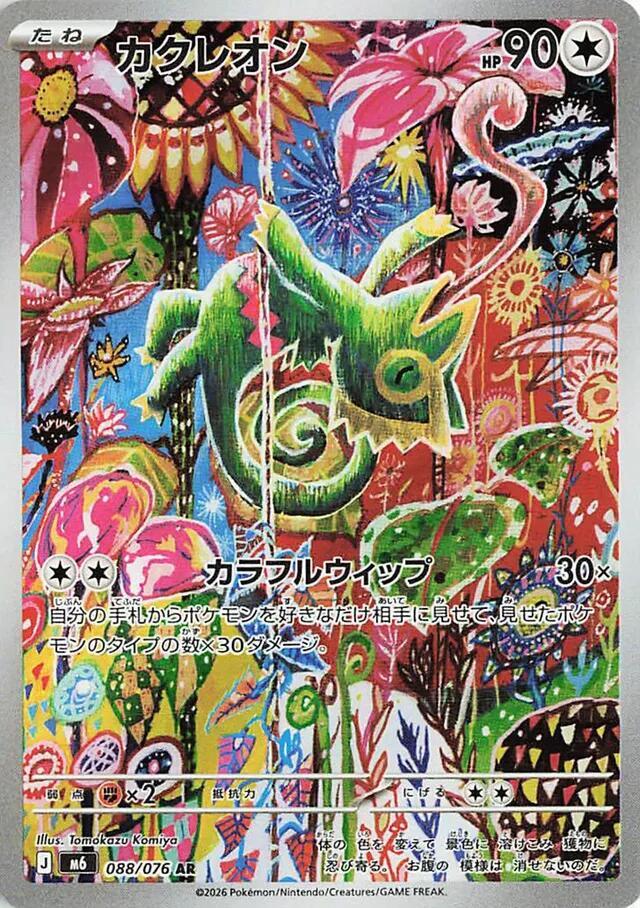
| Art Rare (AR) | 6.7% | ~1 in 15 | Illustration-style full art of a non-ex Pokémon — 92 in 1,380 packs (~1 in 15), about 2 per box. Confirmed ARs include Growlithe (078/076) and Groudon (084/076). |
| Super Rare (SR) | 6.7% | ~1 in 15 | Full-art ex, Mega ex, or supporter — 92 in 1,380 packs (~1 in 15), about 2 per box. Includes Mega Golurk ex and Mega Malamar ex SRs. |
| gold Ultra Rare (UR) | 3.3% | ~1 in 30 | Gold item / tool / energy card — 46 in 1,380 packs (~1 in 30), about 1 per box. The most consistent premium hit after AR and SR. |
| Special Art Rare (SAR) | 0.14% | ~1 in 690 | Premium special-illustration full art — the version most collectors want. 2 in 1,380 packs (~1 in 23 boxes); both observed were Mega Rayquaza ex. |
| Mega Ultra Rare (MUR) | 0.14% | ~1 in 690 | The textured, set-topping chase. 2 in 1,380 packs (~1 in 23 boxes), both Mega Rayquaza ex. A lottery, not a plan — buy the single you want. |
About 83% of packs contained only a regular Rare or Double Rare, so roughly 17% delivered a hit above that floor — most often an Art Rare or Super Rare. Over a full 30-pack box that works out to a near-certain few hits, but the SAR/MUR chase tiers land in only about 1 box in 12.
How the Odds Are Calculated
The model is deliberately simple and honest. For each rarity it takes the observed per-pack rate and treats every pack as an independent draw:
- Chance of ≥1 — the probability at least one pack in your batch contains that rarity, computed as
1 − (1 − rate)^packs. This is the number most people mean by “my odds.” - Expected — the average number you’d pull across your packs, simply
rate × packs. It can exceed 1 for the AR / SR tiers over a box or more. - Base odds — the flat per-pack rate expressed as “1 in N,” so you can see the single-pack chance at a glance.
Two honest caveats. First, the SAR and MUR rates come from a 4-pull sample, so they are the coarsest-grained figures here even though they are the set’s fixed rates. Second, the model assumes packs are independent at the average rate; real Japanese print runs and collation can cluster hits, so a live case can over- or under-shoot the numbers here.
Odds of a Specific Named Card
The calculator prices rarity tiers, not individual cards — and that distinction matters. The ~0.14% SAR rate is the chance of pulling any SAR, but Storm Emeralda has several different SARs (Mega Rayquaza ex, Kyogre, Zinnia’s Trust, Mega Golisopod ex and more). The odds of a specific one are a fraction of that tier rate, which is exactly why chasing a named card through packs almost always costs more than buying the single.
The same holds for the several ARs and SRs. Use the tier odds to judge whether to open at all; use singles when you want one particular card — especially the Mega Rayquaza ex line, where the mascot is spread across four rarities.
Frequently Asked Questions
What are my odds of pulling a Mega Rayquaza ex SAR?
About 0.14% per pack (~1 in 690) from the 1,380-pack sample — roughly a 4% chance over one 30-pack box and about 8% over two boxes. To reach a coin-flip you’d need around 477 packs (~16 boxes). Set your pack count above and pick SAR to see it live — but remember it’s any SAR, and both in our sample were Mega Rayquaza ex.
How many packs to pull a MUR?
The Mega Ultra Rare sits at ~0.14% per pack (~1 in 23 boxes). You’d need roughly 477 packs for a coin-flip chance at a single MUR — a genuine lottery, so buy the single if you want the Mega Rayquaza ex MUR specifically.
Does every pack have a hit?
No — Storm Emeralda has no guaranteed floor card. About 83% of packs held only a regular Rare or Double Rare. Expect the reliable hits (~2 AR, ~2 SR, ~1 gold UR) per box, not per pack.
What’s my chance of a top-tier hit in one box?
Combining SAR and MUR (~0.29% per pack together), a single 30-pack box is about an 8% chance of at least one top-tier hit — roughly 1 box in 12. All four top-tier pulls in our 46-box sample were Mega Rayquaza ex.
Disclaimer: Odds are computed from our fixed 1,380-pack Japanese sample (46 booster boxes). The AR, SR and UR rates sit on a large base of pulls; the SAR and MUR rates come from just 4 combined pulls, so they are the coarsest figures. The calculator models each pack as an independent draw at the average per-pack rate; real openings can over- or under-shoot. The Pokémon Company does not publish official pull rates. This is not financial advice.