
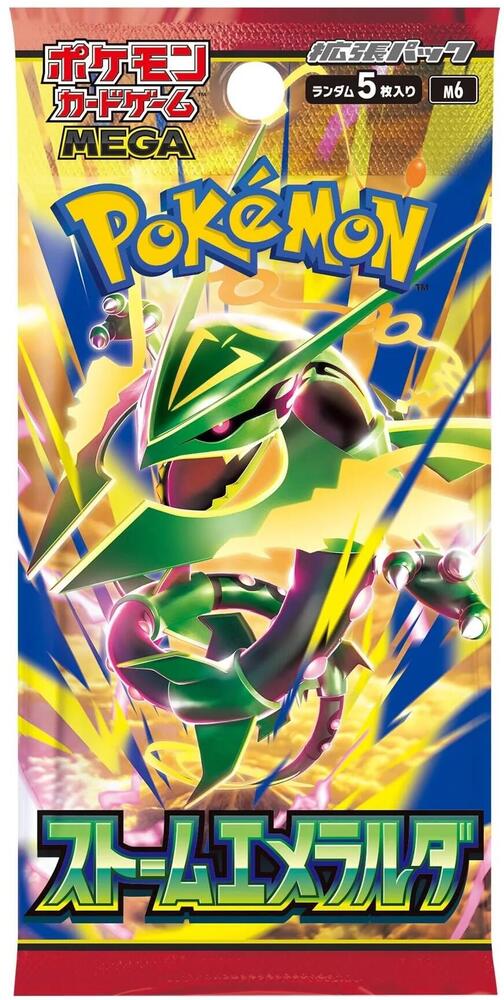
Card prices are sourced from PriceCharting Japanese market data (USD), updated 3 September 2026. SGD equivalents use an approximate 1.35 exchange rate. Storm Emeralda released in Japan in early August 2026, so these prices are freshly minted and volatile — expect the high-end SAR and MUR figures in particular to move sharply over the coming weeks.
The Short Answer
Storm Emeralda is a Japanese set with a 5-card pack and a 30-pack box — there is no bundle. The expected card value per pack is about $4.84, so a box needs roughly $145.32 of cards to break even. At the current market box price of $137.5, the box is technically marginally positive EV (1.06× average return). But that headline number is misleading: it is a lottery, not an edge. The median box loses $−$46, and about 89.4% of boxes lose money at market. The entire positive average comes from the ~1-in-23-box Mega Rayquaza ex MUR ($1,059.92) and its SAR sibling ($469.82).
| Product | Market Price (USD) | Per-Pack Cost | Expected Card Value | Avg Return | Verdict |
|---|---|---|---|---|---|
| Booster Box (30 packs) | ~$137.5 | ~$4.58/pack | $145.32 | 1.06× | +EV on paper, but a lottery. Median −$46. |
| ~Break-even box | ~$145.32 USD (SGD ~$196) | $145.32 | 1.0× | Expected value equals cost. | |
| Single pack (box-derived) | ~$4.58 | ~$4.58/pack | $4.84 | 1.06× | Same 1.06× as the box — but you forfeit the MUR lottery upside. |
| Loose single pack | ~$35 | ~$35/pack | $4.84 | 0.14× | Rip-off. Loses 99.3% of the time. |
The box, explained honestly: Do not read “1.06× expected return” as a green light. Expected value is an average across thousands of boxes, and here that average is dragged up almost single-handedly by one card that appears in roughly 1 box in 23. Open a single box and your most likely result is a loss of around $46 — you are buying a cheap lottery ticket with a genuine (but remote) shot at a $1,059.92 Mega Rayquaza ex. The loose single-pack price of $35 is a straight rip-off (0.14× return) and should never be confused with the box-derived per-pack cost of $4.58.
Buy Storm Emeralda on TCGPlayer
Interactive EV Calculator
Stress-test the maths yourself: switch between a single pack and a full 30-pack box, choose the price you'd actually pay, set a “sift floor” so worthless bulk counts as $0, and edit any pull-rate assumption. Every change re-runs a live Monte Carlo in your browser and updates the expected value, break-even price, ROI and the profit/loss distribution — the Mega Rayquaza ex MUR is what drags the average above break-even, so try lowering its rate and watch the edge evaporate.
Odds aren't officially published — edit any assumption and the whole model re-runs. Values are auto-normalised.
| Tier | Exp. copies | Value |
|---|---|---|
| Rare / Double Rare floor slot | 24.88 | $46.53 |
| Mega Ultra Rare (◇ MUR) | 0.04 | $44.62 |
| Super Rare (SR — full art ex / supporter) | 2.02 | $19.46 |
| Art Rare (AR) | 2.03 | $16.74 |
| Special Art Rare (SAR) | 0.04 | $4.23 |
| Ultra Rare (gold UR — item / tool / energy) | 0.98 | $3.37 |
| Bulk (commons + uncommons) | — | $9.00 |
Live Monte Carlo simulation in your browser. Card prices: PriceCharting (USD), updated 2026-09-03. Pull rates are aggregated from a 1,380-pack (46-box) community sample and fully editable above — treat every figure as a planning estimate, not a guarantee. SGD shown at ~S$1.28/USD.
Card Prices by Rarity
Storm Emeralda (M6) has a 76-card base set plus five secret-rare tiers above it. Unlike a standard SV-era set, the Japanese pack has a single feature slot: a pack either delivers a regular Rare / Double Rare from the base set (~83% of the time) or upgrades that slot to an AR, SR, gold UR, SAR, or MUR hit. Value is extraordinarily concentrated — one card, the Mega Rayquaza ex MUR, is worth more than every other card in the set combined.
Mega Ultra Rare (◇ MUR) — #113
One card. The textured set-topper and the entire reason the box is +EV. Pull rate approximately 1 in 690 packs (~1 in 23 boxes).
| # | Card | Price (USD) | Price (SGD est.) |
|---|---|---|---|
| 113 | Mega Rayquaza ex | $1,059.92 | ~$1,431 |
Special Art Rare (SAR) — #107–112
6 cards. The premium collector tier, also ~1 in 690 packs. Price range: $10–$470, hugely skewed by the Mega Rayquaza ex SAR.
| # | Card | Price (USD) | Price (SGD est.) |
|---|---|---|---|
| 110 | Mega Rayquaza ex | $469.82 | ~$634 |
| 108 | Raikou ex | $65.09 | ~$87.87 |
| 112 | Zinnia's Trust | $31.00 | ~$41.85 |
| 107 | Mega Golisopod ex | $15.90 | ~$21.47 |
| 109 | Mega Golurk ex | $15.82 | ~$21.36 |
| 111 | Aarune | $10.00 | ~$13.50 |
Pool average: $101.27 USD. Pool median: $23.45 USD. The mean is dominated by the Mega Rayquaza ex SAR — pull a SAR and you are far more likely to land the $65.09 Raikou or a sub-$32 card than the $469.82 Rayquaza.
Super Rare (SR) — #89–96, 100–103
12 full-art ex and supporter cards. Expected roughly once every 15 packs (~2 per box). The Mega Rayquaza ex SR (#95) at $44.00 is the standout; the rest cluster in the mid-single-digits.
| # | Card | Price (USD) | Notes |
|---|---|---|---|
| 95 | Mega Rayquaza ex | $44.00 | Top SR — the affordable Rayquaza chase |
| 96 | Talonflame ex | $12.99 | |
| 102 | Zinnia's Trust | $8.47 | |
| 94 | Mega Malamar ex | $7.04 | |
| 100 | Emcee's Hype | $6.80 | |
| 92 | Raikou ex | $6.50 | |
| 103 | Tate & Liza's Training | $5.99 | |
| 89 | Mega Golisopod ex | $5.72 | |
| 93 | Mega Golurk ex | $5.00 | |
| 90 | Heat Rotom ex | $4.99 | |
| 101 | Aarune | $4.30 | |
| 91 | Wishiwashi ex | $3.25 |
Pool average: $9.59 USD. Pool median: $6.25 USD. A dependable ~2-per-box hit that rarely returns the pack cost on its own.
Art Rare (AR) — #77–88
12 illustration-style full arts of non-ex Pokémon. Expected roughly once every 15 packs (~2 per box). Kyogre (#80) and Kecleon (#88) lead the pool.
| # | Card | Price (USD) | Notes |
|---|---|---|---|
| 80 | Kyogre | $17.56 | Top AR — Savage Whirlpool spread attacker |
| 88 | Kecleon | $17.50 | |
| 84 | Groudon | $16.77 | Confirmed Art Rare (084/076) |
| 78 | Growlithe | $10.50 | First AR revealed (078/076) |
| 86 | Azurill | $6.50 | |
| 87 | Altaria | $5.50 | |
| 81 | Electivire | $4.72 | |
| 79 | Magmortar | $4.56 | |
| 85 | Inkay | $4.25 | |
| 83 | Enamorus | $4.23 | |
| 82 | Pincurchin | $4.15 | |
| 77 | Masquerain | $3.25 |
Pool average: $8.29 USD. Pool median: $5.11 USD. Growlithe (078/076) and Groudon (084/076) were the first two ARs revealed pre-release.
Ultra Rare (gold UR) — #97–99, 104–106
6 gold item, tool, and energy cards. Expected roughly once per 30 packs (~1 per box). The most consistent premium slot after AR and SR, but the lowest value — everything sits within a dollar of the $3.59 median.
| # | Card | Price (USD) |
|---|---|---|
| 97 | Adventuring Lantern | $3.75 |
| 104 | Growing Grass Energy | $3.59 |
| 105 | Nitro Fire Energy | $3.59 |
| 106 | Bubbly Water Energy | $3.59 |
| 98 | Pokemon Catcher | $3.00 |
| 99 | Custom Vest | $2.99 |
Pool average: $3.42 USD. A reliable but near-negligible contributor to EV.
Rare / Double Rare floor — #1–76
The base set: 76 Rares and Double Rares (including the base-set Mega ex cards), which fill the feature slot roughly 83% of the time when a pack does not upgrade to a hit. We do not list all 76 individually — they average about $1.87 USD (median $1.48), with the base Mega Rayquaza ex (#58) the top card at $6.76. This is the honest bottom line of the set: five packs in six give you nothing but this floor.
Chase Cards: Top 10 by Value
Mega Rayquaza ex dominates the value landscape across four rarity tiers — MUR (#113), SAR (#110), SR (#95), and a base Double Rare (#58). The MUR alone ($1,059.92) is worth more than the rest of the chase list combined, which is exactly why the set's EV is a lottery: hit that one card and you are up hundreds; miss it and every other pull barely dents the box cost.
Expected Value Per Pack
Using current PriceCharting Japanese market prices weighted by the 1,380-pack (46-box) sample pull rates, here is where the expected value of each pack comes from:
| Component | Pull Rate | Pool Avg (USD) | EV Contribution |
|---|---|---|---|
| Bulk (commons + uncommons) | 100% | $0.30 | $0.30 |
| Rare / Double Rare floor slot | 83.0% | $1.87 | $1.55 |
| Art Rare (AR) | 6.7% | $8.29 | $0.56 |
| Super Rare (SR) | 6.7% | $9.59 | $0.64 |
| Ultra Rare (gold UR) | 3.3% | $3.42 | $0.11 |
| Special Art Rare (SAR) | 0.145% | $101.27 | $0.15 |
| Mega Ultra Rare (MUR #113) | 0.145% | $1059.92 | $1.54 |
Key observations from this table:
- The single MUR card contributes $1.54 of the $4.84 EV — roughly a third of the entire pack's expected value rides on a card you will see in about 1 pack in 690. Remove it and EV collapses to ~$3.30, well below the box-derived pack cost.
- The reliable hits (AR + SR + gold UR) add just $1.31 combined. These are the pulls you actually see per box, and together they do not cover the pack cost.
- The Rare / Double Rare floor contributes $1.55 across 83% of packs — a real but low base, averaging $1.87 per hit.
- This is a textbook skewed distribution: a low, reliable body of value plus one enormous, rare jackpot. The mean says “+EV”; the median tells the truth.
Monte Carlo: The Lottery, Visualised
The EV table above gives averages. What actually happens to individual openers is driven by variance — and in Storm Emeralda the variance is extreme. The charts below show results from 100,000 simulated openings, drawing from the actual Japanese-market card prices and the sampled pull rates, not averages. Toggle to Two Boxes to see how a second box doubles your shot at the Mega Rayquaza ex MUR lottery cluster on the far right.
Each bar = $50 profit/loss range. ··· represents an empty gap in outcomes. The far-right +$950–$1,100 cluster is the ~1-in-23-box Mega Rayquaza ex MUR. 100,000 simulated openings. Prices from PriceCharting Japanese market (USD), September 2026.
Win / Loss summary across all formats
| Scenario | Cost | Win % | Loss % | Median P/L | P5 (bad luck) | P95 (good luck) | Avg Return |
|---|---|---|---|---|---|---|---|
| Pack — box-derived (~$4.58) | $4.58 | 11.9% | 88.1% | −$3 | −$3 | +$3 | 1.06× |
| Box — market (~$137.50) | $137.5 | 10.6% | 89.4% | −$46 | −$68 | +$92 | 1.06× |
| Two Boxes — market (~$275) | $275 | 11.2% | 88.8% | −$84 | −$125 | +$963 | 1.05× |
| Pack — loose single ($35) | $35 | 0.7% | 99.3% | −$33 | −$34 | −$28 | 0.14× |
P5 = the outcome in the worst 5% of openings. P95 = the outcome in the best 5%. Win = profit > $0. Simulation: 100,000 runs, seed 42.
What these numbers mean in practice:
- The market box wins only 10.6% of the time despite a 1.06× average return — a perfect illustration of why average return is the wrong metric for a skewed lottery. 89.4% of boxes finish underwater, with a median loss of −$46.
- Even at the 95th percentile (a very lucky box) you are only up +$92 — unless you hit the MUR, in which case you jump to the far-right +$950–$1,100 cluster. There is almost nothing in between.
- Two boxes push the win rate only to 11.2% and the median to −$84 — buying more boxes does not fix the odds, it just buys more lottery tickets. The P95 jumps to +$963 because a second box roughly doubles the MUR chance.
- The loose single pack at $35 is the worst buy in the set: 0.14× return, losing 99.3% of the time. Never pay single-pack markup here.
The Break-Even Price
If the expected value per pack is $4.84 USD, the break-even prices are:
The market box ($137.5) sits just below the $145.32 break-even, which is why the average return edges above 1.0×. But note how thin that edge is: it exists only because of a single card's current price. Because the MUR carries roughly a third of the EV, the whole picture hinges on how the Mega Rayquaza ex MUR holds up.
Sensitivity to the Mega Rayquaza ex MUR price
| MUR Price Scenario | EV per Pack | Break-even Box (USD) | Box @ $137.5 |
|---|---|---|---|
| Current price ($1,059.92, Sep 2026) | $4.84 | ~$145.32 | 1.06× (marginal +EV) |
| MUR −25% (~$795) | ~$4.46 | ~$133.85 | ~0.97× (−EV) |
| MUR −50% (~$530) | ~$4.07 | ~$122.30 | ~0.89× (−EV) |
| MUR −75% (~$265) | ~$3.69 | ~$110.75 | ~0.81× (−EV) |
Because the MUR carries roughly a third of the pack EV, the box's marginal edge evaporates the moment the MUR softens. A 25% dip in the Mega Rayquaza ex MUR — entirely plausible for a set this fresh — is enough to push the market box underwater. Day-one Japanese secret-rare prices routinely fall 20–40% in the first month, so treat the current 1.06× as a temporary, fragile number.
What You Should Actually Do
If you want a specific card
Buy the single. Use the tcgTalk price comparison to find the best current price. For the Mega Rayquaza ex MUR ($1,059.92) or SAR ($469.82), opening to pull it is not realistic — at ~1 per 23 boxes each, the expected product spend to hit one is many multiples of the single price. The same logic applies to any specific SAR: target it as a single, never through packs.
If you want to open (as a gamble)
Buy a sealed box, not loose packs. The box works out to ~$4.58 per pack versus the $35 loose-pack rip-off, and it is the only format that preserves the MUR lottery upside. Go in understanding that 89.4% of boxes lose money and the median box is down $46 — you are paying $137.5 for a fun opening plus a ~1-in-23 shot at a $1,059.92 card. That is a lottery ticket, not an investment.
If you are buying sealed to hold
Storm Emeralda sealed is a speculative hold on future appreciation, not on current pull value — the box is only break-even-ish today, and only because of one volatile card. As a fresh Japanese release the box price itself may drift as supply settles. If you hold, hold the sealed box for the mascot-set appreciation thesis, and do not expect the current EV to protect you if you open it.
If you already pulled cards to sell
The Mega Rayquaza ex MUR and SAR are the crown jewels — and both are freshly minted, so prices are volatile and skewed to the downside over the next month. New-set secret rares typically soften 20–40% within three months of release. If you pulled a top-tier Rayquaza and are considering selling, acting sooner rather than later tends to yield better prices while hype is at its peak.
Frequently Asked Questions
Is it worth opening Storm Emeralda booster boxes?
Only as a lottery ticket. At the $137.5 market box price the average return is a marginal 1.06×, but that is entirely propped up by the ~1-in-23-box Mega Rayquaza ex MUR ($1,059.92). The median box loses $46, and about 89.4% of boxes lose money. Most openers lose; a small fraction hit the jackpot.
What is the most expensive Storm Emeralda card?
The Mega Rayquaza ex MUR (#113) at approximately USD $1,059.92 (~SGD $1,431). The Mega Rayquaza ex SAR (#110) at USD $469.82 is second. Almost the entire value of the set sits in the Mega Rayquaza ex chase line.
What is the break-even box price for Storm Emeralda?
At about USD $4.84 of expected card value per pack, a 30-pack box breaks even at roughly USD $145.32 (SGD ~$196). The market box at $137.5 is just below that, giving the marginal 1.06× average — but the median outcome is still a loss.
Should I buy loose single packs of Storm Emeralda?
No. The loose single-pack price of $35 is a rip-off — the expected value of a pack is only about $4.84, so a loose pack returns roughly 0.14× and loses money 99.3% of the time. If you want to open, buy a sealed box (~$4.58 per pack).
Should I open packs or buy the Mega Rayquaza ex single?
Buy the single. At roughly 1 MUR per 23 boxes and 1 SAR per 23 boxes, the expected cost to pull a Mega Rayquaza ex through opening far exceeds the single price. Opening only makes sense if you enjoy the gamble itself.
How reliable are these prices and pull rates?
Prices are PriceCharting Japanese-market data from 3 September 2026 — the set only released in early August, so they are fresh and volatile, especially at the SAR and MUR top end. Pull rates come from a 1,380-pack (46-box) community sample; the AR, SR, and gold UR rates sit on a large base, while the SAR and MUR rates derive from just a handful of pulls and are the coarsest figures here.
Disclaimer: All card prices are from PriceCharting Japanese market data (USD), updated 3 September 2026, and are indicative of current secondary-market rates — they will change, and this set is freshly released and volatile. SGD equivalents use an approximate 1.35 exchange rate. Pull rates are community estimates from a 1,380-pack (46-box) sample; The Pokemon Company does not publish official pull rates. Monte Carlo results use 100,000 simulated openings, seed 42. This is not financial advice. Verify current prices on tcgTalk before making any buying or selling decisions.