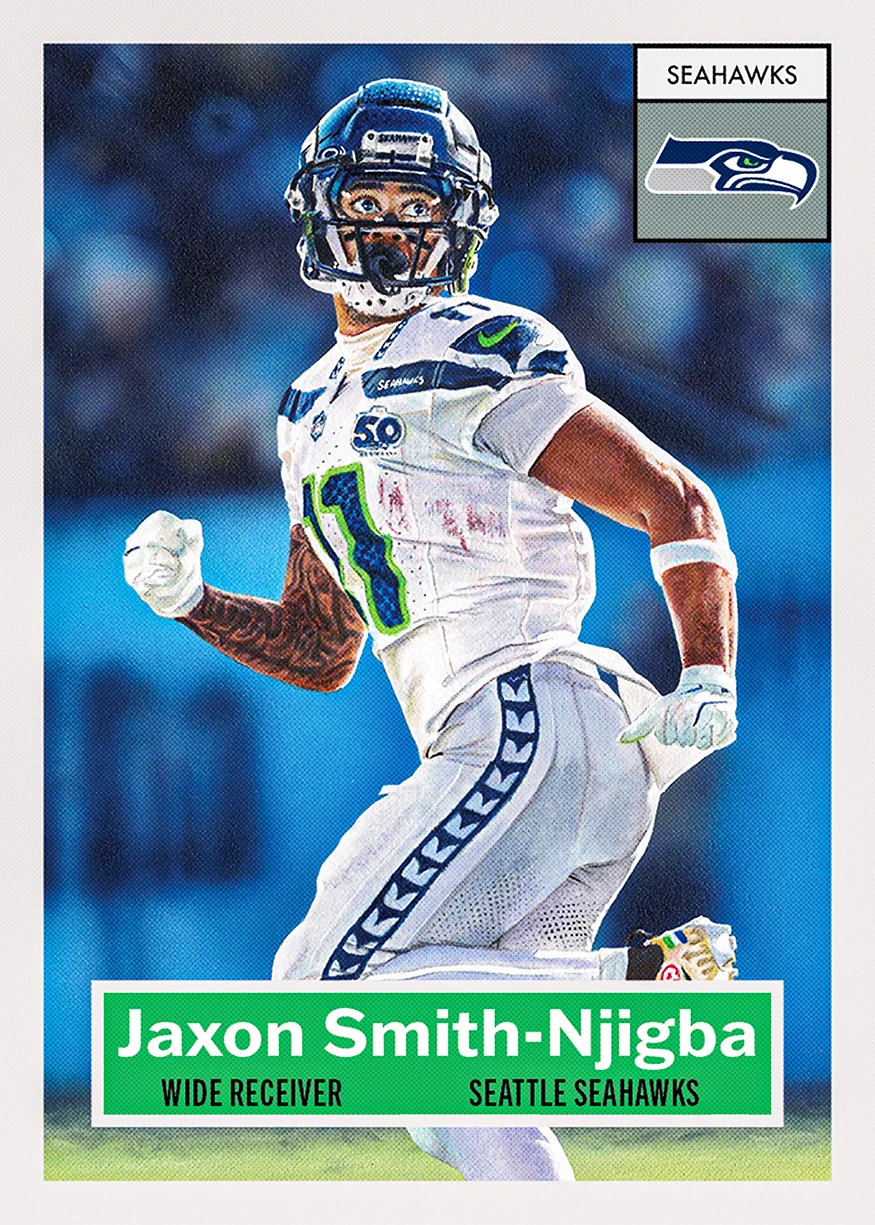
The Jaxon Smith-Njigba 2026 NFL Living Set® card (Card 2) is print-to-order: Topps printed one for every buyer during its 16–24 September 2026 window, then stopped. There is no pack here, so there is no odds sheet and no “1 in N” rate to look up. What there is is one stated population — the Topps Chrome® Superfractor is a 1/1 — and one unknown you supply: the final print run. Those two numbers give an exact answer.
Living Set is drawn art on vintage stock (this one by Josh Trout), released one card at a time, and the hits replace the base card in your order rather than arriving alongside it. That detail matters for the maths: your order of twenty is twenty independent chances, not twenty cards plus a bonus.
Jaxon Smith-Njigba Superfractor Odds Calculator
Enter the final print run (or drag the slider to model a scenario) and your order size. The headline figure is your chance of landing the 1/1 Superfractor, with the order size it would take for a 50%, 90% or 95% shot. The two tiers Topps publishes no count for are listed but deliberately left out of every calculation.
- Background Variation Short Print — advertised as a short print; Topps states no print run
- Topps Chrome® Refractor Parallel — no serial numbering or population published
| Parallel | Copies | Per card | ≥1 in 20 | Expected |
|---|---|---|---|---|
| Chrome Superfractor | ||||
| 1/1 Topps Chrome® Superfractor | 1 | 1 in 10,000 | 0.200% | 0.0020 |
Topps NOW® cards are print-to-order: a parallel numbered to /N has exactly N copies no matter how large the print run grows, so a bigger run makes every numbered card rarer per order — and only above the stated thresholds do the Chrome and Opal tiers exist at all. The model treats each card in your order as an independent draw; Topps does not publish per-order collation, so a real order can over- or under-shoot. The print run is confirmed only after the sales window closes.
How Print-to-Order Odds Work
A capped card has the same number of copies however many base cards sell, so:
- Chance a single card is the Superfractor:
p = 1 ÷ print run - Chance of at least one across an order of N:
1 − (1 − p)N - Cards needed for a T% chance:
ceil( ln(1 − T) / ln(1 − p) )
Which produces the uncomfortable table below. Note the direction of travel: the more people buy this card, the worse your odds get, because the single Superfractor is spread across a larger run. On print-to-order releases, hype is your enemy.
| Print Run | Odds per Card | 1 Card | 5 Cards | 10 Cards | 20 Cards | Cards for 50% |
|---|---|---|---|---|---|---|
| 2,000 | 1 in 2,000 | 0.050% | 0.25% | 0.50% | 1.00% | 1,386 |
| 5,000 | 1 in 5,000 | 0.020% | 0.100% | 0.20% | 0.40% | 3,466 |
| 10,000 | 1 in 10,000 | 0.010% | 0.050% | 0.100% | 0.20% | 6,932 |
| 25,000 | 1 in 25,000 | 0.004% | 0.020% | 0.040% | 0.080% | 17,329 |
| 50,000 | 1 in 50,000 | 0.002% | 0.010% | 0.020% | 0.040% | 34,658 |
The Four Tiers — and the Two With No Numbers
Topps lists four things to look for on this card. Only one of them can be given odds, and we think it is worth being blunt about which:
| Tier | Published Population | Can we compute odds? |
|---|---|---|
| Open-Edition Base Card | Unlimited — prints to demand | N/A — it is the default |
| Background Variation Short Print | None published | No |
| Topps Chrome® Refractor Parallel | None published | No |
| Topps Chrome® Superfractor | 1/1 | Yes |
“Short print” and “refractor parallel” tell you a tier is scarce; they do not tell you how scarce. Without a copy count there is no honest way to turn either into a probability, so we have not invented one. If you see a specific pull rate quoted for the Background Variation or the Refractor, it is an estimate — Topps has not released the figure. We will update this page if that changes.
The Quantity Discount: How Many to Order
The one lever fully in your control, and the one part of this that is completely knowable:
| Order Size | Price Each | Order Total | Saving per Card |
|---|---|---|---|
| 1 card | $8.99 | $8.99 | — |
| 5 cards | $6.50 | $32.49 | 28% |
| 10 cards | $5.50 | $54.99 | 39% |
| 20 cards | $4.50 | $89.99 | 50% |
Twenty cards at $4.50 each is half the unit price of a single card and twenty times the chances at any hit — a real edge on the short print and the refractor, whatever their true rates turn out to be. For the Superfractor it changes nothing meaningful: at a 10,000-card run you would need roughly 6,932 cards for a coin flip. Buy the quantity you want the artwork at; the 1/1 is a free lottery ticket stapled to it.
Frequently Asked Questions
What are the odds of the Superfractor on the Jaxon Smith-Njigba NFL Living Set card?
The Topps Chrome® Superfractor is a 1/1 — exactly one copy exists — so its odds are simply 1 ÷ print run per card. Because Living Set® is print-to-order, that run is not fixed until the sales window closes. At a 10,000-card run, an order of 20 has roughly a 0.2% chance of containing it. At a 2,000-card run the same order is about 1%. It is a lottery ticket in the literal sense, and should be treated as one.
What are the odds of the Background Variation or the Chrome Refractor?
We do not know, and neither does anyone publishing a number. Topps advertises both tiers on the product page — an Open-Edition Base Card, a Background Variation Short Print, a Topps Chrome® Refractor Parallel and the Chrome Superfractor 1/1 — but it publishes a population for only the Superfractor. Without a copy count there is no honest way to state a probability for the short print or the refractor, so this page does not give one. Any site quoting a specific rate for them is estimating.
Does Topps publish odds for Living Set cards?
No. There are no packs, so there is no odds sheet and no "1 in N" rate. The product page says only that "parallels or other non-base card hits will replace the base card in your order" and that "odds of hitting a non-base card are based on total cards ordered." The single population figure Topps does state for this card is the Superfractor being a 1/1, which is what the calculator on this page runs on.
Why does a bigger print run make the Superfractor harder to hit?
Because there is exactly one, no matter how many cards sell. One copy in a 2,000-card run is 1 in 2,000. One copy in a 50,000-card run is 1 in 50,000. So the more people who buy this card, the longer your odds become — hype works directly against you on a print-to-order 1/1, which is the reverse of how sealed product behaves.
Is it worth ordering more cards?
For the base card and the short print, the quantity pricing is a genuine saving: $8.99 for one falls to $4.50 each at twenty, a 50% cut per card, and every extra card is another chance at any hit. For the Superfractor specifically, no realistic order moves the needle — at a 10,000-card run you would need about 6,932 cards for a coin-flip. Order the quantity you actually want the card at, and treat the 1/1 as a free lottery ticket attached to it.
Disclaimer: Living Set® print runs are set by demand and published only after the sales window closes. Figures here are probabilities computed from Topps’ stated 1/1 Superfractor population and a print run you supply — not guarantees. Tiers without a published population are excluded from all calculations. Prices and product details are from the official Topps product page and were correct at the time of writing. This is not financial advice.