Four Decks, One Day
On September 25, 2026, the Gundam Card Game released four starter decks simultaneously — ST11 Aquatic Assault, ST12 Raging Onslaught, ST13 Silent Barrage and ST14 Heavy Dominion. At $15.99 each, it is the first four-deck drop since the game launched, and it lands roughly five weeks ahead of the next booster set, GD06 Stardust Trails, on 31 October 2026.
That gap matters. For about a month these four decks are the newest cards in the game, which is why the community has taken to calling this period GD05.5 rather than treating it as a beginner release. Every card in all four decks is tournament legal, and several of them will show up in constructed decks that have nothing to do with the archetypes they ship in.
The other change is structural. Earlier starter decks each took a single anime series as their theme. These four are built around battle styles instead — underwater, close-quarters, ranged, heavy — so each deck pulls units from across Mobile Suit Gundam, SEED, Wing, Unicorn, Gundam X, The Witch from Mercury and GQuuuuuuX at once. The practical effect is that archetypes which used to be locked to one colour suddenly exist in a second, and pilots that existed in one colour now have a counterpart in another. That is the single most important thing about this wave, and we come back to it below.
What's in the Box
Every ST11–ST14 box contains the same components. Unlike a booster box there is nothing to calculate here — the deck is fixed and identical in every copy, so the only variable is the bonus pack.
| Component | Detail |
|---|---|
| Ready-to-play deck | 50 cards |
| Resource cards | 10 |
| Token cards | 4 |
| Paper damage counter | 1 |
| Rule / playsheet | 1 |
| Bonus pack | 1 — the only randomised element in the box |
The bonus pack is the part worth knowing about. Each deck comes with two parallel-foil cards in a sealed pack, and which two you get varies — the official reveal opened four boxes and pulled a different combination from each, including foil versions of the decks' Legendary Rares. These parallels carry a distinctive finish and a printed mark that the base versions do not, and they are the only cards in the product with any meaningful secondary-market spread. If you are buying multiple copies of a deck, the bonus pack is the only reason any two copies differ.
All Four Decks Compared
Each deck runs two colours and contains two different Legendary Rares at two copies each. Full card lists live on the individual deck guides linked below.
| Deck | Colours | Theme | Legendary Rares | Cards |
|---|---|---|---|---|
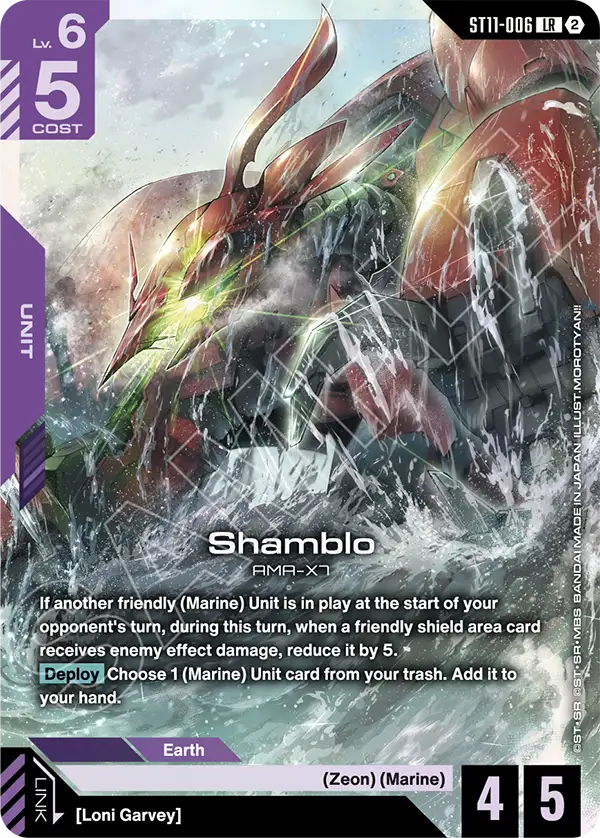
| ST11 Aquatic Assault | Blue / Purple | Underwater combat — the new Marine trait | Char's Z'Gok, Shamblo | 50 |
| ST12 Raging Onslaught | Red / Purple | Close-quarters combat | Gundam Epyon, Unicorn Gundam 02 Banshee (Destroy Mode) | |
| ST13 Silent Barrage | Green / Red | Ranged combat with Bit / Funnel tokens | Qubeley, Gundam Aerial | |
| ST14 Heavy Dominion | Green / White | Heavy units | The-O, Full Armor Unicorn Gundam (Destroy Mode) |
ST11 Aquatic Assault — Blue / Purple
The first Blue/Purple starter deck, built around the brand-new Marine trait.
Verdict: Marine itself is thin — good shell pieces, no payoff pilot. Buy it for Kapool and for the Vulture, Zeon and Phantom Pain cards that upgrade decks you already play.
Plays outside this deck: Kapool · Poorly Planned Offensive · Gundam Leopard · Daughseat · Abyss Gundam
ST12 Raging Onslaught — Red / Purple
Epyon and a purple Banshee that picks First Strike or Suppression on demand.
Verdict: The strongest constructed pickup of the four. The purple Banshee (Destroy Mode) is arguably the best standalone card in the wave, and Ple-Twelve gives Marida decks eight copies of their pilot.
Plays outside this deck: Unicorn Gundam 02 Banshee (Destroy Mode) · Ple-Twelve · The Final Victor · Two Unicorns · GQuuuuuuX (Omega Psycommu)
ST13 Silent Barrage — Green / Red
Bits and Funnels as a token engine, plus the first red Academy cards.
Verdict: Buy it for Gundam Aerial and Suletta Mercury — a pair that slots into any X/Red ping deck. The Bits shell itself is utility, not a deck, until it gets more support.
Plays outside this deck: Gundam Aerial · Suletta Mercury · Gundam Pharact · GX-Bit · Operation to Intercept Solomon
ST14 Heavy Dominion — Green / White
The-O and Full Armor Unicorn — big bodies, plus generic Newtype links.
Verdict: The-O anchors a genuine blue/white control shell for this month. The sleeper is how many cards here take a generic Newtype link — one new pilot can link to a great many existing cards.
Plays outside this deck: Paptimus Scirocco · Natural Talent · Palace Athene · G-Falcon DX · The-O
The Best Cards in the Wave
These are the cards most likely to appear in decks that have nothing to do with the archetypes they were printed for. Ranked by how much we expect them to reshape existing lists rather than by raw power.
| # | Card | Deck | Why it matters |
|---|---|---|---|
| 1 | Kapool | ST11 | A level 1, cost 1 body that replaces itself. Because it counts itself as the Marine unit its own effect asks for, it reads as a flat “draw 1 when destroyed on your opponent’s turn.” Purple aggro goes from 12 one-drops to 16, or 20 in purple/green. |
| 2 | Unicorn Gundam 02 Banshee (Destroy Mode) | ST12 | Exile four from trash for First Strike on your main, or Suppression at action speed. Choosing after your opponent decides whether to block is what makes it unfair — they have to guess. |
| 3 | Gundam Aerial | ST13 | Two damage on attack plus a once-per-turn ping for one, at action speed, by resting any friendly unit. Three points of reach per turn cycle taxes low-HP decks off the board. |
| 4 | Ple-Twelve | ST12 | Also treated as Marida Cruz, so Marida decks run eight copies. Filters early, draws late — a Manurva effect stapled to a pilot. |
| 5 | Suletta Mercury (red) | ST13 | Turns every burn command into a cantrip while the paired unit is attacking. Goes on anything; the constraint is arranging the kill during the attack. |
| 6 | Paptimus Scirocco | ST14 | AP −1 per rested enemy unit, so −3 or −4 against a deck that just attacked. Titans, Jupitris and Newtype traits together give it roughly fifteen existing link targets. |
| 7 | Poorly Planned Offensive | ST11 | Bounces a rested enemy unit with 3 or less HP on burst and on main/action, drawing a card on the proactive half. Hits grunts, tokens and the entire 4/3 tier. |
| 8 | Gundam Pharact | ST13 | Forces the enemy to exile two units from their own trash, every attack. Trash hate has never existed in this game before. |
| 9 | Natural Talent | ST14 | Burst AP −3, or a modal main/action that either shrinks a unit or rests up to two. A lot of flexibility on one command. |
| 10 | Haman Karn / GFreD | ST13 | Two different generic pilot searches in green. Consistency tools tend to age better than power cards. |
How These Decks Change the Meta
The one-drop problem gets worse
Bandai previously capped how many vanilla level 2, cost 1 units a deck could run, to stop lists stacking 16–20 one-drops. That cap has been quietly eroding, because it only restricts vanilla 2/2 stat lines — one-drops with text sidestep it entirely. Green already had several. Purple had Gundam Exia Repair.
Kapool adds another four to purple, and a good one. The practical result: a purple deck can run 12 one-drops regardless of its second colour, purple/blue can run 16, and purple/green can reach 20. The original restriction was a band-aid rather than a fix, and this wave is where it comes off.
The game gets its first trash hate
Gundam Pharact (ST13) forces the enemy player to exile two unit cards from their trash on every attack; Palace Athene (ST14) does it once, on deploy. Nothing in the game has done this before, and a lot of current decks lean on their trash — Mobile Fighter recurs commands from it, cruise-control Unicorn builds count cards in it, and the new purple Banshee literally pays it as a cost.
Whether this reshapes the format depends on how widely these cards actually get played. Pharact sits in Academy, which is perennially popular at locals regardless of tier, so expect to run into it there. In best-of-three with a sideboard it is an obvious two-of; in best-of-one it competes for slots against cards that are good in every matchup rather than a few.
New decks to expect
- Red/purple Banshee aggro — the purple Banshee plus Ple-Twelve's card draw gives purple a second viable aggro shell alongside the existing green/purple build. Having more than one aggro formula in the format is healthy.
- Blue/white control on The O — The-O's stun effect, double Pathamus and the Jupiter cards make a real control deck for this month. It is unlikely to survive contact with the full GD06 meta, but it will put up results in the meantime.
- Red/blue ZAFT — Ash being a blue ZAFT unit opens a colour pair that simply did not exist before.
Generic Newtype links are the quiet one
Several cards across ST13 and ST14 take Newtype as their link condition rather than a specific pilot. Newtype is one of the broadest traits in the game, so every card printed this way retroactively increases what existing pilots can be paired with — Amuro, Char, Paptimus Scirocco and Banagher all gain targets. It is the least flashy thing in the wave and probably the one with the longest tail.
Which Deck Should You Buy?
If you are buying all four, the order barely matters. If you are buying one or two, this is the priority:
- ST12 Raging Onslaught — The strongest constructed pickup of the four. The purple Banshee (Destroy Mode) is arguably the best standalone card in the wave, and Ple-Twelve gives Marida decks eight copies of their pilot.
- ST11 Aquatic Assault — Marine itself is thin — good shell pieces, no payoff pilot. Buy it for Kapool and for the Vulture, Zeon and Phantom Pain cards that upgrade decks you already play.
- ST13 Silent Barrage — Buy it for Gundam Aerial and Suletta Mercury — a pair that slots into any X/Red ping deck. The Bits shell itself is utility, not a deck, until it gets more support.
- ST14 Heavy Dominion — The-O anchors a genuine blue/white control shell for this month. The sleeper is how many cards here take a generic Newtype link — one new pilot can link to a great many existing cards.
The honest bottom line. These are not decks you buy to play out of the box and win with — none of the four archetypes is finished, and several are clearly waiting on support that arrives in GD06 Stardust Trails. Marine in particular has good pieces and no payoff pilot. What you are actually buying is a cheap, fixed-price way to pick up four to six cards that will slot straight into decks you already play, with a pair of foil parallels attached. Judged that way, ST12 is comfortably the best value and ST11 is worth it for Kapool alone. Buy singles for anything you only want one copy of — the decks are only good value when you want the playset.
What Comes Next: GD06 Stardust Trails
The reason to think about ST11–ST14 as a month-long format rather than a permanent one is that GD06 Stardust Trails lands on 31 October 2026, roughly five weeks after these decks. Several of the archetypes introduced here are visibly incomplete, and the expectation across the community is that their missing pieces are in that set.
Marine is the clearest case. It has two strong Legendary Rares, a functional shell and no pilot worth building around — and at the time of the decks' release, nothing Marine-related had been announced for GD06. Bits and Funnels are in a similar position: a coherent set of interactions with no card that converts a wide token board into a win.
The first GD06 cards were revealed on the same official broadcast that opened these decks, and both point at the pattern this wave established — taking an existing card into a new colour. A purple version of a unit that has previously been green and red, and a purple pilot with the Newtype trait, both carrying a link condition to a character introduced in the recent series. If that is representative, GD06 continues widening colour pairs rather than adding entirely new archetypes.
The practical advice: buy the ST11–ST14 cards you want for decks you already play, and be cautious about investing heavily in an incomplete archetype on the assumption its support is coming. Marine may well get what it needs on 31 October 2026. It may also wait another set.
Two events bracket this period. Release events for the four decks run 24 September – 7 October 2026, and the GCG Expo — a full-day event covering everything from beginner play to the New Type Challenge — ran across the release weekend itself. A 2-on-2 team format campaign also runs alongside, which is worth noting because several cards in this wave scale explicitly with the number of opposing players: Full Armor Unicorn's draw, The-O's stun and ST14's Battlefield Emotions all read very differently in multiplayer than in a one-on-one game.
Frequently Asked Questions
Which Gundam ST11–ST14 starter deck should I buy first?
ST12 Raging Onslaught. It has the purple Unicorn Gundam 02 Banshee (Destroy Mode), the strongest standalone card in the wave, plus Ple-Twelve — which is also treated as Marida Cruz, letting Marida decks run eight copies of their pilot. ST11 is the second pick, almost entirely for Kapool.
What comes in a Gundam Card Game starter deck?
A ready-to-play constructed deck, 10 resources, 1 EX Base, 1 EX Resource, deck-specific tokens, damage counters, a playsheet and a rules insert, plus a 2-card bonus pack of parallel-foil cards. The bonus pack is the only randomised part of the box.
Are the ST11–ST14 starter decks tournament legal?
Yes, every card in all four. That is why this wave is being treated as a competitive release rather than a beginner product — Kapool, Poorly Planned Offensive, the purple Banshee, Gundam Aerial and Paptimus Scirocco are all expected to see play outside their own decks.
How many Legendary Rares are in the starter decks?
Two different LRs per deck, at two copies each — eight distinct Legendary Rares across the wave. Foil parallel versions of some of them appear in the bonus pack.
What is the best card in ST11–ST14?
Kapool from ST11, on most competitive reads. It counts itself as the friendly Marine unit its effect requires, so it functions as a flat “draw 1 when destroyed on your opponent’s turn” on a level 1, cost 1 body. In raw power the purple Banshee (Destroy Mode) from ST12 is stronger, but Kapool changes more decks.
How does this wave compare to a normal booster set?
It behaves like a small set. Four decks at roughly 50 cards each, with no randomised pull rates to calculate — you know exactly what you are getting before you buy, which is the opposite of the GD05 Freedom Ascension box-opening experience. The trade-off is that you cannot open into value; the ceiling is the two foil parallels.
Should I buy the decks or just buy the singles?
If you want a playset of any card in a deck, buy the deck — four copies of Kapool cost more as singles than ST11 does. If you want one or two copies of one card, buy the single. The decks are priced as product, not as value, and none of the four archetypes is currently strong enough to play unmodified.
Disclaimer: Card lists and contents are compiled from the official product reveal and are being confirmed against the English printing; a small number of card names are still provisional and are marked as such on the individual deck guides. Card evaluations are pre-release and early-format analysis, not tournament results. Prices move fast around a release — verify current prices before buying or selling. This is not financial advice.