
Quick answer: a regular Homeworlds booster box is 24 packs; every pack has one guaranteed hyperspace foil and one final slot that is either a rare or a legendary. Across 108 regular packs where legendaries were counted on camera, 23 were legendaries (~21%) — about 5 per box, with ~79% of packs ending on a plain rare. A Carbonite Edition display is 12 packs, every card hyperspace, one prestige card in every pack, and it averaged 6.8 legendaries per box over 9 boxes. The marquee chase, a showcase foil leader, came up 3 times in 108 Carbonite packs (1 per 3 boxes) and zero times in 108 regular packs. With at least 12 showcases in the set and the top one at $389, chasing a named showcase is a 36-to-54-box proposition. Buy the single.
What Is Homeworlds?
Homeworlds (set code HMW) is the ninth set of Star Wars Unlimited, and it hit stores for prerelease weekend on 23–25 October 2026 ahead of wide release the following week. Every number on this page comes out of that prerelease weekend, which is the window where search demand for pull rates peaks and nobody has data yet.
Thematically the set is about planets rather than people — Naboo, Kashyyyk, Endor, Dathomir — and the card pool leans hard into creatures, Gungans, Wookiees and Ewoks, with a new fortification card type that attaches to your base rather than a unit, plus weakness tokens and a pile of grit units. Openers were close to unanimous that the art is the best the game has printed: "this is my favourite set so far, looking at the overall art", said the opener who cracked six Carbonite boxes in one sitting, and "95% of the art and design direction for me in this set is really, really good."
For pull-rate purposes, Homeworlds runs the same base ladder as the rest of the game — Common → Uncommon → Rare → Legendary — with four premium lines layered on top:
- Hyperspace — the full-bleed border variant, in non-foil and foil. One hyperspace foil is guaranteed in every regular pack; in Carbonite packs every card is hyperspace.
- Prestige — the premium insert, and this set prints it in two visible tiers: tier 1 non-foil (collector numbers #801–#847) and tier 2 foil (#849–#896). Openers use "tier one / tier two" on camera, and the set uses several different prestige frames rather than one house treatment.
- Showcase foil — the top chase: an alternate-art foil leader, in the #783–#800 collector-number band. That is 18 slots; 12 have priced copies on PriceCharting so far and every one of those 12 is a leader, so read the pool as "at least 12, up to 18" until the rest trade.
- Serialized — numbered /250, sitting on top of the prestige line. Not Carbonite-exclusive.
The base set runs to 272 cards (eBay listings show the "#49/272" style collector numbering), and PriceCharting tracks 861 items under the set once every variant and sealed product is counted.
Prerelease-weekend data — read it as a ceiling, not a mean. This page aggregates community openings from the 23–25 October prerelease weekend totalling 240 packs: 132 regular booster packs (5½ boxes) and 108 Carbonite Edition packs (9 boxes, including one complete four-box case). Denominators differ by row and are stated explicitly, because not every opener tracked every slot. Launch-window creator samples skew optimistic — people who film at release tend to publish their best boxes — and the single-set-week prices quoted here are the most volatile they will ever be.
Box Contents & Pack Structure
Homeworlds sells in the following main sealed formats, with PriceCharting ungraded values as of 25 October 2026:
- Booster Display (regular) — 24 packs, 16 cards per pack. $73.74, which is $3.07 a pack
- Carbonite Edition Booster Display — 12 packs. $183.00, which is $15.25 a pack. The opener who cracked a case put store pricing at "somewhere between $200 and $250 depending on when you buy it" — call it $16.67–$20.83 a pack at retail
- Booster Case — 4 Carbonite displays (48 packs) per case, confirmed on camera
- Booster Pack (single) — $6.99 regular, $29.98 Carbonite
- Prerelease Kit — $26.45
- Spotlight Decks — $24.94 each (Chewbacca, Grand Moff Tarkin/Death Star), or $109.48 for the display. These hold the non-hyperspace spotlight cards, which are not in packs
The regular pack
A 16-card regular pack is, in the words of one opener, "a foil in every pack, and then at the end we have one, two, three uncommons usually followed by either a rare or a legendary." The structure that matters:
- A leader and a base (bases are double-sided with tokens on the reverse — this set adds the weakness token)
- Commons, then three uncommons
- One rare-or-legendary slot — the final card, and the whole game as far as these odds go
- One guaranteed hyperspace foil, usually a common or uncommon
- Occasional extras: a prestige card (non-foil only in regular packs), a scattering of extra hyperspace non-foils in the uncommon slots, and — rarely — a double-rare pack. One opener hit two double-rare packs in a single box and both contained a Garnac
The Carbonite Edition pack
Carbonite is a different product, not a richer version of the same one. Every card in the pack is hyperspace — non-foils in the front half, foils in the back — and there is exactly one prestige card per pack, which is why a 12-pack box yields 12 prestige cards. One opener summarised the layout precisely: "the real magic either happens on that first card flip or within the middle of the pack. They have packed in all of the valuable cards at those slots." The showcase, when it comes, breaks that rule and lands up front.
The practical consequence is that a Carbonite pack has no filler rarity but plenty of filler value: the same opener's worst packs were "one rare, a common prestige, and then just uncommons and commons in the foil slot" — at $15–20 a pack.
Sample breakdown
The 240 packs break down as follows. Carbonite and regular are kept strictly separate in every table below, because their slot structures have nothing in common.
Carbonite Edition — 108 packs, 9 boxes:
- A complete four-box case plus two more boxes (72 packs) — the backbone of the Carbonite numbers, opened in one sitting by an opener who counted legendaries per box and totalled them at the end: 42 legendaries, 1 serialized, zero showcases in six boxes
- Two boxes from one opener (24 packs) — 8 legendaries, a showcase and a serialized Gungi in the first; 4 legendaries and a showcase Osha in the second
- One box from a third opener (12 packs) — 7 legendaries and a showcase Asajj Ventress, their first showcase ever pulled on camera
Regular booster — 132 packs, 5½ boxes:
- Four full boxes with explicit legendary counts (96 packs) — 4, 4, 5 and 7 legendaries
- One half box (12 packs) — 3 legendaries and 1 prestige
- One full box opened at speed (24 packs) — legendaries not tallied, but the opener is a self-described showcase collector and confirmed the box had none. Counted in the showcase denominator, excluded from the legendary denominator
One of the four counted regular boxes was tallied as "at least five legendaries" by an opener who said outright he was not tracking them, and he did not check for a showcase. He is in the legendary denominator at five and out of the showcase denominator — which is why the legendary sample is 108 packs and the showcase sample is also 108 packs, but they are not the same 108 packs.
Pull Rate Data: 240 Packs
Fantasy Flight does not publish official Star Wars Unlimited pull rates, so every figure here is a community estimate. Two separate tables, because the two products are not comparable pack-for-pack.
Regular booster — 132 packs (5½ boxes)
The rare-or-legendary slot is one card per pack, so the Legendary and Rare only rows together account for 100% of that slot. Hyperspace, prestige and showcase are separate parallel slots layered on top, so the column does not sum to 100%.
| Pull | Observed | % per Pack | Per 24-Pack Box |
|---|---|---|---|
| Legendary (rare slot) | 23 / 108 | 21.3% | ~5.1 |
| Rare only — no legendary | 85 / 108 | 78.7% | ~19 |
| Hyperspace foil (guaranteed, any rarity) | 132 / 132 | 100% | 24 |
| Prestige card (non-foil only) | 2 / 84 | 2.4% | ~0.6 |
| Prestige foil (tier 2) | 0 / 84 | — | Carbonite only |
| Showcase foil leader | 0 / 108 | — | None observed* |
| Serialized /250 | 0 / 132 | — | Confirmed possible, none in sample† |
The "Rare only" row is the honesty check: roughly four packs in five end on a plain rare. *Zero showcases in 108 packs does not mean regular packs lost their showcases — if the rate is the ~1-in-12-boxes figure Ashes of the Empire showed, you would see none in 4.5 boxes about 40% of the time. The sample is simply too small to measure it. †One opener in the sample said he had pulled a serialized card "from regular regular packs actually, not carbonite" in an unfilmed box, which confirms they exist outside Carbonite without giving us a rate.
Carbonite Edition — 108 packs (9 boxes, including a full case)
| Pull | Observed | % per Pack | Per 12-Pack Box |
|---|---|---|---|
| Hyperspace (every card in the pack) | 108 / 108 | 100% | Whole box |
| Prestige card (any tier) | 108 / 108 | 100% | 12 |
| — of which prestige foil (tier 2) | ~1 in 3 | ~33% | ~4 |
| Legendary | 61 / 108 | 56.5% | ~6.8 |
| Showcase foil leader | 3 / 108 | 2.8% | ~0.33 (≈1 in 3 boxes) |
| Serialized /250 | 2 / 108 | 1.9% | ~0.22 (≈1 in 4.5 boxes) |
The tier-2 prestige figure is a count from the two boxes where prestige was itemised card-by-card (4 of 12 in one, 2–3 of 12 in the other), not a full-sample tally — treat ~4 per box as a working figure. Legendary counts per Carbonite box ran 4, 5, 5, 6, 7, 8, 8, 8, 10: the 95% interval on 61-in-108 is 5.6 to 7.9 per box, so "about seven" is solid, and the case opener arrived at exactly that figure independently — "we actually got 42 legendaries. A little bit higher than I thought. Seven per box."
Buy Homeworlds on TCGPlayer
Named Notable Pulls
Every chase card logged across the 240 packs, so you can see what the rates above are actually made of:
- Showcase foils (3, all from Carbonite): Asajj Ventress (#783), Osha in the first pack of a box, and one more mid-box. All three came from three different openers' boxes — and all three of those openers were opening only one or two boxes. The six-box case run got none
- Serialized (2, both Carbonite): a Gungi numbered 180/250 — a Wookiee with a lightsaber, pulled in the opening packs of the sample's very first box — and a Shield Team numbered 146/250, which is a common. Its opener's reaction is the honest version of serialized hype: "I wouldn't expect the shield team to be a whole lot, unless there are some secret shield team collectors out there"
- Prestige foils that actually carry value: General Grievous - Scourge of Dathomir (#864, $38.98), Sando Aqua Monster (#874, $34.17), Ritual Dragon (#881, $29.00), Luminara Unduli (#886, $27.20), Qui-Gon Jinn (#885, $25.82), Mae (#883, $25.26). The Grievous prestige foil was the card openers reacted hardest to: "that's a chase card from my perspective, at least when it comes to just pure collectibility"
- The legendaries that kept reappearing: Ritual Dragon, Mae - Kill the Dream, Emperor Palpatine - Consolidating Power, General Grievous, Qui-Gon Jinn, Sando Aqua Monster, Giant Gorax and Hunter showed up across unrelated boxes. Three separate regular boxes pulled Ritual Dragon
- Duplication is the Carbonite story. The case opener hit six Luke Skywalker - Dreaming Farmboy cards across six boxes — "an average of one per box", three or four of them the prestige printing — plus four Qui-Gon Jinns, three Sando Aqua Monsters and three Chewbaccas, and said so repeatedly: "are we going to get the exact same cards in every box this whole way through?"
- Double legendary packs happen in both products. One regular pack produced Qui-Gon Jinn and Tarfful together; one Carbonite pack produced two legendaries in the hyperspace slot and was called "the first Carbonite pack I've seen two legendaries in"; another produced Luminara, Qui-Gon and a Luminara prestige in one pack
- The miss worth naming: nobody in 240 packs pulled a showcase Maul, the set's most expensive card. At least four separate openers said on camera that it was the one they wanted
Key Findings
- ~5 legendaries per regular box, and that feels low to the people opening them. 23 in 108 packs is 5.1 per 24-pack box. Two openers flagged it independently without knowing each other's results: one set the bar at "you really want to hit at least five legendaries — if you don't get five in a regular booster box, it is sad" and then finished on four; another closed a four-legendary box with "I think that makes it the worst box I've ever opened for Star Wars Unlimited" and said he would buy a second box to "see if the pull rates have been decreased for regular boxes." But the data does not confirm a cut. Against the ~28% we measured for Ashes of the Empire, 23-in-108 gives p = 0.13 — the kind of gap that resolves either way with another five boxes. Two openers' instincts and a non-significant p-value are worth reporting together, not as proof.
- Four packs in five end on a plain rare. 78.7% of regular packs produced no legendary at all. That is the number that decides whether you enjoy opening this set, and it is the one nobody advertises.
- Showcases are now a Carbonite product. 3 in 108 Carbonite packs against 0 in 108 regular packs. If regular packs ran at the Carbonite rate you would expect zero only 4.8% of the time, so the concentration is real at the edge of significance. The caveat cuts the other way too: the regular sample cannot distinguish "rarer than before" from "same as before".
- The Carbonite showcase rate is lumpy enough to be dangerous. Three openers with one or two boxes each hit one apiece; one opener with six boxes hit none and concluded on camera that "they definitely lowered the amount of showcases that you get in these" and then "these packs are really making a case for buying singles." Pooled, it is 1 in 3 boxes with a 95% interval running from about 1-in-9 to better than 1-in-2. A single box is a coin flip you will probably lose.
- Prestige in regular boxes has collapsed; prestige in Carbonite is now the whole point. Carbonite is one prestige per pack — 12 a box, roughly 4 of them foil. Regular boxes gave us 2 prestige in 84 tracked packs (~0.6 per box), and one opener noted it was "the first box I've opened since they've added prestiges to regular boxes that I did not pull a prestige out of." If you want prestige cards, the regular box is not the product.
- Carbonite legendaries are reliable and that is the problem. 6.8 per box with a tight interval — but they are hyperspace and prestige printings of legendaries that mostly trade at $4–$15. A box of seven legendaries at $183 does not clear its own cost without a showcase or a top-tier serialized.
- Both serialized cards we saw were low-value characters. A common Shield Team and a Gungi. The case opener's closing note is the one to keep: "probably one of the things they can work on to improve the value of this more is having serialized cards be some more higher tier characters more often."
- The value is in the prestige foils, not the base legendaries. The most expensive non-showcase, non-serialized cards in the set are prestige foils and hyperspace printings — Grievous prestige foil at $38.98 beats the plain legendary Grievous at $13.02 by 3x. The regular box is the cheapest route to playable cards; it is close to the worst route to valuable ones.
Rarity Breakdown
Star Wars Unlimited layers premium lines over a short base ladder, so here is the Homeworlds ladder in plain English, ordered by value. Per-box figures are for the 24-pack regular box unless stated.
| Rarity Tier | Description | Observed Rate | Expected Per Box |
|---|---|---|---|
| Common / Uncommon | Base cards, three uncommons a pack; the bulk of every box | Guaranteed | Most of the box |
| Rare | The final-slot hit when no legendary appears | 78.7% of regular packs | ~19 |
| Legendary | Top base rarity — the playable leaders and marquee units | 21.3% of regular packs | ~5 |
| Hyperspace foil | Full-bleed foil border variant; one guaranteed per regular pack, usually C/U | 1 per pack | 24 |
| Prestige (tier 1, non-foil) | Premium insert, #801–#847; several different frames across the set | ~2.4% of regular packs | ~0.6 (12 per Carbonite box, incl. tier 2) |
| Prestige foil (tier 2) | The foil half of the prestige line, #849–#896 — where the non-showcase money is | Carbonite only | 0 regular · ~4 per Carbonite box |
| Showcase foil | Alt-art foil leader, #783–#800 band (12–18 cards) — the box chase | 2.8% of Carbonite packs | ~1 in 3 Carbonite boxes · 0 in 108 regular packs |
| Serialized /250 | Numbered prestige; possible in both products, concentrated in Carbonite | 1.9% of Carbonite packs | ~1 in 4.5 Carbonite boxes |
The Chase Cards
Prices below are PriceCharting ungraded values as of 25 October 2026 — prerelease weekend, which is the single most volatile pricing moment in a set's life. On a set this new the ungraded average is a thin rolling figure weighted toward presale listings, and it runs above where singles settle. Read the ranking as reliable and the absolute numbers as provisional.
| Card | Rarity | Set Number | Market Price (USD) | Notes |
|---|---|---|---|---|
| Maul - Old Master | Showcase Foil | #798 | $388.96 | The set jackpot, and the showcase every opener named. Zero pulled in 240 packs |
| Doctor Hemlock - Emotion Has No Place Here | Showcase Foil | #785 | $300.00 | Widely called the best leader in the set — play value plus showcase scarcity |
| Tarfful - Fighting from the Shadowlands | Showcase Foil | #792 | $234.90 | The Kashyyyk grit deck's leader; one of the set's most-built archetypes |
| Darth Sidious - There Is No Mercy | Showcase Foil | #793 | $219.75 | Sidious always holds a floor. Listed at $250 on eBay in the same window |
| Asajj Ventress - No Time For Regret | Showcase Foil | #783 | $205.00 | One of the three showcases actually pulled in this sample |
| Showcase foils, the whole band | Showcase Foil | #783–#800 | $50 – $389 (median ~$205) | Maz Kanata, Tarkin, Grievous, Chewbacca, Jar Jar, Poggle all sit $180–$210. Only The Warrior (#800) is cheap, at ~$50 |
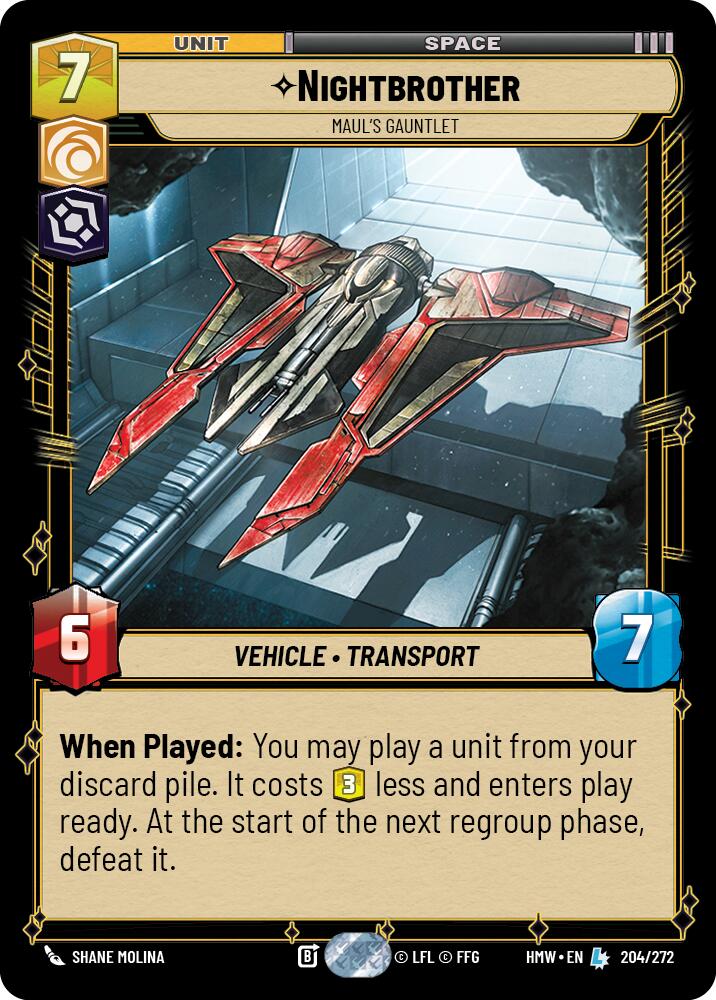
| Nightbrother - Maul's Gauntlet | Rare (+ variants) | #204 / #476 / #714 | $29.50 / $44.09 / $36.14 | The best playable card in the set per multiple openers — and the only non-premium card near the top. Hyperspace non-foil is dearer than the foil |
| General Grievous - Scourge of Dathomir | Prestige Foil | #864 | $38.98 | The most expensive prestige foil and the one openers reacted hardest to. Plain legendary is $13.02 |
| Sando Aqua Monster | Prestige Foil | #874 | $34.17 | A serialized copy was listed at $400 on eBay during prerelease weekend |
| Ritual Dragon | Prestige Foil | #881 | $29.00 | The most-pulled legendary in our regular-box sample — three separate boxes |
| Luminara Unduli - Besieged General | Prestige Foil | #886 | $27.20 | Base legendary is $17.41; the prestige foil carries a ~56% premium |
| Emperor Palpatine - Consolidating Power | Legendary | #110 (HS foil #620) | $12.30 ($22.20 HS foil) | The legendary openers rated highest for play. The cheap one to buy, never to chase |
| Hunter - Everyone Get to Cover! | Legendary | #35 (HS foil #545) | $17.31 ($21.60 HS foil) | Core to the Tarfful shell. Buy as a single, never chase through packs |
| Mae - Kill the Dream | Legendary | #55 | $14.21 | The Maul deck's payoff; appeared in four separate boxes here. A $14 single, not a box chase |
The headliner: showcase Maul
Maul - Old Master is the clearest chase card the game has printed in a while, and it is the single strongest argument against opening Homeworlds. At $388.96 it is more than five regular displays, and more than two Carbonite displays. Four separate openers in this sample named it as the card they wanted. None of them got it, and the sample is 240 packs deep.
The arithmetic is not close. Showcases came up once per three Carbonite boxes, and the pool is 12 to 18 cards, so a named showcase is roughly a 36-to-54-Carbonite-box proposition — $6,600 to $9,900 of product at $183 a display, or $7,200 to $13,500 at the $200–250 store pricing one opener quoted. The card costs $389. You would spend 17 to 25 times its value to expect one copy, and roughly a third of the people who spent it still would not have it.
Regular vs Carbonite
Homeworlds is the first Star Wars Unlimited set where the two booster products have genuinely different jobs, and the data says so cleanly:
| Regular Booster Display | Carbonite Edition Display | |
|---|---|---|
| Packs / price | 24 · $73.74 ($3.07 a pack) | 12 · $183.00 ($15.25 a pack) |
| Legendaries per box | ~5.1 | ~6.8 |
| Legendaries per dollar | 1 per $14.46 | 1 per $26.91 |
| Prestige per box | ~0.6, non-foil only | 12, ~4 of them foil |
| Showcase foil | 0 in 108 packs | ~1 in 3 boxes |
| Serialized /250 | Possible, 0 in 132 packs | ~1 in 4.5 boxes |
| Playable card volume | 384 cards, 24 packs of commons & uncommons | Thin — premium printings of a narrow pool |
| What it is for | Building decks | Collecting prestige & hunting showcases |
We are deliberately not publishing a dollar expected value per box. On a set that is days old, PriceCharting's ungraded averages are still converging downward and are least reliable at the cheap end — which is where 19 of 24 regular packs and most of a Carbonite box's prestige cards land. An EV figure built from those numbers would read well above the truth. The structural comparison above and the honest per-slot rates are the substitutes.
The directional read is unambiguous all the same. Per dollar, the regular box gives you nearly twice the legendaries and several times the raw card count — 384 cards for $73.74 against 12 premium packs for $183. Carbonite buys you one thing the regular box barely offers: a one-in-three shot at a $180–$389 showcase, plus twelve prestige cards from a pool where only the top handful clear $25.
Should You Open or Buy Singles?
Open if:
- You are building Homeworlds decks. At $3.07 a pack the regular display is the cheapest route into the set's playables, and the Tarfful, Pogle, Wicket/Ewok, Omega and Hemlock shells are mostly commons, uncommons and rares. Every opener who was building rather than collecting came away happy
- You want hyperspace cards to foil out a deck. One per regular pack, 24 a box, and hyperspace printings usually trade near the plain version — the cheapest premium-looking deck in any TCG this year
- You are buying a regular display and treating any showcase as a windfall rather than a plan
- You collect prestige art specifically and accept Carbonite's price — the set's prestige frames are the most varied the game has printed, and the complaint from openers was duplication, not quality
- You just want to open Star Wars cards. The art consensus on this set is genuinely strong, and the commons are part of why
Buy singles if:
- You want any showcase. Every priced one sits between $50 and $389, and a named one is 36–54 Carbonite boxes. There is no version of this chase that works
- You want Nightbrother - Maul's Gauntlet, the set's best playable. The base rare is $29.50 — about 40% of a regular display — and it is a rare, so you will not reliably open the copies you need either
- You want a specific legendary. Palpatine is $12.30, Hunter $17.31, Mae $14.21, Grievous $13.02. At ~5 legendaries a box from a large pool, expecting a named one takes several boxes and costs many times the card
- You want the valuable prestige foils. Grievous ($38.98), Sando Aqua Monster ($34.17), Ritual Dragon ($29.00) and Luminara ($27.20) are all cheaper than one and a half Carbonite packs, and Carbonite hands you a random prestige from a pool where most are under $10
- You are buying Carbonite as an investment. Nine boxes in this sample produced 3 showcases and 2 low-tier serialized cards between them. Six consecutive boxes produced none of either
The numbers on chasing showcase Maul
- Observed showcase rate: 3 in 108 Carbonite packs — 1 per 3 boxes. 0 in 108 regular packs
- The showcase pool is 12–18 cards (#783–#800, 12 priced so far), so a named one is roughly 36–54 Carbonite boxes at the observed rate
- 36–54 displays at $183 is $6,600–$9,900 — $7,200–$13,500 at the $200–250 retail one opener quoted
- The card is $388.96. That is 17–25x the card's value to expect one copy, and roughly a third of people who spent it would still not have it
- Buying all 12 priced showcases outright costs about $2,550 — roughly 14 Carbonite displays. You would not complete that set in 14 boxes, or in 100
- If you just want Maul art on a premium card: the set also prints Maul - Only Revenge Remains, whose prestige foil (#890) is $8.40
The honest bottom line: Homeworlds is a beautiful, cheap, generous player set and a punishing collector set. The regular display at $73.74 is one of the better buys in the game right now — 24 guaranteed hyperspace foils, about five legendaries, and the whole common and uncommon pool for the price of two Carbonite packs — as long as you understand that four packs in five end on a plain rare and that prestige has all but left the product. Carbonite is where the showcases and serialized cards live, and at $183–250 a display it asks you to pay $15–20 a pack for a one-in-three shot at the only cards that pay for the box. Three openers hit that shot in this sample. One opener missed it six boxes in a row and ended his video with the right advice: go grab the singles. If you want showcase Maul, Doctor Hemlock or the Grievous prestige foil, buy the card and spend the rest on a regular display you can actually play with.
Frequently Asked Questions
Does every Homeworlds pack guarantee a legendary?
No. In a regular pack the final slot resolves to either a rare or a legendary, and across 108 packs where legendaries were counted on camera only 23 — about 21% — were legendaries. The other ~79% of packs ended on a plain rare. Every regular pack does guarantee one hyperspace foil, but that foil is usually a common or uncommon. Carbonite Edition packs are different: the legendary rate there is about 56% per pack, because every slot in the pack is a premium slot.
How many legendaries do you get per Homeworlds box?
About 5 in a regular 24-pack box and 6.8 in a 12-pack Carbonite box. The regular boxes in this sample came in at 4, 4, 5 and 7 legendaries (plus a half box at 3 in 12 packs). The nine Carbonite boxes ran 4, 5, 5, 6, 7, 8, 8, 8 and 10. The regular figure is below the ~6.8 per box we measured for Ashes of the Empire, and two openers said independently that it felt low — but at 23-in-108 the gap is not statistically conclusive (p = 0.13), so treat it as a flag, not a finding.
What are the Homeworlds showcase pull rates?
3 showcase foils in 108 Carbonite packs — 1 per 3 boxes — and zero in 108 regular booster packs. The Carbonite figure is lumpy: three different openers with one or two boxes each hit one apiece, while a six-box case run produced none and its opener concluded on camera that the rate had been cut. Pooled, the 95% interval runs from about 1-in-9 boxes to better than 1-in-2. The zero in regular packs does not prove regular showcases got rarer — at the ~1-in-12-boxes rate Ashes of the Empire showed, you would see none in 4.5 boxes about 40% of the time. What the data does support is that showcases now concentrate in Carbonite.
Is the showcase Maul worth chasing through packs?
No. Maul - Old Master (Showcase Foil #798) is the most expensive card in the set at about $388.96. The showcase band is #783–#800 — 18 slots, 12 with priced copies so far — and at the observed 1-in-3-Carbonite-boxes rate a specific one is roughly a 36-to-54-box proposition: $6,600–$9,900 of product at the current $183 display price, or 17–25 times the card's own value. Buy the single. Every showcase in the set except The Warrior sits between $180 and $389, so this logic holds for all of them.
What is the Homeworlds prestige card pull rate?
Prestige is where this set diverges most from its predecessors. Carbonite packs contain one prestige card each — 12 per box, roughly 8 non-foil (tier 1) and 4 foil (tier 2) — so a Carbonite box is effectively a prestige box. Regular boosters are thin: 2 prestige in the 84 regular packs where the slot was tracked, about 0.6 per 24-pack box, and two of the four boxes that tracked it had none at all. One opener called it "the first box I've opened since they've added prestiges to regular boxes that I did not pull a prestige out of." Prestige foils never appear in regular packs.
How often do you pull a serialized card in Homeworlds?
We logged 2 serialized cards in 108 Carbonite packs — a Gungi numbered 180/250 and a Shield Team common numbered 146/250 — roughly 1 per 4.5 Carbonite boxes, though two hits is an observation rather than a rate. Serialized cards are numbered to 250 and are not Carbonite-exclusive: one opener confirmed pulling one from regular packs in an unfilmed box. Both copies we saw were low-tier characters (one of them a common), which is why neither rescued its box.
How does Homeworlds compare to Ashes of the Empire?
The structure is unchanged — 24-pack regular displays with a guaranteed hyperspace foil in every pack, 12-pack Carbonite displays, showcase foil leaders on top — but three things moved. Regular-box legendaries ran lower (5.1 per box here versus ~6.8 in Ashes of the Empire). Regular-box prestige fell hard, from ~2 per box to ~0.6. And Carbonite got considerably better: prestige is now one per pack, and showcases landed at 1 in 3 boxes where our single Ashes Carbonite box produced none. Homeworlds is the first set where the honest split is that Carbonite is the collector product and the regular display is the player product, with very little overlap between them.
Is a Homeworlds Carbonite box worth opening?
Only if you want prestige cards or a lottery ticket. At $183–250 for 12 packs you are paying $15–20 a pack for 12 prestige cards (most under $10), about 7 legendaries in hyperspace or prestige printings worth $4–15 each, and a one-in-three chance at a $180–389 showcase. Nine boxes in this sample produced 3 showcases and 2 low-value serialized cards between them, and six consecutive boxes produced neither. Per dollar the regular display gives you nearly twice the legendaries and several times the raw card count.
Disclaimer: Pull rates are community estimates aggregated from 240 Star Wars Unlimited Homeworlds packs opened over the 23–25 October 2026 prerelease weekend — 132 regular booster packs (5½ boxes) and 108 Carbonite Edition packs (9 boxes, including a complete four-box case) — with per-row denominators stated above. Fantasy Flight Games does not publish official Star Wars Unlimited pull rates. Prices are PriceCharting ungraded market values as of 25 October 2026; on a set this new they sit above where singles settle and move fast — verify current prices before buying or selling. This is not financial advice.