
Masterset Calculator
A masterset means one of every card in the set. Set your cost per pack, choose which rarity tiers you want every card from, and the calculator estimates how many packs — and how much money — it takes to finish. Everything is built on the 652-pack verified sample behind our 30th Anniversary pull-rate page, so as we fold in more opening data, this number updates with it.
At launch, a single loose pack traded around $20 and a Booster Bundle worked out cheaper per pack. Use your real cost — the total scales straight off it.
Toggle the tiers you want every card from. Turn on the FUR pair for a “true” masterset — watch the number jump.
| Tier | Cards | Per pack | Packs to finish | Cost |
|---|---|---|---|---|
| Classic Reprint (gold border)Bottleneck The 30 gold-border classic reprints. 30 distinct cards at a low ~10% tier rate — usually the single biggest bottleneck. | 30 | 9.8% | 1,220 ~90%: 1,727 | $20,748 |
| Special Illustration Rare (SIR) Special Illustration Rares. A dozen-plus distinct cards at ~5.5% — a heavy bottleneck alongside the reprints. | 13 | 5.5% | 749 ~90%: 1,134 | $12,732 |
| Illustration Rare (IR) Illustration Rares. Estimated count — set numbering runs past 128 (Maushold is 146/128), implying a mid-teens+ IR pool. | 18 | 18.4% | 342 ~90%: 503 | $5,813 |
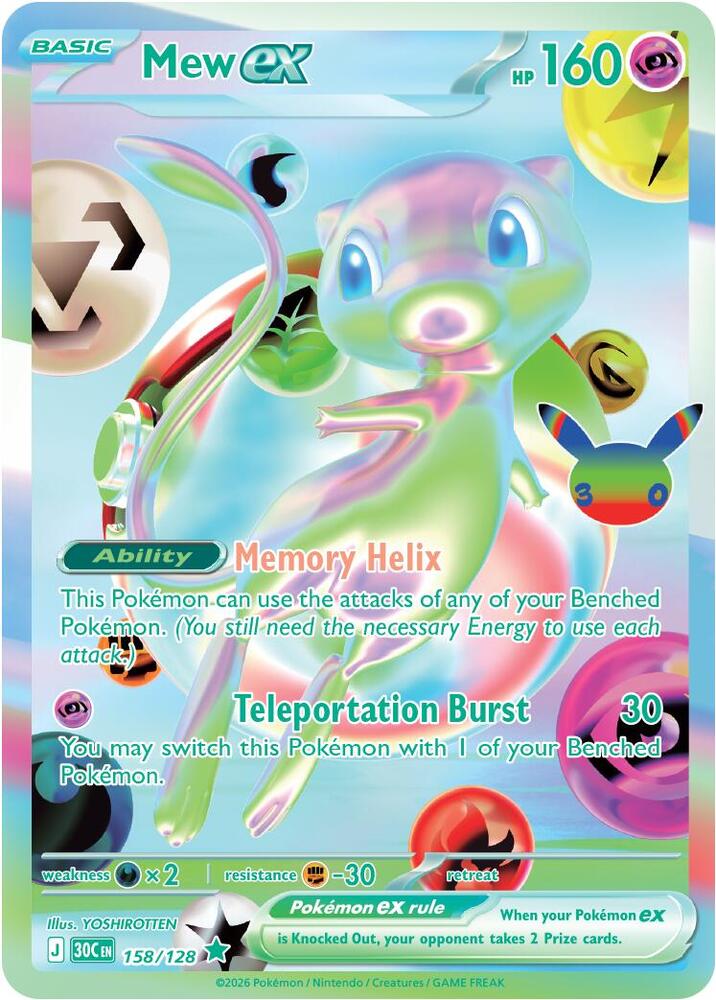
| FUR (YOSHIROTTEN) The two YOSHIROTTEN FUR cards (Mewtwo ex, Mew ex). Pack-pullable but at ~1.2%, so completing the pair alone still runs into the hundreds of packs. Off by default. | 2 | 1.2% | 244 ~90%: 479 | $4,146 |
| Standard ex (Double Rare) Standard ex (Double Rare). Distinct-card count is an early estimate; the most common secondary hit, so it completes quickly. | 15 | 21.9% | 227 ~90%: 339 | $3,858 |
| Holo Pikachu The 30-card / 30-artist holo Pikachu subset. Guaranteed one per pack, so it fills fast — rarely the bottleneck. | 30 | 100% | 120 ~90%: 170 | $2,037 |
Each row is what that tier alone would take to complete. Your masterset finishes when the slowest included tier does, so the headline number tracks the bottleneck row (highlighted) — the others fill in well before it.
How to Read the Number
The calculator gives you two headline figures, and the gap between them is the whole point:
- Average (expected) — if you could run the masterset attempt many times, this is the typical pack count. It is the mean, and for a task like this the mean sits well below what most people actually experience.
- ~90% confidence budget — the pack count that finishes the set in about 9 of 10 attempts. This is the number to actually plan around, because completion has a long right tail: the unlucky runs are much longer than the lucky ones.
Multiply either by your cost per pack and you have the money figure. The tool defaults to a rough loose-pack price, but the honest input is whatever you pay — cheaper sealed product (a Booster Bundle) drops the per-pack cost and scales the whole total down.
The Stats: Why It Costs So Much
Completing a set is a textbook “coupon collector’s problem.” The counter-intuitive part is that the last few cards cost far more than the first many, and that is exactly what makes a masterset so expensive. Here is the reasoning the calculator uses.
For a rarity tier with n distinct cards, where each pack has probability P of yielding some card from that tier, the expected number of packs to collect all n is:
That trailing sum (the harmonic number) is why the tail hurts. When you have 1 of 30 reprints, almost every reprint you hit is new. When you have 29 of 30, you have to wait — on average — for 30 more reprint pulls just to see the single missing card. Since a reprint only shows up in ~10% of packs, that final card alone can cost hundreds of packs.
A worked example on the current data, for the two heaviest tiers:
| Tier | Distinct cards (n) | Per-pack rate (P) | ≈ Packs to complete |
|---|---|---|---|
| Classic reprint (gold border) | 30 | 9.8% | ~1,220 |
| SIR (Special Illustration Rare) | 13 | 5.5% | ~750 |
| IR (Illustration Rare) | 18 | 18.4% | ~340 |
| Standard ex | 15 | 21.9% | ~225 |
| Holo Pikachu subset | 30 | 100% (1/pack) | ~120 |
| FUR (YOSHIROTTEN) | 2 | 1.2% | ~245 |
These are the per-tier figures the calculator sums up. n-values are early estimates except the confirmed 30-card Pikachu subset, 30 reprints, and 2 FUR — adjust as the English checklist firms up.
The Bottleneck Explained
Notice the tiers finish at wildly different rates. The Pikachu subset is done in ~120 packs; the ex tier in ~225. But those same packs are also rolling for reprints and SIRs — so by the time you have every ex, you are nowhere near done on the reprints. The masterset only completes when its slowest tier does, which is why the headline number tracks the bottleneck (the highlighted row in the calculator), not the sum of every tier.
On today’s data the bottleneck is the 30 gold-border classic reprints at ~9.8% per pack — roughly 1,220 packs on their own. Everything else completes comfortably inside that window, so ~1,220 packs is the honest average for the whole pack-obtainable masterset. Flip on the FUR pair and, depending on the rates, it can rival or exceed the reprints as the new bottleneck — two cards at 0.5% is its own kind of brutal.
Three caveats keep this honest, and the calculator states them inline:
- Independence assumption: the model treats each pack as an independent draw at the average rate. Real print runs cluster hits, so a live attempt can over- or under-shoot.
- Sample-limited inputs: the per-pack rates rest on 652 packs and the distinct-card counts are still estimates; the rare tiers move the total the most.
- Some cards aren’t pack-obtainable: the UPC-exclusive day/night Pikachu ex FUR and Classic Collection Pack never drop from standard packs, so a true 100% masterset needs singles on top of any pack count.
The bottom line: the guaranteed holo Pikachu makes every pack feel productive, but a masterset is decided by its rarest, most numerous tier — and coupon-collector math means the last handful of cards dominate the cost. For nearly everyone, opening to a point and then buying the singles you are missing is far cheaper than ripping to completion.
Frequently Asked Questions
How many packs to complete a masterset?
About 1,220 on average on the current data, bottlenecked by the 30 classic reprints — and closer to 1,730 to be ~90% sure. The calculator shows the live figure and lets you add or drop tiers.
How much will it cost?
Enter your cost per pack — it multiplies straight through. At the $16.91 loose-pack price on 3 October 2026 that is roughly $20,600 average and ~$29,300 for the ~90% budget. Cheaper sealed product scales it down — a Booster Bundle works out near $14.33 a pack.
Why is the last card so expensive?
Coupon-collector math: once you own most of a tier, nearly every hit is a duplicate, so the final missing card can take as many packs as the first dozen combined. That tail is where most of the cost lives.
Can I finish a masterset from packs alone?
No — the day/night Pikachu ex FUR promos and the UPC-only Classic Collection Pack never come from standard packs. The calculator prices the pack-obtainable tiers; the rest must be bought.
Disclaimer: All figures are modelled estimates from 652 verified pack openings and early per-tier card counts, and carry real variance in the rare tiers. The model assumes independent packs at the average rate and equally likely cards within a tier; real openings can over- or under-shoot. The Pokémon Company does not publish official pull rates. This is not financial advice.