The Collapse, in Three-Day Buckets
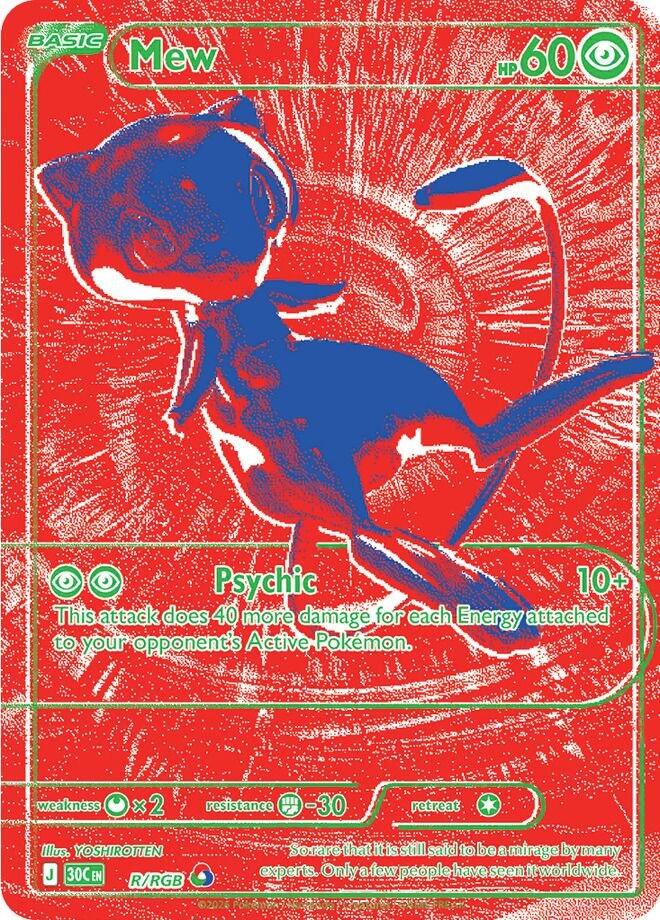
Pokémon 30th Celebration released on 16 September 2026. Three days later its marquee card — the YOSHIROTTEN Mew ex #158 FUR — had lost more than nineteen twentieths of its value. These are TCGplayer market prices in the platform's own three-day buckets:
| Bucket (2026) | Market Price | vs Peak | Status |
|---|---|---|---|
| 30 Aug – 1 Sep | $3,166.50 | −5.0% | Pre-release |
| 2 – 4 Sep | $3,222.00 | −3.3% | Pre-release |
| 5 – 7 Sep | $3,333.00 | Peak | Pre-release |
| 8 – 10 Sep | $3,044.16 | −8.7% | Pre-release |
| 11 – 13 Sep | $1,977.66 | −40.7% | Pre-release |
| 14 – 16 Sep | $1,257.79 | −62.3% | Release (16 Sep) |
| 17 – 19 Sep | $150.68 | −95.5% | Post-release |
| 20 Sep * | $124.99 | −96.2% | Post-release |
For scale: a collector who bought at the 5–7 September peak and sold on 19 September lost $3,182 per copy.
* The 20 September figure is a PriceCharting print rather than a TCGplayer three-day bucket, and it is not yet backed by confirmed sales — treat it as indicative. It is included because it is the first reading at which the two sources agree.
Update, 20 September: the slide has not stopped. Across the 102 30th Celebration singles with confirmed sales on both 19 and 20 September, the median card fell a further 15.5% in a single day — 77 fell, 18 held, 7 rose. Mew ex #158 now prints at $124.99, which is 16% below the $148.82 TCGplayer market price it carried the day before and 96.2% below its 5–7 September peak. For contrast, Pitch Black and Chaos Rising were flat over the same 24 hours, and both of their chase cards were unchanged to the cent.
It Started Before Release
This is the part that gets missed. Four of the seven buckets above are entirely pre-release, and by the 11–13 September bucket the card was already down 40.7% — before a single pack had legally hit shelves in most of the world.
Nothing about the card changed in that window. What changed is that pull-rate data started arriving. Early verified openings began circulating in the first week of September, and the market repriced against them in close to real time. By the time the set actually released, the correction was already two-thirds complete.
That ordering matters, because it rules out the usual explanation. A normal post-release slide is supply arriving on the market — people opening packs and listing singles. Here the price broke before the supply did. The market was not reacting to cards being listed; it was reacting to finding out how many cards there were going to be.
Hit Rates: 30th vs Pitch Black vs Chaos Rising
Every English pack contains a guaranteed card at the bottom of its rarity ladder — for 30th Celebration a holo Pikachu, for the others a Regular Rare. The number that describes a set's generosity is the secondary hit rate: how often a pack gives you something on top of that floor.
| Set | Released | Sample | Secondary Hit Rate | 95% CI |
|---|---|---|---|---|
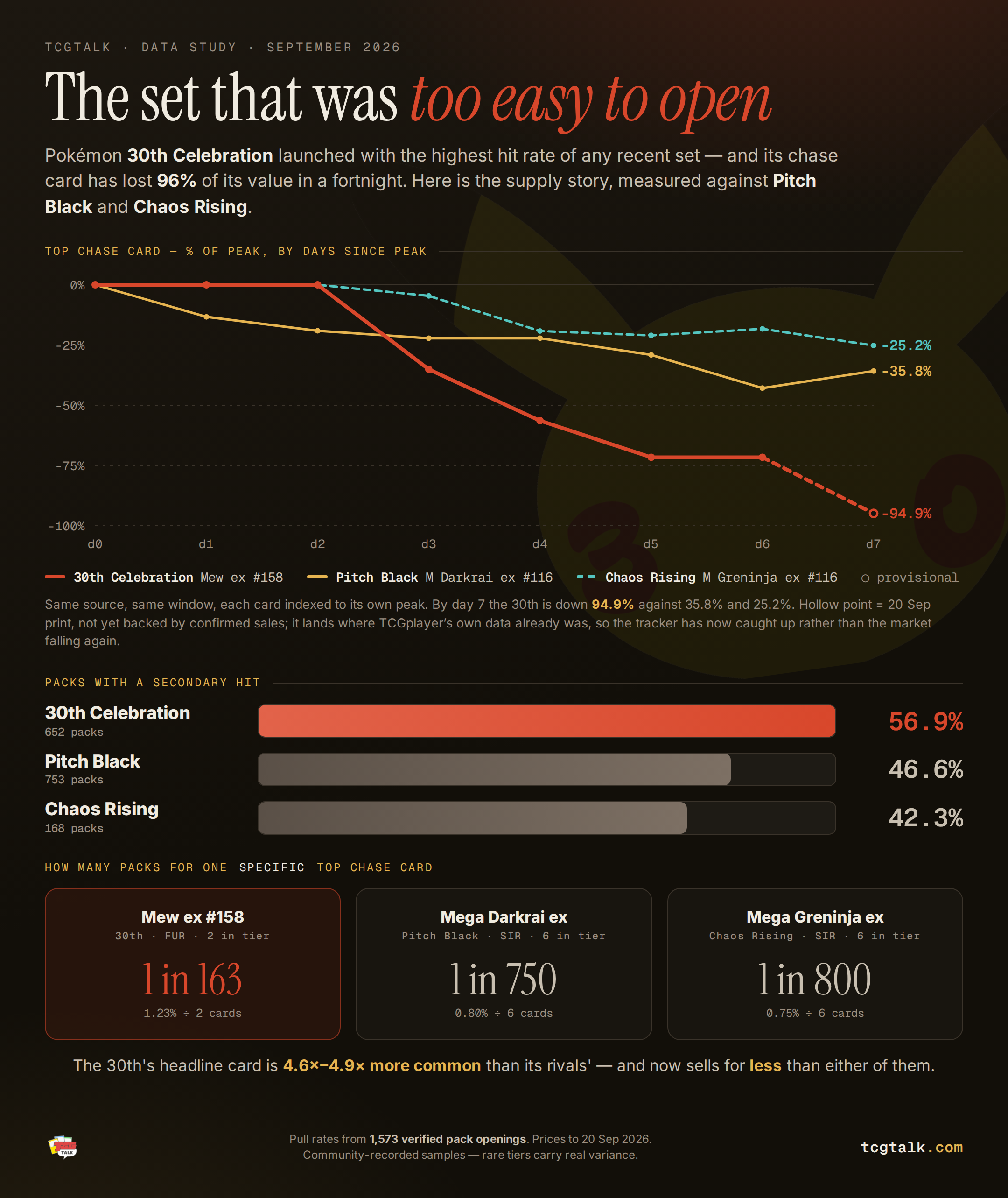
| 30th Celebration | 16 Sep 2026 | 652 packs | 56.9% | 53.1 – 60.7% |
| Pitch Black (ME05) | 16 Jul 2026 | 753 packs | 46.6% | 43.1 – 50.2% |
| Chaos Rising (ME04) | 22 May 2026 | 168 packs | 42.3% | 34.8 – 49.7% |
30th Celebration is the outlier and the gap is not noise. A Fisher exact test puts it at p = 0.00014 against Pitch Black and p = 0.00094 against Chaos Rising. Pitch Black and Chaos Rising are statistically indistinguishable from each other (p = 0.35) — so the two comparison sets form a single baseline, and 30th Celebration sits clearly above it.
Put plainly: open ten 30th Celebration packs and you expect roughly six hits. Ten Chaos Rising packs gives you roughly four.
The Number That Actually Matters
Hit rate is the headline, but it understates the problem, because it treats every hit as equivalent. The number that drives a specific card's price is how many packs you open to get that exact card — the tier rate divided by how many cards share the tier.
Rarity names do not transfer across sets. 30th Celebration has a FUR tier sitting above its SIRs; Pitch Black and Chaos Rising top out at SIR. Comparing "SIR to SIR" compares labels, not scarcity. Comparing per-card does:
| Set — top chase card | Tier Rate | Cards in Tier | Packs per Named Card |
|---|---|---|---|
| 30th — Mew ex #158 (FUR) | 1.23% | 2 | 1 in 163 |
| 30th — a named SIR (#147–156) | 5.52% | 10 | 1 in 181 |
| Pitch Black — Mega Darkrai ex (SIR) | 0.80% | 6 | 1 in 750 |
| Chaos Rising — Mega Greninja ex (SIR) | 0.75% | 6 | 1 in 800 |
30th Celebration's headline card is 4.6× more common per pack than Pitch Black's and 4.9× more common than Chaos Rising's. That is the mechanism. Four to five times the supply of the set's most wanted card, entering a market that had priced it at $3,333.
There is a second, stranger result buried in that table. In 30th Celebration, a named FUR (1 in 163) is no harder to pull than a named SIR (1 in 181) — the tiers are effectively the same scarcity per card, because the FUR tier holds only two cards while the SIR tier holds ten. The set has a rarity ladder that, at the top, is not really a ladder. In Pitch Black and Chaos Rising the top tier is genuinely the bottleneck. In 30th Celebration it is not.
The price outcome follows exactly:
| Set's most expensive card | Current Price | Packs per Copy |
|---|---|---|
| 30th — Mew ex #158 | $124.99 | 1 in 163 |
| Pitch Black — Mega Darkrai ex #116 | $193.31 | 1 in 750 |
| Chaos Rising — Mega Greninja ex #116 | $169.64 | 1 in 800 |
The chase card of the biggest, most anticipated English set of the year is now the cheapest of the three. It is also, by a wide margin, the easiest to pull.
Disclosure: product links above are TCGplayer affiliate links — tcgTalk may earn a commission on purchases at no extra cost to you. Prices change constantly; click through for live pricing.
The Third Supply Leg: 19 Products
Pull rate is per-pack. Total supply is per-pack multiplied by packs printed, and 30th Celebration is unusual there too. There are 19 separate English products confirmed to contain 30th Celebration packs — booster bundles, two Ultra Premium Collections, a binder collection, two ex boxes, a Ditto Premium Collection, two figure collections, ETBs including a Pokémon Center variant, tech sticker collections, mini tins, blisters, poster collections, a Knock Out Collection and loose packs.
For comparison, Pitch Black and Chaos Rising run the standard lineup: booster box, bundle, ETB, blisters. TCGplayer called 30th Celebration "probably the biggest set release Pokémon has ever seen." A sprawling product lineup is a deliberate distribution decision, and it multiplies whatever the per-pack rate already is.
We should be careful here, and we will say so plainly: we can measure the hit rate, and we cannot measure the print run. Pull rate, print volume and pre-release speculation all point the same direction on this set, and they are confounded with each other. What the data supports is that the supply side explains the collapse. What it cannot do is apportion the blame between those three precisely.
Where the Other Tiers Land
The full rarity comparison, per pack, across all three sets:
| Tier | 30th Celebration | Pitch Black | Chaos Rising |
|---|---|---|---|
| Guaranteed floor | Holo Pikachu, every pack | None | None |
| Standard ex | 21.9% (~1 in 4.6) | 25.0% (~1 in 4) | 23.2% (~1 in 4.3) |
| Illustration Rare | 18.4% (~1 in 5) | 11.6% (~1 in 9) | 10.7% (~1 in 9) |
| Classic reprint (gold border) | 9.8% (~1 in 10) | — | — |
| Full art / UR | — | 3.6% | 3.6% ex + 3.0% non-ex |
| SIR | 5.5% (~1 in 18) | 0.8% (~1 in 125) | 0.75% (~1 in 134) |
| Top tier (FUR) | 1.2% (~1 in 82) | — (SIR is top) | — (SIR is top) |
| No secondary hit | 43.1% | 53.4% | 57.7% |
The Illustration Rare row is the quiet one. At 18.4%, 30th Celebration prints IRs at roughly 1.7× the rate of either comparison set — about one every five packs against one every nine. Its 18-card IR range (#129–146) is where the set's mid-tier value went, and it is the tier most likely to keep sliding, because the supply is broad rather than concentrated.
The SIR row is the dramatic one. 5.5% against 0.8% and 0.75% — 30th Celebration prints Special Illustration Rares at nearly seven times the rate of either comparison set. Even after spreading that across ten cards rather than six, a named 30th SIR is four times easier to pull than a named SIR in the other two sets.
What to Watch Over the Next 4–8 Weeks
- Where the floor for Mew ex #158 actually is. Measured the same way — peak to now — Pitch Black's Mega Darkrai ex #116 is down 63.2% and Chaos Rising's Mega Greninja ex #116 is down 71.7%, both over months rather than days. Mew ex #158 is at −96.2% in a fortnight, far past either floor, and the 20 September print has not yet found support. It fell fast enough that it may have overshot; a modest recovery from here would be the normal pattern.
- The Booster Bundle's early-October street date. This is the main widely-available sealed product and it has not landed yet. A second supply wave into an already-saturated singles market is the clearest downside risk to the mid tiers.
- The UPC-exclusive Classic Collection Pack in November 2026. Three guaranteed reprints per pack. The gold-border classic reprints already appear in about 10% of normal packs; a guaranteed-reprint product arriving on top of that will pressure the reprint tier specifically.
- The IR tier (#129–146). At 18.4% per pack across 18 cards, this is the most oversupplied tier in the set relative to its comparables. If anything keeps sliding after the chase cards stabilise, it is this.
- Whether the pull rates hold. 652 packs is a solid sample for the common tiers but the FUR rate rests on 8 pulls. If the true rate is meaningfully lower than 1.23%, the per-card scarcity gap narrows and some of this argument softens. We will update the numbers as the sample grows.
The honest bottom line: 30th Celebration is a genuinely fun set to open and the most generous English release we have measured — a guaranteed holo Pikachu every pack, a hit in 56.9% of them, and an IR every five. Every one of those statements is also a reason its singles are cheap. A high hit rate and a high card price are not compatible for long, and this set is the clearest demonstration of that we have on record. Open it for the experience. Buy the singles, because they will be cheaper than chasing them — and on current evidence, cheaper still next month.
Frequently Asked Questions
Why did 30th Celebration cards crash so hard?
Supply. 30th Celebration has the highest hit rate of the three recent English sets we measured — 56.9% of packs contain a secondary hit, against 46.6% for Pitch Black and 42.3% for Chaos Rising. More importantly, its top chase card sits in a two-card tier, so a specific FUR lands roughly once every 163 packs, compared with about 1 in 750 for a named Pitch Black SIR and 1 in 800 for a named Chaos Rising SIR. The set was priced before anyone had opened it, and repriced once the pull data arrived.
How much did Mew ex 158/128 fall?
TCGplayer market price peaked at $3,333.00 in the 5–7 September bucket — before the set released — and printed at $150.68 in the 17–19 September bucket. That is a 95.5% decline in twelve days. It has since printed lower again, at $124.99 on 20 September — a 96.2% fall from peak. Roughly 40% of the original fall happened before the 16 September release date, while the only new information available was pull-rate data from early openings.
Is 30th Celebration worth opening?
For the experience, yes — every pack carries a guaranteed holo Pikachu and 56.9% of packs give you something on top, the highest rate of any recent English set. As an investment, no. A high hit rate is the same thing as high supply, and this set demonstrated exactly what that does to singles prices. If you want a specific card, buy the single.
Which set holds value better, 30th Celebration, Pitch Black or Chaos Rising?
On the evidence so far, the two lower-hit-rate sets. 30th Celebration's headline card now trades around $125, below Pitch Black's Mega Darkrai ex SIR at about $193 and Chaos Rising's Mega Greninja ex SIR at about $170 — despite 30th Celebration being the far bigger and more hyped release. Scarcity, not hype, is what held those prices up.
Why did price trackers show Mew ex #158 so much higher than TCGplayer?
Because most trackers publish a trailing monthly average, and on a set this new that average stays weighted toward inflated pre-release sales. On 19 September 2026 PriceCharting listed Mew ex #158 at $700.00 against a TCGplayer market price of $148.82 — 4.7× higher — while sealed product from the same set matched within 10% on the same day, confirming the gap was lag on newly-traded singles rather than a difference between the sources. On 20 September the tracker repriced to $124.99 and the gap closed. The lesson holds for the next new set: for roughly the first month, treat a trailing average as a ceiling and use the three-day bucket history instead.
Disclaimer: Pull rates are community estimates recorded from 1,573 verified pack openings across the three sets (652 / 753 / 168) and carry real variance in the rare tiers — the 30th Celebration FUR rate in particular rests on 8 pulls. Prices are TCGplayer market prices to 19 September 2026 for 30th Celebration plus the provisional 20 September tracker print noted above, and settled aggregate prices for Pitch Black and Chaos Rising, which are old enough for trailing averages to have converged. Prices change constantly — verify before buying or selling. This is not financial advice.