
The Short Answer
The most common question about this set is some version of "which SAR is the hard one?" — usually asked by someone about to pay a premium for a single because a forum thread said it was scarce. After 57 sealed boxes, the honest answer is that there is no hard one.
Every Japanese 30th Celebrations box contains exactly one SAR. That SAR is drawn from a pool of nine cards, and across 56 named pulls the distribution is statistically indistinguishable from perfectly flat. Gengar led our sample with 10 and Fuecoco trailed with 2, which looks like a five-fold rarity gap — but a chi-square test on those counts returns p = 0.35, which is not remotely significant. The spread is noise.
That has a direct consequence for anyone pricing singles: if one SAR is selling for a large multiple of the others, that premium is demand, not scarcity. Popularity, art and playability move these prices. Pull rates do not.
The second finding is a correction to our own earlier work. Our original 17-box sample put the FUR at roughly 1 in 2.8 boxes. With 57 boxes, the real figure is closer to 1 in 4.1 — and the Mew-versus-Mewtwo split, which looked 2:1 in favour of Mew, is now exactly 7:7.
The SAR Pool: Nine Cards
Across 57 boxes we recorded named SARs for 56 of them (one box in the earlier sample logged an SAR without writing down which). Those 56 pulls produced exactly nine distinct cards and nothing else:
Gengar · Sylveon · Mewtwo · Pikachu · Greninja · Mew · Salamence · Jirachi · Fuecoco
Two of those — Jirachi and Fuecoco — never appeared in the original 17-box sample at all, which is why our earlier guide could only say "at least seven distinct SARs." The larger sample closes that gap. It also shows why the earlier undercount happened: with only 16 named pulls, missing two cards out of nine is completely ordinary.
Could there be a tenth SAR we have still not seen? It is unlikely but not impossible. If a tenth card existed at the same weighting, the chance it stayed hidden through 56 draws is about 2.7%. Low enough to plan around nine, high enough that we describe the pool as nine observed rather than nine confirmed.
SAR Distribution: Every Named Pull
Here is the full count, split by sample so you can see that the two datasets tell the same story independently. The final column is what a perfectly even nine-card pool would predict over 56 draws.
| SAR | 17-box sample | 40-box sample | Combined | Share | 1 in N boxes | Expected if flat |
|---|---|---|---|---|---|---|
| Gengar | 4 | 6 | 10 | 17.9% | 5.6 | 6.2 |
| Sylveon | 3 | 6 | 9 | 16.1% | 6.2 | 6.2 |
| Mewtwo | 2 | 6 | 8 | 14.3% | 7.0 | 6.2 |
| Pikachu | 3 | 5 | 8 | 14.3% | 7.0 | 6.2 |
| Greninja | 1 | 4 | 5 | 8.9% | 11.2 | 6.2 |
| Mew | 2 | 3 | 5 | 8.9% | 11.2 | 6.2 |
| Salamence | 1 | 4 | 5 | 8.9% | 11.2 | 6.2 |
| Jirachi | — | 4 | 4 | 7.1% | 14.0 | 6.2 |
| Fuecoco | — | 2 | 2 | 3.6% | 28.0 | 6.2 |
| Total named | 16 | 40 | 56 | 100% | — | 56 |
One box in the 17-box sample recorded an SAR without a name, so 57 boxes yield 56 named pulls. Salamence appears in the raw logs under several spellings and is normalised here.
Is Any SAR Actually Rarer?
Look at that table and the temptation is obvious: Gengar at 10, Fuecoco at 2. Five times the pulls. Surely Fuecoco is the chase?
No. That gap is exactly the size you should expect from randomness at this sample size, and there is a standard test for it. Running a chi-square goodness-of-fit test against a flat nine-card pool gives χ² = 8.93 on 8 degrees of freedom, p = 0.35. The conventional threshold for calling a distribution uneven is p < 0.05. We are seven times further away from that than we would need to be. The data gives no reason at all to believe any SAR is rarer than any other.
A second way to see it: we simulated 400,000 rounds of drawing 56 cards from a perfectly even nine-card pool. In 35% of those rounds, some card landed on 2 or fewer purely by chance. In other words, more than a third of the time a genuinely flat pool produces a "Fuecoco" — a card that looks five times scarcer than the leader and simply is not. Ours happened to be Fuecoco. Run the next 57 boxes and it will very likely be a different card.
The confidence intervals make the same point. Gengar's 10 of 56 gives a 95% interval of 10.0% to 29.8%. Fuecoco's 2 of 56 gives 1.0% to 12.1%. A flat pool sits at 11.1% — comfortably inside both. The two intervals even overlap each other.
Odds of Pulling One Specific SAR
Because each box guarantees exactly one SAR from a flat pool of nine, the maths here is unusually clean. Each sealed box is one draw at 1 in 9, independent of the last.
| Sealed boxes opened | Packs | Chance of one specific named SAR |
|---|---|---|
| 1 | 20 | 11.1% |
| 3 | 60 | 29.8% |
| 5 | 100 | 44.5% |
| 6 | 120 | ~50% — coin flip |
| 7 | 140 | 56.2% |
| 9 | 180 | 65.4% |
| 12 | 240 | 75.7% |
| 20 | 400 | 90.5% |
Note how slowly that column climbs. Nine boxes — 180 packs — still leaves you a one-in-three chance of never seeing the card you wanted. To get to 90% confidence you need roughly 20 sealed boxes. This is the single strongest argument in the set for buying the single instead: you will spend twenty boxes to be reasonably sure of one card, and collect nineteen SARs you did not ask for on the way.
The counterweight is that those nineteen are not worthless. Every box also delivers its two gold-border classic reprints, roughly 4.5 ex and 3.7 AR, so the effective cost of the chase is the box price minus whatever you recover reselling the rest. That recovery rate is the number to work out before you commit — see the full box contents breakdown for what else is in there.
Collecting All Nine SARs
If your goal is the complete SAR set rather than one card, this becomes a coupon-collector problem — and the flat distribution makes it tractable. With one guaranteed draw per box from nine evenly weighted cards, the expected number of boxes is 9 × H₉, or about 25.5 boxes.
But the mean is misleading here, because the distribution has a long right tail. We simulated 300,000 collections to get the actual spread:
| Outcome | Boxes | Packs |
|---|---|---|
| Lucky (25th percentile) | 18 | 360 |
| Typical (median) | 23 | 460 |
| Mean | 25.5 | 509 |
| Unlucky (75th percentile) | 30 | 600 |
| 90% confident | 38 | 760 |
| 95% confident | 44 | 880 |
The shape of that table is the familiar coupon-collector trap: the first five or six SARs arrive quickly, and then the last two eat most of your budget. Once you are holding seven of nine, each additional box only has a 2-in-9 chance of showing you something new — so you can reasonably expect to open four or five more boxes for each remaining card. Half of your total spend goes on the final two SARs.
Worth noting that 57 boxes is more than double the median needed for a full SAR set, and our combined sample did indeed see all nine — which is consistent with the model rather than a coincidence.
FUR: Mew vs Mewtwo
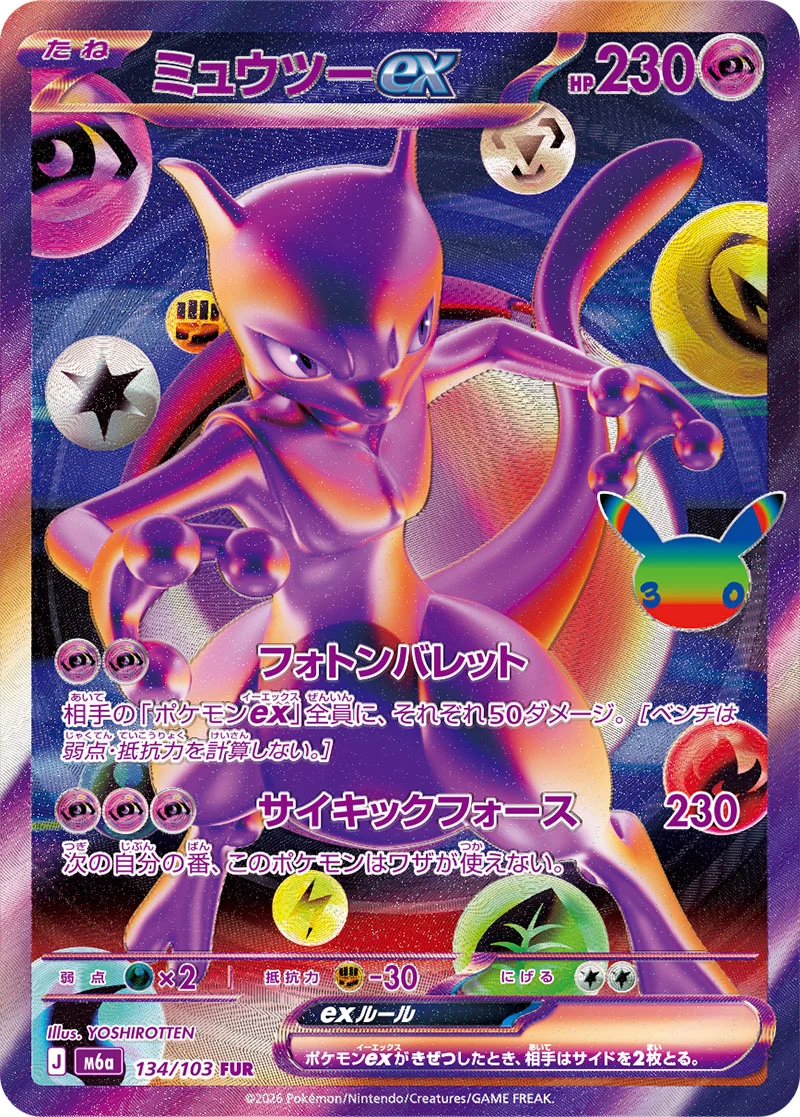
The two YOSHIROTTEN FUR cards — Mew ex and Mewtwo ex — sit above the SAR tier and are the only genuine variance in an otherwise deterministic box. Here is what 57 boxes produced:
| FUR | 17-box sample | 40-box sample | Combined | Per box | 1 in N boxes |
|---|---|---|---|---|---|
| Mew ex | 4 | 3 | 7 | 12.3% | 8.1 |
| Mewtwo ex | 2 | 5 | 7 | 12.3% | 8.1 |
| Any FUR | 6 | 8 | 14 | 24.6% | 4.1 |
Seven and seven. This is the cleanest illustration in the whole dataset of why small samples mislead. Our 17-box sample showed Mew at twice Mewtwo's rate and we flagged it in that guide as "well within noise." The 40-box sample then swung the other way, 5 Mewtwo to 3 Mew. Combined, they cancel exactly. Treat the two FURs as equally likely.
The structural detail from the original guide still holds across all 57 boxes: the FUR never replaces the box SAR. Every single FUR box also contained its guaranteed SAR. The FUR sits on top of the box floor rather than consuming it, so a FUR box is strictly better than a normal one — not a different distribution of the same value.
| Target | Boxes for 50% | Boxes for 90% |
|---|---|---|
| Any FUR | ~2.5 | ~8 |
| Mew ex FUR specifically | ~5.3 | ~18 |
| Mewtwo ex FUR specifically | ~5.3 | ~18 |
Why the FUR Rate Just Dropped
Our main pull rate guide originally put the FUR at 6 in 17 boxes — 35.3%, or about 1 in 2.8. The combined figure is 24.6%, or about 1 in 4.1. That is a meaningful downgrade, and it is worth being explicit about why it happened, because it is not a case of one number being wrong and the other right.
Six pulls is simply not many. The 95% confidence interval on 6 of 17 runs from 17% to 59% — a range so wide it was barely a constraint at all, which is why that guide flagged the FUR as its one genuinely thin line. The 40-box sample came in at 8 of 40, or 20%, which sits comfortably inside that interval. There is no contradiction between the two datasets; the first one was just imprecise.
Pooled, 14 of 57 gives a 95% interval of 15% to 37%. Still not narrow, but now genuinely informative. The honest summary is: somewhere between one FUR every three boxes and one every seven, most likely one every four.
Per pack, 14 FURs in 1,140 packs is 1.23%, or roughly 1 in 81 — down from the 1.8% / 1-in-57 figure the original sample implied. If you have been valuing sealed boxes using the older number, this revision moves the expected value of a box down by a meaningful margin, because the FUR is the highest-value card in the set and the only one that can lift a box above its guaranteed floor.
Box by Box: The 40-Box Sample
The raw results from the newer opening, one row per sealed box. Every box produced exactly one SAR; the FUR column shows the eight boxes that also carried a YOSHIROTTEN card. The 17-box sample's full per-card breakdown, including ex, AR and reprints, is on the main pull rate guide.
| Box | SAR | FUR |
|---|---|---|
| 1 | Fuecoco | — |
| 2 | Pikachu | — |
| 3 | Sylveon | — |
| 4 | Gengar | — |
| 5 | Pikachu | — |
| 6 | Greninja | Mewtwo ex |
| 7 | Jirachi | — |
| 8 | Mew | — |
| 9 | Mew | — |
| 10 | Sylveon | — |
| 11 | Mewtwo | — |
| 12 | Sylveon | — |
| 13 | Mewtwo | Mewtwo ex |
| 14 | Greninja | — |
| 15 | Sylveon | — |
| 16 | Sylveon | — |
| 17 | Mewtwo | Mew ex |
| 18 | Mewtwo | — |
| 19 | Gengar | — |
| 20 | Fuecoco | — |
| 21 | Gengar | Mew ex |
| 22 | Greninja | Mewtwo ex |
| 23 | Salamence | — |
| 24 | Gengar | — |
| 25 | Jirachi | — |
| 26 | Jirachi | — |
| 27 | Pikachu | — |
| 28 | Pikachu | — |
| 29 | Greninja | — |
| 30 | Mewtwo | — |
| 31 | Salamence | Mewtwo ex |
| 32 | Salamence | — |
| 33 | Gengar | Mewtwo ex |
| 34 | Mewtwo | — |
| 35 | Pikachu | — |
| 36 | Mew | — |
| 37 | Gengar | — |
| 38 | Jirachi | Mew ex |
| 39 | Salamence | — |
| 40 | Sylveon | — |
| Total | 40 SARs | 8 FURs |
Two details worth pulling out of that table. First, no box produced two SARs and no box produced zero — the guarantee is exact, not approximate. Second, the FUR boxes are scattered with no clustering: boxes 6, 13, 17, 21, 22, 31, 33 and 38. If FUR distribution followed any case-level pattern, 40 consecutive boxes would be a reasonable place to see it, and we do not.
What This Means If You Are Buying
- Any SAR premium is demand, not rarity. All nine sit at 1 in 9. If a listing justifies its price with scarcity, that claim does not survive 57 boxes of data — but a genuine demand premium on a popular character is real and will persist.
- One specific SAR costs about nine boxes on average, and twenty to be 90% sure. Compare that total against the single price before you open anything. In almost every case the single wins.
- A full nine-card SAR set runs about 23 boxes at the median, 38 for 90% confidence. Budget for the tail, not the mean — the last two cards are half the cost.
- Revise your box EV downward for the new FUR rate. 1 in 4.1 boxes, not 1 in 2.8. If you were modelling sealed box value on the older figure, the top-end contribution was overstated by roughly a third.
- Mew and Mewtwo FURs are equally hard. Any price gap between them is demand. Neither is the "harder pull."
- The box floor is the real product here. Fifty-seven for fifty-seven on the SAR guarantee makes this one of the most predictable sealed products in Pokémon. You are buying a guaranteed SAR plus a 24.6% FUR lottery ticket — that is the honest description of a box.
Methodology & Limits
What the sample is. Two separate openings of sealed Japanese 30th Celebrations booster boxes, recorded independently and confirmed not to overlap: 17 boxes logged card by card, and 40 boxes in which only the SAR and FUR slots were written down. Combined, 57 boxes and 1,140 packs. Because both samples are whole sealed boxes rather than loose packs, they are not vulnerable to the pack-searching bias that distorts loose-pack data in this set.
What this page does not cover. The 40-box sample recorded nothing below the SAR tier, so it cannot extend our figures for standard ex, AR, gold-border classic reprints, hit-pack counts or Pikachu-only packs. Those all remain based on the 17-box / 340-pack sample and are unchanged on the main guide. Do not read the 57-box sample size as applying to those numbers.
Known limits. One box in the 17-box sample logged an SAR without recording which card, so named-SAR figures rest on 56 pulls rather than 57. The nine-card pool is observed, not confirmed against an official checklist — a tenth evenly weighted SAR had about a 2.7% chance of hiding through 56 draws. The FUR rate, even pooled, carries a 95% interval of 15% to 37%; it is much better constrained than it was at 17 boxes but is still the loosest number here. And the flat-distribution finding is a failure to reject uniformity, not proof of it: a small weighting difference between SARs could exist and be invisible at n = 56. What we can say confidently is that no SAR is dramatically rarer than the others.
Statistical methods. Chi-square goodness-of-fit against a uniform nine-card pool; Wilson score intervals for proportions; Monte Carlo simulation (300,000–400,000 runs) for coupon-collector percentiles and for the extreme-count check.
Frequently Asked Questions
Which 30th Celebrations SAR is the rarest?
None of them, as far as 57 sealed boxes can tell. Nine distinct SARs appeared across 56 named pulls, running from Gengar at 10 down to Fuecoco at 2. That looks dramatic, but a chi-square test returns p = 0.35 — nowhere near significant. The data is entirely consistent with every SAR sitting at a flat 1 in 9. In a perfectly even pool there is a 35% chance that some card lands on 2 or fewer out of 56 draws purely by luck; Fuecoco is that card in our sample, and in the next 57 boxes it will probably be a different one.
How many SARs are in the Japanese 30th Celebrations set?
We observed nine: Gengar, Sylveon, Mewtwo, Pikachu, Greninja, Mew, Salamence, Jirachi and Fuecoco. Fifty-six named pulls turned up these nine and nothing else. If a tenth existed at equal weighting, the chance it stayed hidden is about 2.7% — so nine is very likely complete, but we call it nine observed rather than nine confirmed.
How many boxes for one specific SAR?
About nine on average. One box is an 11.1% shot, five boxes 44.5%, and roughly six boxes gets you to even odds. For 90% confidence you need about 20 sealed boxes, or 400 packs — at which point the single is almost certainly the cheaper route.
How many boxes to collect all nine SARs?
Around 25 to 26 on average, with a median of 23. The tail is long: 30 boxes gets you there 75% of the time, and you need about 38 boxes (760 packs) for 90% confidence. The last two or three SARs account for most of that, because each new box has a shrinking chance of showing you something you do not already own.
What is the FUR pull rate?
Fourteen FURs across 57 boxes — 24.6% of boxes, about 1 in 4.1, or 1.23% per pack (roughly 1 in 81). This revises down our original 17-box estimate of 1 in 2.8, which carried a 95% interval of 17%–59% and was always provisional. The pooled interval is 15%–37%. The FUR still never replaces the box SAR — every FUR box also had its guaranteed SAR.
Is the Mew ex FUR rarer than Mewtwo ex?
No — dead even at 7 and 7 across 57 boxes. Our 17-box sample showed Mew at twice Mewtwo's rate; the 40-box sample showed the reverse. Combined, they cancel out perfectly. Both sit at roughly 12.3% per box, about 1 in 8.1 boxes each.
Does every box really guarantee an SAR?
Yes, and it is now the best-evidenced fact about the set. Fifty-seven sealed boxes produced exactly 57 SARs — never zero, never two, no exceptions in either dataset. Two independently sourced samples agreed completely. A guarantee holding 57 out of 57 is a structural property of how boxes are assembled, not an average you might fall short of.
Boxes or singles for a specific SAR?
Singles, in nearly every case. The per-box guarantee only pays off if you are happy with any of the nine. The moment you want a specific one, the flat 1-in-9 distribution means roughly nine boxes for one card, plus eight SARs you did not want. Those eight have resale value, so the true cost is below nine boxes — but you carry the spread, the shipping and the time. Compare the single price against nine boxes before committing.
Disclaimer: Pull rates are community estimates from 57 sealed Japanese 30th Celebrations boxes across two independent openings, covering the SAR and FUR tiers only. The per-box SAR guarantee held across the full sample and is reliable. The flat SAR distribution is a failure to reject uniformity at n = 56, not proof of it. The FUR rate rests on 14 pulls and retains real variance. All prices are estimates — verify current prices before buying or selling. This is not financial advice.