
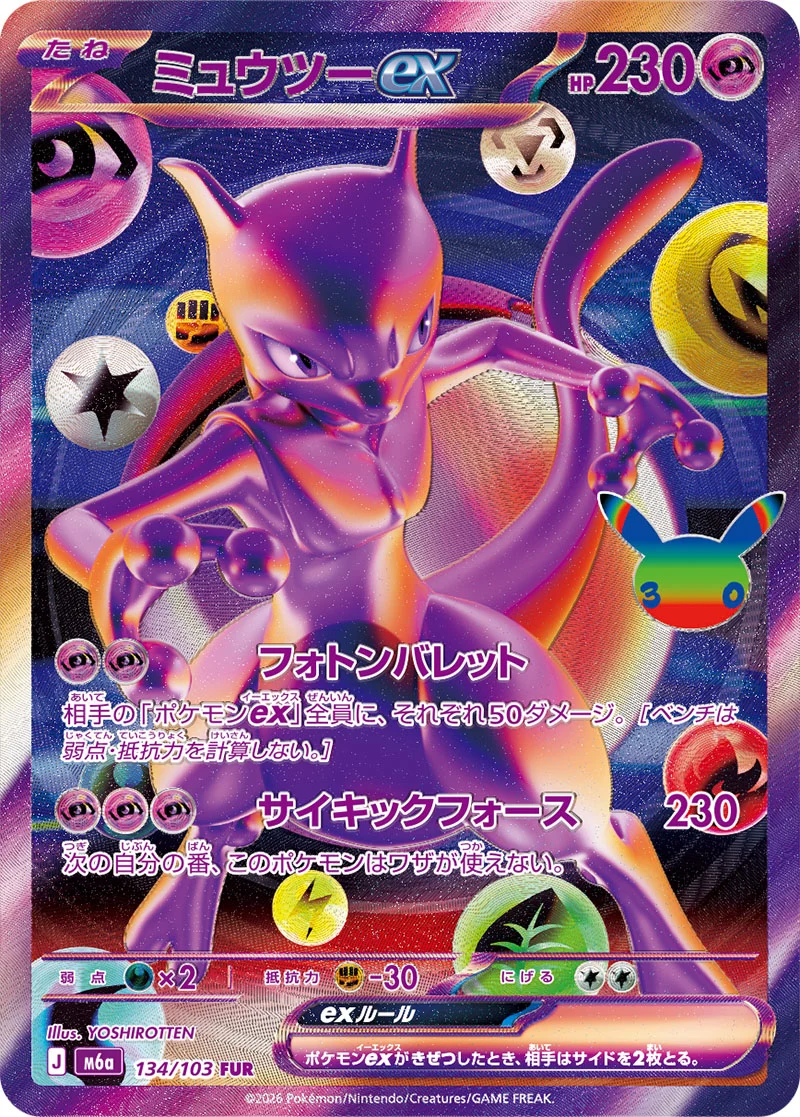
SAR and FUR — all 57 boxes (1,140 packs). Every box opened had its top-end cards recorded, so the SAR guarantee and the FUR rate are backed by the full sample. A guarantee that holds 57 times out of 57 is a structural fact, not a small-sample artifact.
Everything else — 17 boxes (340 packs). Standard ex, AR, classic reprint, blank-pack and double-hit rates need a full card-by-card log, and 17 of the 57 boxes were recorded that way. Those rows are solid but rest on the smaller sample. Each table below states which scope applies.
The FUR figure moved with the larger sample: the first 17 boxes ran hot at 6 FUR (35% of boxes), and across all 57 it settles at 14 (24.6%, ~1 in 4.1 boxes). That is exactly why sample size matters on the rare tiers.
What Is Japanese 30th Celebrations?
30th Celebrations is the Japanese release of the Pokémon 30th anniversary set. It is a smaller, denser set than the English version: 103 base cards against the English 128, in six-card packs rather than five, sold in 20-pack booster boxes. Japanese sealed product for this set carries a steep premium over an ordinary set, which is precisely why the box-level pull rates matter so much here.
The core mechanic carries over from the English set: every pack contains one guaranteed Pikachu from the anniversary Pikachu subset. In all 340 packs we logged, every pack had its Pikachu. Treat it as the floor of the pack, never the hit.
Where the two releases diverge — and the reason this page exists separately from our English 30th Anniversary pull rate guide — is the box configuration. Japanese boosters are built on fixed per-box slots. English boosters are not. The English set's SIR rate is a probability you roll against on every pack; the Japanese set's SAR is a slot that fills exactly once per box, every box. The numbers below confirm that 17 boxes out of 17, from both directions at once.
The rarity ladder observed in this sample, from the floor upward: guaranteed Pikachu → standard ex (Double Rare) → AR (Art Rare) → gold-border classic reprint → SAR (Special Art Rare) → FUR, with the FUR slot occupied by the two YOSHIROTTEN cards, Mew ex and Mewtwo ex.
Box Pull Rates: What One Box Gets You
This is the table most people actually want, because almost nobody buys 30th Celebrations one pack at a time. Every figure is measured directly from 17 sealed boxes rather than extrapolated from a pack rate.
| Per 20-Pack Box | Average | Range | Boxes with ≥1 | Guaranteed? | Sample |
|---|---|---|---|---|---|
| Pikachu (base) | 20 | 20–20 | 17 / 17 | Yes — 1 per pack | 17 boxes |
| Standard ex (Double Rare) | 4.5 | 3–5 | 17 / 17 | At least 3, every box | 17 boxes |
| AR (Art Rare) | 3.7 | 3–5 | 17 / 17 | At least 3, every box | 17 boxes |
| Classic reprint (gold border) | 2.1 | 2–3 | 17 / 17 | Yes — 2 (16/17 boxes) | 17 boxes |
| SAR (Special Art Rare) | 1.0 | 1–1 | 57 / 57 | Yes — exactly 1, always | 57 boxes |
| FUR (YOSHIROTTEN) | 0.25 | 0–1 | 14 / 57 (25%) | No — the only real variance | 57 boxes |
| SAR-or-better | 1.25 | 1–2 | 57 / 57 | Yes — at least 1 | 57 boxes |
| Hit packs (something beyond the Pikachu) | 9.1 | 9–10 | 17 / 17 | Yes — 9, fifteen boxes out of 17 | 17 boxes |
| Pikachu-only packs | 10.9 | 10–11 | 17 / 17 | Effectively fixed at 11 | 17 boxes |
| Total hit cards per box | 11.6 | 10–13 | 17 / 17 | — | 17 boxes |
"Hit packs" counts packs containing anything above the guaranteed Pikachu; "total hit cards" counts the cards themselves, which is higher because some packs carry two. The two boxes with 10 hit packs were both FUR boxes. The Sample column is the honest part: SAR and FUR were recorded across all 57 boxes opened, while the rows needing a card-by-card log rest on the 17 boxes recorded that way.
The two numbers that define this set
- 1 SAR per box, 57 boxes out of 57. Never zero, never two, across every box we have opened. The per-pack data confirms it independently: 57 SARs in 1,140 packs is exactly 5.0%, or precisely 1 in 20 — which is exactly one 20-pack box. Two different ways of counting land on the same answer, which is what a real guarantee looks like.
- 9 hit packs and 11 blanks per box. Fifteen of the 17 boxes logged pack by pack contained exactly 9 packs with something beyond the Pikachu. The other two had 10, and both were FUR boxes. A 30th Celebrations box is not a random scatter of hits — it is a fixed structure, and you can predict it before you cut the shrink.
How many boxes per hit
Using the observed rates, this is how much sealed product each outcome takes:
| What you want | Boxes needed (observed) | Packs needed |
|---|---|---|
| Any SAR | 1 — guaranteed | 20 |
| Any FUR (Mew ex or Mewtwo ex) | ~4.1 | ~81 |
| One specific named SAR (10 in the pool) | ~10 | ~200 |
| A specific FUR (Mew ex or Mewtwo ex) | ~8.1 | ~163 |
The first row is the set's whole pitch, and the last two are why you should buy singles for anything specific. Price these against the current cost of a sealed box wherever you buy — sealed pricing moves constantly and varies a lot by importer.
Box Contents & Pack Structure
A 30th Celebrations booster box is 20 packs of 6 cards. Every pack carries a Pikachu, so a sealed box always produces 20 Pikachus plus whatever fills the hit slots — on average 11.6 hit cards spread across 9 packs.
That structure is the single most important thing to understand before you buy. A sealed Japanese box has a floor. You cannot open a box and get nothing — a bad box still hands you an SAR, two classic reprints, three ex and three AR across 9 hit packs. The flip side is that a good box is also capped: without a FUR, the ceiling on a box is its one SAR. The variance lives almost entirely in which SAR you get and whether a FUR happens to show up.
It also means loose Japanese packs are a trap. Because the hits sit in fixed slots and a box has a known 9-hit/11-blank shape, a box can have its SAR pack identified and pulled out with the rest sold as loose packs or resealed. Buy sealed boxes from a reputable source, or accept that a loose pack is a ~54% chance of a Pikachu and nothing else.
Where to buy Japanese sealed product
30th Celebrations boxes are not distributed through Western retail channels, so sealed product means importing or paying an import premium locally. Our two relevant walkthroughs:
- Best Japanese Pokémon card stores — which shops actually stock sealed Japanese boxes and how their pricing compares
- How to buy from Yuyutei (Singapore) — the standard route for Japanese singles, which is what you want if you are chasing one specific SAR rather than opening
- How to buy from Mercari Japan — where loose and resealed boxes surface; read the "loose packs are a trap" note above before you bid
Pack Pull Rates: 340 Packs
The same data viewed one pack at a time. SAR and FUR are computed on all 1,140 packs (57 boxes); the remaining rows need a card-by-card log and are computed on the 340 packs from the 17 boxes recorded that way.
| Rarity | Pulls | % per Pack | Per 20-Pack Box | Roughly |
|---|---|---|---|---|
| Standard ex (Double Rare) | 77 | 22.6% | ~4.5 | 1 in 4.4 packs |
| AR (Art Rare) | 63 | 18.5% | ~3.7 | 1 in 5.4 packs |
| Classic reprint (gold border) | 35 | 10.3% | ~2.1 | 1 in 9.7 packs |
| SAR (Special Art Rare) | 57 | 5.0% | 1.0 (guaranteed) | exactly 1 in 20 |
| FUR (YOSHIROTTEN) | 14 | 1.2% | ~0.25 | 1 in 81 packs · 1 in 4.1 boxes |
| Pikachu only (no additional hit) | 185 | 54.4% | ~10.9 | Just over half of all packs |
| Packs opened | 340 / 1,140 | — | 20 | 17 logged / 57 boxes |
Rows sum above 100% because a single pack can contain more than one hit — 12.6% of the fully-logged packs did. The guaranteed Pikachu appears in 100% of packs and is not counted as a hit. SAR-or-better (SAR plus FUR) works out to 71 in 1,140 packs, or 6.2% — about 1.25 per box. Note the SAR and FUR rows rest on 1,140 packs while the ex, AR, classic-reprint and Pikachu-only rows rest on 340.
Box by Box
The raw per-box results for the 17 boxes logged pack by pack, so you can see for yourself how little the box composition moves. Every row is one sealed box. (The other 40 boxes had only their SAR and FUR recorded — they are summarised in the SAR pool table below.)
| Box | SAR | FUR | ex | AR | Reprints | Hit packs | Pikachu only |
|---|---|---|---|---|---|---|---|
| 1 | 1 | — | 5 | 4 | 2 | 9 | 11 |
| 2 | 1 | — | 4 | 5 | 2 | 9 | 11 |
| 3 | 1 | 1 | 5 | 3 | 2 | 9 | 11 |
| 4 | 1 | — | 5 | 4 | 2 | 9 | 11 |
| 5 | 1 | 1 | 4 | 3 | 2 | 9 | 11 |
| 6 | 1 | — | 4 | 4 | 2 | 9 | 11 |
| 7 | 1 | — | 5 | 3 | 2 | 9 | 11 |
| 8 | 1 | — | 4 | 3 | 2 | 9 | 11 |
| 9 | 1 | 1 | 5 | 3 | 2 | 9 | 11 |
| 10 | 1 | — | 5 | 4 | 2 | 9 | 11 |
| 11 | 1 | — | 5 | 3 | 3 | 9 | 11 |
| 12 | 1 | — | 5 | 4 | 2 | 9 | 11 |
| 13 | 1 | 1 | 4 | 5 | 2 | 10 | 10 |
| 14 | 1 | 1 | 5 | 3 | 2 | 9 | 11 |
| 15 | 1 | 1 | 5 | 4 | 2 | 10 | 10 |
| 16 | 1 | — | 4 | 4 | 2 | 9 | 11 |
| 17 | 1 | — | 3 | 4 | 2 | 9 | 11 |
| Total | 17 | 6 | 77 | 63 | 35 | 155 | 185 |
What the box table tells you
- The SAR column is a straight line of 1s. And it stays a straight line across all 57 boxes we have opened — 57 boxes, 57 SARs. This is the set's defining feature and the answer to the most-asked question about it.
- The reprint column is a straight line of 2s, broken once by a 3. Two gold-border classics per box is effectively a second guarantee.
- The hit-packs column is a straight line of 9s, broken twice by a 10 — and both exceptions were FUR boxes. You get 9 interesting packs and 11 Pikachus, every time.
- ex and AR are tightly banded at 3–5. No box went below 3 or above 5 on either. Combined, every box delivered 7–9 ex-or-AR cards.
- FUR is the only real variance. Six of these 17 had one — but across all 57 boxes it is 14, or roughly 1 in 4. That is the difference between a good box and an average one, and it is a coin flip you cannot influence.
- The worst box in the sample (box 17) still produced 1 SAR, 3 ex, 4 AR and 2 reprints across its 9 hit packs. There is no such thing as a dead box in this set.
The SAR Pool: Which SAR Will You Get?
You are guaranteed one SAR per box — the open question is which. The pool is ten cards, and our 57 boxes produced a lopsided-looking spread that, tested properly, is indistinguishable from an even pool. Prices, though, are anything but even: the pool runs nearly 9× from top to bottom.
| SAR | Card no. | Price (Yuyu-tei) | Pulled | Boxes per copy observed |
|---|---|---|---|---|
| Pikachu ex | 127/103 | ¥12,800 | 8 across both | ~7.1 for either |
| Pikachu ex | 126/103 | ¥9,980 | ||
| Mew ex | 129/103 | ¥9,980 | 5 | ~11.4 |
| Gengar ex | 131/103 | ¥8,980 | 10 | ~5.7 |
| Mewtwo ex | 128/103 | ¥5,980 | 8 | ~7.1 |
| Sylveon ex | 130/103 | ¥4,980 | 9 | ~6.3 |
| Jirachi ex | 132/103 | ¥3,980 | 4 | ~14.3 |
| Greninja ex | 125/103 | ¥1,980 | 5 | ~11.4 |
| Salamence ex | 133/103 | ¥1,480 | 5 | ~11.4 |
| Fuecoco ex | 124/103 | ¥1,480 | 2 | ~28.5 |
| Pool of 10 | 124–133 | avg ¥6,162 | 57 | 1 per box |
"Boxes per copy observed" is 57 ÷ that SAR's count — what this particular sample happened to produce. It is not a pull rate, and the spread in that column is almost certainly noise rather than a real rarity difference (see below). Prices are Yuyu-tei sell prices pulled on 2026-10-03 from the m06a set page; Japanese singles move fast, so treat them as a snapshot.
The important read: this spread does not mean some SARs are rarer. It is tempting to look at Gengar on 10 and Fuecoco on 2 and conclude Fuecoco is the chase card. A chi-square goodness-of-fit test against a flat nine-card pool says otherwise — χ² = 8.93, 8 degrees of freedom, p = 0.35, nowhere near the p < 0.05 needed to call a distribution uneven. Simulating 400,000 draws of 56 cards from a perfectly even pool, 35% of runs produce some card sitting on 2 or fewer purely by chance. Ours happened to be Fuecoco. Read any price gap between them as demand, not scarcity — the price table below shows exactly that. Our SAR & FUR distribution guide works through the statistics in full.
Pool size — now settled at ten cards. We previously called the pool "nine observed, not confirmed" and put roughly a 2.7% chance on a tenth SAR hiding through 56 named pulls. Yuyu-tei's set list resolves it, and the answer is neater than a hidden card: Pikachu ex has two different SARs, 126/103 and 127/103. Our openings logged both simply as "pikachu," so the tenth card was never missing — it was folded into the Pikachu count.
That makes the chi-square test above a test of nine Pokémon, not nine cards, and it stands exactly as computed. For planning a chase, use the card count: 1 in 10 per box for a specific SAR card, or 1 in 9 if you just want "a Pikachu SAR" and either artwork will do. (Splitting Pikachu's 8 pulls evenly across its two cards and re-testing against a flat ten-card pool gives χ² = 10.4 on 9 degrees of freedom, p = 0.32 — the same conclusion. The 4/4 split is an assumption; our logs do not distinguish the two.)
What the box guarantee is actually worth
Because every box yields exactly one SAR and the pool tests as statistically even, the unweighted pool average is the right expectation for a random box: ¥6,162, with a median of ¥5,480. No frequency weighting is applied, because there is no evidence the frequencies differ.
The spread around that average is the real story. Your guaranteed SAR is somewhere between ¥1,480 (Fuecoco ex or Salamence ex) and ¥12,800 (Pikachu ex 127/103) — a ~9× swing on a card you are certain to receive. So the guarantee removes the risk of getting nothing, but not the risk of getting a poor box. Compare ¥6,162 against whatever a sealed box costs you locally to judge whether the guarantee is priced fairly.
And here is the payoff of the flat-pool finding: if scarcity drove price, the cards we pulled least would cost the most. They do not. Gengar ex was the most-pulled SAR in our sample (10 of 57) and is the fourth most expensive; Fuecoco ex was the least-pulled (2) and sits at the bottom of the price pool, now level with Salamence ex. Across the nine names the correlation between pull count and price is mildly positive — the opposite direction from a scarcity model, and on nine points not meaningful either way. Price here is demand: Pikachu and Mew carry mascot and nostalgia value, Fuecoco and Salamence do not. Do not pay a "rarity" premium on a card that is not actually rarer.
Named notable pulls
- FUR (14 across 57 boxes): Mew ex ×7 and Mewtwo ex ×7 — the YOSHIROTTEN pair, and the top of the set. The first 17 boxes suggested Mew was twice as common; the full sample resolves it to a dead-even 7/7 split, which is what you would expect from a two-card slot.
- SAR (57 across 57 boxes): Gengar ×10, Sylveon ×9, Pikachu ×8, Mewtwo ×8, Mew ×5, Greninja ×5, Salamence ×5, Jirachi ×4 and Fuecoco ×2, plus one SAR logged without a name. Those are nine distinct Pokémon across a ten-card pool — Pikachu ex has two different SARs — and the spread tests as statistically even. Jirachi and Fuecoco only surfaced once the sample passed 17 boxes.
- Standard ex (77 across the 17 logged boxes): by far the most common secondary hit, in 22.6% of packs and 3–5 per box.
- AR (63 across the 17 logged boxes): 18.5% of packs, 3–5 per box — the workhorse hit of the set.
- Classic reprints (35 across the 17 logged boxes): the gold-border vintage subset, locked at 2 per box.
- Guaranteed every pack: 1 Pikachu from the anniversary subset, in 340 of 340 fully-logged packs.
Key findings
- Every box guarantees exactly 1 SAR: 57 out of 57, and exactly 5.0% (1 in 20) per pack — the two counts agree precisely. A sealed box buys a known SAR floor; the gamble is only over which one.
- Every box gives 9 hit packs and 11 blanks: fifteen of the 17 fully-logged boxes hit 9 exactly, the other two hit 10. Box composition barely moves.
- Two gold-border classic reprints per box in 16 of the 17 boxes logged pack by pack. Treat this as a second guarantee when you value a box.
- Just over half of packs are blanks: 185 of the 340 fully-logged packs (54.4%). That is worse per pack than the English set — the Japanese configuration concentrates value into fixed box slots rather than spreading it thinly across every pack.
- FUR is on top of the SAR, never instead of it: all 14 FUR boxes also contained their guaranteed SAR. Roughly 1 FUR every 4.1 boxes, split dead even at 7 Mew ex and 7 Mewtwo ex.
- Standard ex is the most common secondary hit at 22.6% of packs — nearly 1 in 4 — ahead of AR at 18.5%.
- 12.6% of packs double up with two hits on top of the Pikachu, most often AR + ex (from the 340 fully-logged packs).
- A specific named SAR costs about 9 boxes on an even split — but the pool is uneven, so it runs from ~6 boxes for Gengar to ~29 for Fuecoco. Either way, far more than the single.
Double-Hit Packs: SAR + ex, AR + ex
A six-card Japanese pack has room for more than one hit, and 43 of the 340 fully-logged packs (12.6%) used it. This is the second question people ask about the set, so here is the full combination breakdown:
| Pack contents (beyond the guaranteed Pikachu) | Packs | % of all packs |
|---|---|---|
| Nothing — Pikachu only | 185 | 54.4% |
| ex only | 40 | 11.8% |
| AR only | 31 | 9.1% |
| AR + ex | 29 | 8.5% |
| Classic reprint only | 23 | 6.8% |
| SAR only | 13 | 3.8% |
| ex + classic reprint | 8 | 2.4% |
| FUR only | 5 | 1.5% |
| SAR + AR | 2 | 0.6% |
| SAR + classic reprint | 2 | 0.6% |
| AR + classic reprint | 1 | 0.3% |
| FUR + classic reprint | 1 | 0.3% |
| Total | 340 | 100% |
The honest answer on SAR + ex: your SAR pack really can carry a second card — 5 of the 23 SAR/FUR packs (22%) did, pairing the top card with either an AR or a gold-border classic reprint. But across 340 packs we did not record a single pack containing both an SAR and a standard ex. If that combination exists, it is rarer than roughly 1 in 340 packs in this configuration — and the 40 later boxes, which recorded SAR and FUR only, did not contradict that. The double hit people actually see most often is AR + ex at 8.5% — nearly 1 pack in 12.
The practical read: when you hit your box SAR, there is about a 1-in-5 chance it brings a friend. Do not stop reading the pack when you see the SAR.
Rarity Breakdown
| Rarity Tier | Description | Observed Rate | Expected Per Box |
|---|---|---|---|
| Pikachu (base) | Guaranteed anniversary Pikachu in every pack; the pack floor, never the hit | 100% of packs | 20 |
| Standard ex (Double Rare) | Non-full-art ex Pokémon — the everyday hit of the set | 22.6% of packs | ~4.5 (range 3–5) |
| AR (Art Rare) | Full-art illustrated non-ex cards; the Japanese equivalent of the English IR | 18.5% of packs | ~3.7 (range 3–5) |
| Classic reprint (gold border) | Reprinted vintage cards with a gold border and 30th anniversary stamp | 10.3% of packs | 2 (effectively guaranteed) |
| SAR (Special Art Rare) | Premium full-art ex / character art — ten cards: two Pikachu ex plus Gengar, Sylveon, Mewtwo, Mew, Greninja, Salamence, Jirachi and Fuecoco | 5.0% of packs (1 in 20) | 1 (guaranteed, 57/57 boxes) |
| FUR (YOSHIROTTEN) | Mew ex & Mewtwo ex digital fine-art cards; the top of the set, and a bonus on top of the box SAR | 1.2% of packs | ~0.25 (1 in 4.1 boxes) |
The two "guaranteed" rows are what separate this set from its English counterpart. The SAR held at exactly one across all 57 boxes and the reprints at exactly two across 16 of the 17 logged pack by pack — those are structural box slots, not averages you hope to hit. The FUR line now rests on 14 pulls across 57 boxes, firm enough to trust at ~1 in 4.1 boxes.
The Chase Cards
The chase splits three ways: the YOSHIROTTEN FUR pair at the ceiling, the ten-card SAR pool that every box is guaranteed to feed you exactly one of, and the gold-border classic reprints that drive the nostalgia side of the set. Prices are Yuyu-tei sell prices for the Japanese cards, pulled from the m06a set page on 2026-10-03 — that is what a Japanese shop charges you for the single today. Japanese singles move fast, so re-check before acting; our price comparison covers the wider market.
| Card | Rarity | Observed in sample | Yuyu-tei price (JPY) | Notes |
|---|---|---|---|---|
| Mew ex (YOSHIROTTEN) | FUR | 7 in 57 boxes | ¥12,800 | The set's statement piece; dead level with Mewtwo ex once the sample reached 57 boxes |
| Mewtwo ex (YOSHIROTTEN) | FUR | 7 in 57 boxes | ¥7,980 | The marquee card — roughly 1 every 8.1 boxes, identical to Mew ex |
| Gengar SAR | SAR | 10 of 57 SARs | ¥8,980 | The most frequent SAR by a clear margin (~1 every 5.7 boxes), yet the fourth most expensive in the pool — demand, not scarcity |
| Pikachu SAR | SAR | 8 of 57 SARs | ¥12,800 | Anniversary-set Pikachu with mascot demand; two artworks (126 and 127) and now the most expensive card in the pool |
| Sylveon SAR | SAR | 9 of 57 SARs | ¥4,980 | Eeveelution premium; the second most common SAR, yet still trades above its rarity |
| Mew SAR | SAR | 5 of 57 SARs | ¥9,980 | Distinct from the Mew ex FUR — don't confuse the two when buying singles |
| Mewtwo SAR | SAR | 8 of 57 SARs | ¥5,980 | Same warning — the SAR and the FUR Mewtwo are different cards at very different prices |
| Greninja SAR | SAR | 5 of 57 SARs | ¥1,980 | Mid-pack at ~1 every 11.4 boxes; Greninja carries strong standing demand |
| Salamence SAR | SAR | 5 of 57 SARs | ¥1,480 | Looked like the rarest SAR at 17 boxes; the full sample puts it mid-pack, and it now sits level with Fuecoco ex at the bottom of the price pool |
| Gold-border classic reprints | Classic | 2 per box | Varies widely | Buy as singles — you get two per box at random from a large subset, so targeting one through boxes is hopeless |
| Anniversary Pikachu (base) | Base | every pack | Bulk | One guaranteed per pack — never chase these; they will be the cheapest cards in the set |
Prices are Yuyu-tei sell prices in yen, a snapshot from 2026-10-03. Two SARs are omitted here — Jirachi ex (¥3,980) and Fuecoco ex (¥1,480) — and both appear in the full ten-card pool table above. Note that the "observed in sample" column does not explain the price column: the pool tests as statistically even, so these gaps are demand, not scarcity. The observed column is still the useful number here — it tells you the relative scarcity within the SAR pool, which is what actually drives the price spread. Note that the SAR-vs-FUR split on Mew and Mewtwo catches a lot of buyers out: check the rarity stamp, not just the artwork.
Japanese vs English 30th Pull Rates
If you are deciding which version to open, this is the comparison that matters. Both sets share the guaranteed-Pikachu hook and the gold-border reprint subset, but they distribute value in opposite ways.
The trade is clean. Japanese packs are individually worse and Japanese boxes are individually better. You will open more dead packs — 54.4% versus 43.1% — but you cannot get skunked on a sealed box, and your FUR odds per pack now sit level with the English rate (1.2% in both printings). If you are ripping loose packs for the experience, English gives you a better pack-by-pack hit rate. If you are buying sealed to open a whole box, the Japanese guarantee structure removes the worst outcome entirely.
One caveat before you import: this set's sealed product carries a steep premium, so the guarantee is priced in. A guaranteed SAR is only a good deal if the SAR pool is worth more than a box costs you. Check Japanese vs English card values before assuming the Japanese version is the cheaper route to the same artwork — for this set, it may not be.
Box Expected Value: Every Component
With the full set priced we can do the thing the pull rates alone cannot: put a number on what a sealed box actually contains. Every card in the set maps to one of seven slots, and we know how many of each a box delivers — so the expected value is just the per-box count times the pool average, summed.
| Slot | Cards in pool | Per box | Pool average | EV contribution |
|---|---|---|---|---|
| Guaranteed SAR 124–133 | 10 | 1 | ¥6,162 | ¥6,162 |
| FUR (YOSHIROTTEN) 134–135 | 2 | 0.246 | ¥10,390 | ¥2,556 |
| Classic reprints 136–165 | 30 | 2.06 | ¥3,705 | ¥7,632 |
| AR (Art Rare) 104–123 | 20 | 3.71 | ¥448 | ¥1,662 |
| Standard ex (RR) 047–048+ | 10 | 4.53 | ¥164 | ¥743 |
| Pikachu subset 017–046 | 30 | 20 | ¥288 | ¥5,760 |
| Commons / uncommons 001–016, 049–103 | 63 | 88.46 | ¥63 | ¥5,573 |
| Total — retail replacement, every card | ¥30,038 | |||
| Excluding bulk commons & uncommons | ¥24,506 | |||
| Hits only (SAR + FUR + classic + AR + ex) | ¥18,746 | |||
Per-box counts come from the 17 boxes logged card by card, except the FUR, which uses the 24.6% rate from all 57. Prices are a 2026-10-03 snapshot from the Yuyu-tei m06a page.
Where the value actually sits
- The classic reprints are now the biggest line — two cards per box contributing ¥7,632, about 31% of the box's non-bulk value. They overtook the guaranteed SAR this month, because the reprint pool is wildly top-heavy and its top end rose while the modern chase fell: a Charizard and a Lugia both at ¥29,800 drag a pool whose median is only ¥780. Most boxes get two ordinary reprints; a few get a genuine chase card here.
- The guaranteed SAR is the second biggest line at ¥6,162 — about 25% of the non-bulk value, and the one component you are certain to get.
- The FUR contributes ¥2,556 despite landing in only a quarter of boxes — that is the whole 24.6% × ¥10,390 tail in one number.
- The 20 Pikachu are not nothing. At a ¥288 average they add ¥5,760, more than the AR and ex slots combined. But they are also the hardest part to realise: twenty near-identical cards from a 30-card subset is exactly the sort of lot a shop pays very little for.
- Standard ex is the weakest slot — the most common hit by count (4.53 per box) and the smallest contributor at ¥743.
The spread, not the average
The mean box is misleading on its own, because two components are lottery-shaped: whether a FUR shows up at all, and whether your guaranteed SAR is a ¥12,800 Pikachu or a ¥1,480 Fuecoco. Simulating 300,000 boxes — resampling real observed box compositions and drawing card identities at random — gives the actual spread, excluding bulk:
| Outcome | Box value (excl. bulk) |
|---|---|
| Unlucky (5th percentile) | ¥11,340 |
| 25th percentile | ¥15,940 |
| Typical (median) | ¥21,140 |
| Mean | ¥24,454 |
| 75th percentile | ¥28,400 |
| Lucky (95th percentile) | ¥50,320 |
The median box (¥21,140) sits about ¥3,310 below the mean (¥24,454) — the usual signature of a long right tail. Half of boxes land under the median, and the top 5% are carried by a FUR plus a strong SAR or a Charizard/Lugia reprint. If you are opening one box, the median is the number to plan around; the mean only describes what happens across many.
How to use this: we deliberately do not quote a box price, because Japanese sealed pricing varies enormously by importer and moves constantly. Take whatever a box costs you landed — including shipping and any import charges — and compare it against the ¥24,506 replacement figure, then discount heavily for the fact that you are a seller, not a buyer. As a rough guide, if you would have to sell into a shop at half of Yuyu-tei's asking prices, the realistic recovery on a median box is nearer ¥10,570. Opening is a hobby, not an arbitrage.
Should You Open or Buy Singles?
Open if:
- You are buying sealed boxes, not loose packs — the entire appeal of this set is the box guarantee, and loose packs throw it away
- You want an SAR and don't care which one — one box, one SAR, every time, is about as certain as booster-opening gets
- You want the gold-border classic reprints and are happy taking two at random per box
- You are building the anniversary Pikachu subset — 20 guaranteed Pikachus per box makes boxes the efficient route
- You enjoy the rip and accept that 11 of your 20 packs will be Pikachu-only
Buy singles if:
- You want one specific SAR — Gengar, Pikachu, Sylveon, whichever. See the maths below; it is not close.
- You want either YOSHIROTTEN FUR — at ~1 in 4.1 boxes for any FUR and ~1 in 8.1 boxes for a specific one, you are spending several boxes' worth of sealed product on a coin flip
- You want a particular classic reprint — you get two per box drawn at random from a large subset, so targeting one is hopeless through boxes
- You want a specific AR — 3–5 per box from a wide AR pool means the same problem at a lower price point
The numbers on chasing a specific SAR
- Guaranteed rate: exactly 1 SAR per box, 57 boxes out of 57. That part is free — you are not gambling on whether, only on which.
- Pool size: ten cards — nine Pokémon, with two different Pikachu ex SARs on Yuyu-tei's set list. The observed spread across nine names is statistically indistinguishable from an even split (χ² = 8.93, df = 8, p = 0.35). Treat every SAR as 1 in 10 boxes — no card in the pool is a demonstrably harder pull.
- Cost: about 10 sealed boxes — 200 packs for a specific SAR on average, and roughly 22 boxes to be 90% confident of landing it — before international shipping, and before you account for the 200-plus Pikachus you now own.
- Offsetting value: you do keep the other nine SARs, ~45 ex, ~37 AR and 21 classic reprints along the way — roughly ¥245,060 of retail replacement value at Yuyu-tei prices, though you would realise far less selling it. You are now a seller of Japanese singles, not a collector.
- Versus the FUR: chasing a specific YOSHIROTTEN card is worse still. Mew ex and Mewtwo ex each appeared 7 times in 57 boxes — about 8.1 boxes per copy, on a much firmer sample than before.
The honest bottom line: this is the rare set where opening sealed boxes is defensible and opening packs is not. The 1-SAR-per-box guarantee is real — it held 57 times out of 57, and the per-pack rate lands on exactly 1 in 20 to confirm it — and it means a sealed box has a genuine floor: an SAR, two gold-border classics, and seven to nine ex-or-AR cards across a fixed 9 hit packs, every single time. That is a legitimately different proposition from the English set, where a bundle can hand you nothing. But the guarantee is priced into what sealed product costs, and 11 of your 20 packs will be a Pikachu and nothing else. If you want an SAR and the experience of opening, buy a sealed box. If you want a specific SAR, a specific reprint, or either YOSHIROTTEN FUR, buy the single — at roughly seven boxes for a named SAR and eight-plus for a named FUR, opening is not a strategy, it is a donation.
Frequently Asked Questions
Does every Japanese 30th Celebrations box guarantee an SAR?
Yes. Across all 57 sealed boxes in our sample, every single box produced exactly one SAR — 57 boxes, 57 SARs, never zero and never two. The per-pack maths confirms it from the other direction: 57 SARs in 1,140 packs is exactly 5.0%, or precisely 1 in 20, which is exactly one 20-pack box. This is a hard box guarantee, not a statistical average. One sealed box, one SAR — that is the floor, whichever SAR it turns out to be.
How many hit packs are in a box?
Nine. Fifteen of the 17 boxes logged pack by pack contained exactly 9 packs with something beyond the guaranteed Pikachu and 11 Pikachu-only packs; the other two had 10 hit packs, and both of those were FUR boxes. A 30th Celebrations box is not a random scatter of hits — it is a fixed 9-and-11 structure. Those 9 hit packs carried 10 to 13 actual hit cards, because some packs double up.
Can a pack contain an SAR and an ex at the same time?
Packs do double up — 43 of the 340 fully-logged packs (12.6%) carried two hits on top of the guaranteed Pikachu, most commonly an AR plus a standard ex (29 packs). Five of the 23 SAR/FUR packs also carried a second card: two SAR + AR, two SAR + classic reprint, and one FUR + classic reprint. We did not record an SAR and a standard ex in the same pack across 340 packs, so if that combination exists it is rarer than about 1 in 340. The common double hit is AR + ex, not SAR + ex — and when you do hit your box SAR, there is roughly a 1-in-5 chance it brings a second card with it.
How many AR cards are in a box?
About 3.7. We logged 63 ARs across the 17 boxes recorded pack by pack, with every box landing between 3 and 5 — that is 18.5% of packs, or roughly 1 AR every 5 packs. AR is the second most common hit after the standard ex, and functions as the Japanese equivalent of the English Illustration Rare.
What is the FUR pull rate?
Fourteen FUR cards across 57 boxes — seven Mew ex and seven Mewtwo ex — which is 1.2% of packs, about 1 in 81, or roughly one FUR every 4.1 boxes. Fourteen of 57 boxes had one, so a sealed box is about a 25% shot. The important structural detail is that the FUR never replaced the box SAR: all 14 FUR boxes also contained their guaranteed SAR. If you specifically want one of the two, the even 7/7 split puts it at about 8.1 boxes. Note this figure moved: the first 17 boxes ran hot at 35% of boxes, and the larger sample settled it at 25%.
What percentage of packs are blanks?
185 of the 340 fully-logged packs (54.4%) contained only the guaranteed Pikachu — about 11 packs in every box. So slightly more than half of packs give you nothing above the floor, and 45.6% deliver a secondary hit. That is a worse per-pack hit rate than the English 30th Celebration set (43.1% blanks), which is the direct consequence of the Japanese configuration concentrating value into fixed per-box slots rather than spreading it across every pack.
How does this compare to the English 30th Celebration set?
The Japanese set is deterministic where the English set is random. Japanese boxes guarantee exactly 1 SAR every time — 57 boxes out of 57 — plus 2 gold-border classic reprints and 9 hit packs in every box logged pack by pack, and keep ex and AR counts in a tight 3–5 band. The English set has no box-level guarantee — its SIR rate is about 5% per pack with no floor, so an English bundle can genuinely deliver nothing. In exchange, English packs are individually better: 43.1% blanks versus 54.4%. Full side-by-side table above, and our English 30th Anniversary pull rate guide has the English numbers in depth.
Are loose Japanese packs safe to buy?
Be careful. Because the hits sit in fixed box slots and a box has a known 9-hit/11-blank shape, a box can have its SAR pack identified and removed before the remaining packs are sold loose or resealed. A genuinely random loose pack is a 54.4% chance of a Pikachu and nothing else; a searched one is worse. Buy sealed boxes from a reputable source — see our guides to Japanese card stores and buying on Mercari Japan.
Disclaimer: Pull rates are community estimates from 57 sealed 30th Celebrations boxes. SAR and FUR figures rest on all 57 boxes (1,140 packs); ex, AR, classic-reprint, blank-pack and double-hit figures rest on the 17 of those logged card by card (340 packs). The 1-SAR-per-box guarantee held across all 57 boxes and is reliable; the FUR line rests on 14 pulls and the rarest SARs on two or three, so those still carry variance. All prices are estimates — verify current prices before buying or selling. This is not financial advice.