
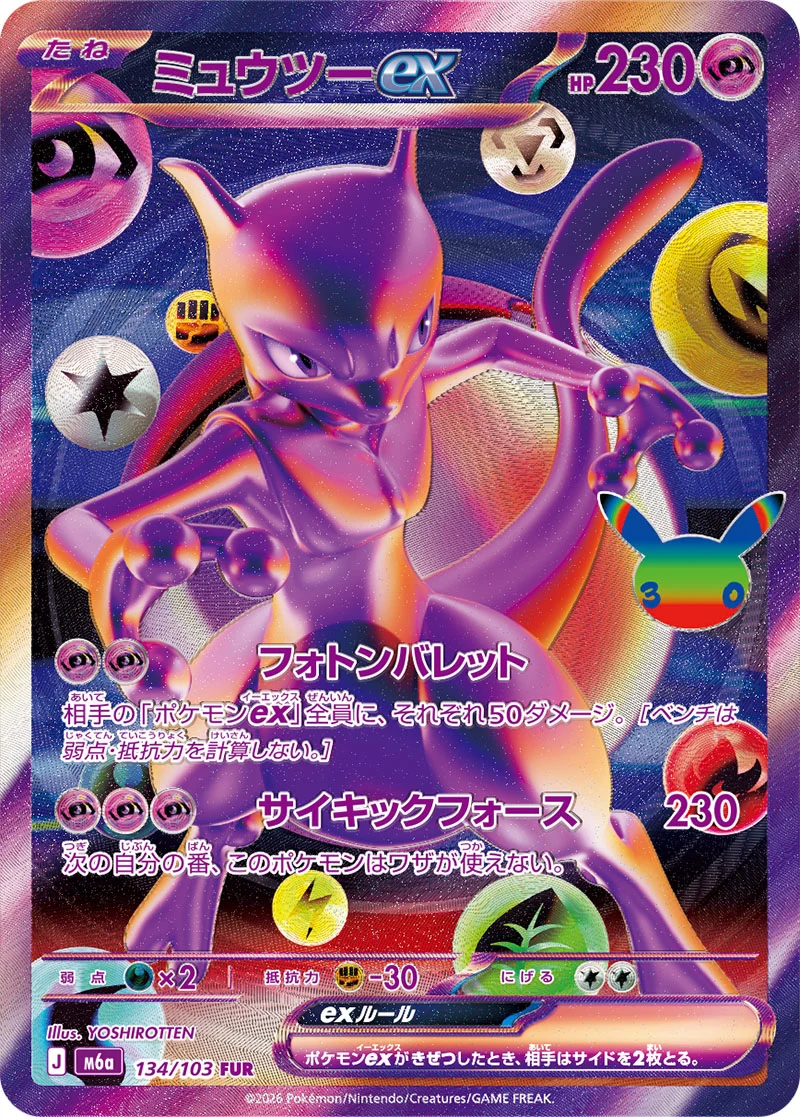
Japanese 30th Celebrations is the rare set where a sealed box and twenty loose packs are not the same thing. Across 57 sealed boxes, every single one produced exactly 1 SAR — never zero, never two. In the 17 boxes logged pack by pack, every one also produced 2 gold-border classic reprints and 9 hit packs. Those are fixed slots, not averages you hope to hit.
So this calculator asks for boxes and loose packs separately. Sealed boxes apply the guarantees; loose packs get modelled as independent rolls at the per-pack rate, with no floor. Pick what you're chasing and it does the rest.
The Calculator
Packs bought individually rather than as part of a sealed box. These get no box guarantee — each is an independent roll at the per-pack rate, which is why loose packs are a much worse deal.
Pick the card you actually want. The big number is your chance of pulling at least one across your sealed boxes and loose packs combined.
| Rarity | Per pack | Per box | Chance of ≥1 | Expected | Base odds |
|---|---|---|---|---|---|
| PikachuGuaranteed | 100% | 20 | 100% | 20 | every pack |
| Standard ex (Double Rare)Common | 23% | 3–5 | 100% | 4.5 | 1 in 4.4 |
| AR (Art Rare)Common | 19% | 3–5 | 100% | 3.7 | 1 in 5.4 |
| Classic Reprint (gold border)Chase | 10% | 2–3 | 100% | 2.1 | 1 in 9.7 |
| SAR (Special Art Rare)Chase | 5.0% | 1 | 100% | 1 | 1 in 20 |
| FUR (YOSHIROTTEN)Lottery | 1.2% | 0–1 | 25% | 0.2 | 1 in 81 |
Sealed boxes are not modelled as 20 independent packs. Across 57 sealed boxes, every box produced exactly 1 SAR; across the 17 logged pack by pack, every box also produced 2 gold-border classic reprints and 9 hit packs — so those rows show a flat 100% for any box count, not a binomial estimate. Only the FUR is a genuine per-box gamble (14 of 57 boxes, ~1 in 4.1). Loose packs get no guarantee and are modelled independently at the per-pack rate.
These are category odds. The SAR pool spans nine different Pokémon and is not evenly weighted, so the chance of hitting one *specific* named card is far longer than the tier rate shown here — roughly 9 boxes on an even split, and anywhere from ~6 boxes (Gengar) to ~29 (Fuecoco) on the observed distribution.
Estimates only. SAR and FUR rates come from 57 sealed boxes (1,140 packs); ex, AR and classic-reprint rates come from the 17 of those logged pack by pack (340 packs). The 1-SAR-per-box guarantee held across all 57 boxes and is reliable; the FUR line rests on 14 pulls and still carries some variance. Loose-pack odds assume each pack is an independent draw at the observed rate; real collation clusters hits. Not affiliated with The Pokémon Company.
How the Box Maths Works
A standard pack-odds calculator computes 1 − (1 − rate)^packs and treats every pack as an independent draw. For most sets that's the right model. For this one it produces a badly wrong answer on the single most-searched question.
At the observed 5.0% per-pack SAR rate, the independent model says twenty packs gives you a ~64% chance of at least one SAR. But if those twenty packs are a sealed box, the real answer is 100% — it held 57 times out of 57. So the tool splits the two:
- Sealed boxes. Rarities that appeared in every sampled box (Pikachu, ex, AR, classic reprint, SAR) are treated as certain for any box count, with expected counts taken from the observed per-box mean. The FUR, which appeared in 14 of 57 boxes, is one Bernoulli trial per box at that observed rate.
- Loose packs. No guarantee applies. Each pack is an independent draw at the per-pack rate, exactly as a normal calculator would treat it.
- Combined. The two are independent sources of failure, so the chance of at least one is
1 − P(miss in boxes) × P(miss in loose packs).
The practical upshot is visible the moment you use it: set 1 box and the SAR reads 100%; set 0 boxes and 20 loose packs and it drops to 64%. That gap is the value of buying sealed, and it is the single best argument against loose Japanese packs.
The Rates Behind It
Every figure comes from our Japanese 30th Celebrations pull-rate guide. Two sample scopes apply: SAR and FUR were recorded across all 57 sealed boxes (1140 packs), while ex, AR and classic reprint need a full pack-by-pack log and rest on the 17 boxes (340 packs) recorded card by card. The "Boxes with ≥1" column states which applies to each row. This page never invents a number; the two share one data file.
| Rarity | Per pack | Per box | Boxes with ≥1 | What it means |
|---|---|---|---|---|
| Pikachu | 100% | 20 | 17 / 17 | One guaranteed Pikachu in every pack, from the anniversary subset. The floor, not a chase — 340 of 340 packs had one, so a sealed box is always 20 Pikachus. |
| Standard ex (Double Rare) | 22.7% | 3–5 | 17 / 17 | The most common secondary hit — 77 in 340 packs (~1 in 4.4). Every one of the 17 boxes delivered between 3 and 5, so a sealed box never gives you zero. |
| AR (Art Rare) | 18.5% | 3–5 | 17 / 17 | The Japanese equivalent of the English Illustration Rare — 63 in 340 packs (~1 in 5.4). Banded tightly at 3 to 5 per box across all 17 boxes. |
| Classic Reprint (gold border) | 10.3% | 2–3 | 17 / 17 | Gold-border 30th-stamped vintage reprints — 35 in 340 packs. Effectively a second box guarantee: 16 of 17 boxes held exactly 2, and one held 3. |
| SAR (Special Art Rare) | 5.0% | 1 | 57 / 57 | The set-defining box guarantee — exactly 1 in every one of 57 sealed boxes, never zero and never two. At 57 in 1,140 packs the per-pack rate is precisely 5.0%, or 1 in 20: exactly one 20-pack box. |
| FUR (YOSHIROTTEN) | 1.2% | 0–1 | 14 / 57 | Mew ex & Mewtwo ex digital fine-art — the top of the set, and the only real variance in a box. 14 in 1,140 packs (~1 in 81); 14 of 57 boxes had one (~1 in 4.1), split dead even at 7 Mew and 7 Mewtwo. All 14 also contained their guaranteed SAR. |
How Many Boxes For…?
The shortcuts people ask for most, straight off the observed rates:
| What you want | Sealed boxes | Packs | Confidence |
|---|---|---|---|
| Any SAR | 1 | 20 | 100% — guaranteed, 57/57 boxes |
| Two SARs | 2 | 40 | 100% — one per box |
| Any FUR (Mew ex or Mewtwo ex) | 1 | 20 | ~25% |
| Any FUR | 3 | 60 | ~57% |
| Any FUR | 5 | 100 | ~76% |
| Any FUR | 8 | 160 | ~90% |
| One specific named SAR | ~9 | ~180 | even-split estimate; ~6 for Gengar, ~29 for Fuecoco |
| A specific FUR (Mew ex or Mewtwo ex) | ~8 | ~163 | the pair split 7/7 across 57 boxes |
The first two rows are the set's whole pitch. The last two are why you should buy the single for anything specific — and why the calculator shows tier odds rather than pretending to price a named card.
Frequently Asked Questions
What are my odds of pulling an SAR?
From a sealed box, 100%. Across 57 sealed boxes every one produced exactly one SAR — never zero, never two. The per-pack rate confirms it independently: 57 SARs in 1,140 packs is exactly 5.0%, or precisely 1 in 20, which is exactly one 20-pack box. Loose packs are a different story — each is an independent 5.0% roll with no guarantee, so 10 loose packs is only about a 40% chance. That is why the calculator asks for boxes and loose packs separately.
Why ask for boxes instead of just packs?
Because a Japanese sealed box is not 20 random packs. The set has fixed per-box slots: 1 SAR in every one of 57 boxes, plus 2 gold-border classic reprints and 9 hit packs in every box logged pack by pack, with ex and AR banded at 3–5. A normal pack calculator would report roughly a 64% chance of an SAR in 20 packs when the real answer for a sealed box is 100%. Modelling the two separately is the only way to get the guarantee right.
How many boxes do I need for a FUR?
About four. The YOSHIROTTEN FUR cards appeared in 14 of our 57 boxes, so one box is roughly a 25% shot, two about 43%, three about 57%, five about 76% and eight about 90%. The FUR is the only real gamble in a sealed box — everything else is guaranteed or tightly banded. It never replaced the box SAR: all 14 FUR boxes also held their guaranteed SAR, and the pair split dead even at seven Mew ex and seven Mewtwo ex.
How many boxes for a specific named SAR?
Roughly nine. You get one SAR per box, and 57 boxes spread those SARs across nine different Pokémon: Gengar (10), Sylveon (9), Pikachu (8), Mewtwo (8), Mew (5), Greninja (5), Salamence (5), Jirachi (4) and Fuecoco (2). That spread looks uneven, but it is not statistically distinguishable from a flat nine-card pool (chi-square p = 0.35), so plan on about 1 in 9 boxes for any of them — roughly 20 boxes to be 90% confident. Full working in our SAR & FUR distribution guide. The calculator deliberately shows tier odds rather than named-card odds — and in almost every case buy the single instead.
Are loose Japanese packs worth buying?
They are a much worse deal, and the calculator makes that visible — set boxes to 0 and loose packs to 20 to see it. A loose pack carries no guarantee: 54.4% chance of just the Pikachu, 5.0% at an SAR, 1.2% at a FUR. Worse, because a box has a known 9-hit/11-blank shape, its SAR pack can be identified and removed before the rest are sold loose or resealed.
Disclaimer: Estimates only. SAR and FUR come from 57 sealed boxes (1140 packs); ex, AR and classic-reprint rates come from the 17 of those logged pack by pack (340 packs). The 1-SAR-per-box guarantee held across all 57 boxes and is reliable; the FUR line rests on 14 pulls and still carries some variance. Loose-pack odds assume independent draws at the observed rate — real collation clusters hits. Not financial advice, and not affiliated with The Pokémon Company.