
Era of Spiders Pack Calculator
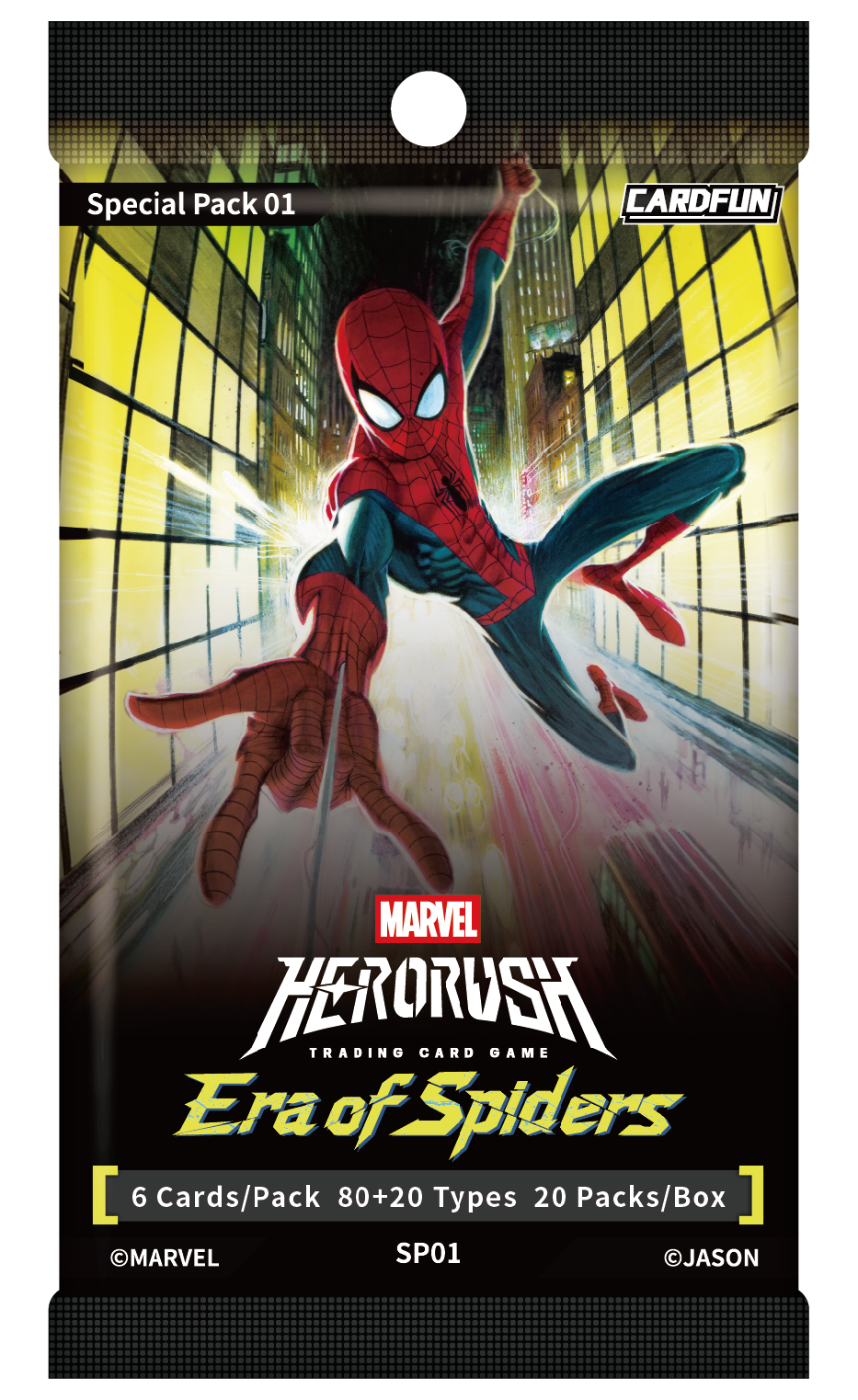
Every Era of Spiders (SP01) pack is six all-foil cards: one Rush Point, four base R cards, and one character hit at SR or above. Because that hit is a single card, the question is never really “will I get a hit?” — it is which tier the slot lands on, and how many packs it takes to reach the one you actually want.
Set your pack count below, or tap a box preset — and note that SP01 ships in two box sizes: a 20-pack box in English and a 10-pack box in Indonesia. Then switch between any card in the tier and one specific card: Card Fun publishes 41 MR, 16 GR, 12 UR and 8 HR, so named-card odds are real arithmetic rather than a guess. All rates come from the 140-pack, 10-box sample behind our Era of Spiders pull-rate page.
Every Era of Spiders pack is six all-foil cards, and one of them is the character hit — so the question is which tier that single slot lands on. Pick a tier and the big number is your chance of at least one across your pack count. Mind your box size: SP01 ships as a 20-pack box in English and a 10-pack box in Indonesia.
| Rarity | Per pack | Chance of ≥1 | Expected | Base odds |
|---|---|---|---|---|
| Super Rare (SR)Common | 40% | >99.9% | 8 | 1 in 2.5 |
| Grand Rare (GR)Common | 27% | 99.8% | 5.4 | 1 in 3.7 |
| Ultimate Rare (UR)Chase | 12% | 93% | 2.5 | 1 in 8.1 |
| Marvel Rare (MR)Chase | 8.5% | 83% | 1.7 | 1 in 12 |
| Secret Rare (SEC)Lottery | 1.5% | 27% | 0.3 | 1 in 65 |
| Hero Rare (HR)LotteryEstimate | 0.7% | 13% | 0.1 | 1 in 140 |
Every SP01 pack carries one Rush Point card alongside its character hit, and all ten boxes confirmed the one-per-pack cadence. Two things make this track more than filler. First, the MR Rush Point is the most over-treated card in the product — gold stamping, embossing and textured foil on one card — and it appeared in 3 of the 10 boxes, which is the one Rush Point rung our sample is large enough to put a rate on. Second, the Rush Point scene art assembles into a single large poster across nine or ten pieces, and a full 20-pack box still came up three pieces short of completing it. The lower rungs carry no percentages because the sample does not fix them, and no Rush Point rate affects your character-hit odds.
Why these do not sum to 100%: These are measured per-pack frequencies over the 130 packs whose hit rarity we know, and they add up to about 89% rather than 100%. The missing ~11% is a measurement gap, not a confirmed blank-pack rate: the two 20-pack boxes that were tallied on camera each came to 17 named hits across 20 packs, while both fully-logged 10-pack boxes came to 10 hits from 10 packs. Either a handful of packs in the larger boxes top out at R, or hits were missed while those openings were sped up. We would rather show you the gap than inflate every tier to make the column sum to 100%.
Switch the mode above to see named-card odds. The tier rate is the chance of hitting *any* card in that tier, and SP01’s tiers are wide: 41 MR variants, 16 GR, 12 UR and 8 HR. Pulling an MR is near-certain across a 20-pack box; pulling the one MR character you actually want is roughly 1 in 485 packs. Specific-card odds assume the cards inside a tier are evenly weighted, which Card Fun has not confirmed — and note that the high rarities are alternate-rarity prints of the same 80-card roster, so Electro exists as both an MR and a GR. Named-card mode is switched off for Secret Rare because Card Fun has not published how many SEC cards the set holds.
Rates come from 140 packs across 10 boxes opened in the set’s launch window — four 20-pack English boxes and six 10-pack Indonesian boxes — of which 130 packs have a known hit rarity. The SR, GR, UR and MR shares are observed; the SEC rate is observed but came entirely from one box; the HR row is an ESTIMATED CEILING, not a measurement, because no Hero Rare appeared at all. The calculator models each pack as an independent draw at the observed rate, which real collation can violate — UR demonstrably does, arriving as a fixed 3 per 20-pack box. The Rush Point insert is a separate track and does not affect your character-hit odds. Not affiliated with Card Fun or Marvel.
First: Which Box Are You Buying?
This is the question that invalidates most of the per-box numbers circulating for this set. Era of Spiders ships in two different box configurations, and both are legitimately “a box of Era of Spiders”:
| Box | Packs | Retail | Expected MR | Observed UR |
|---|---|---|---|---|
| English / SEA box Singapore, Malaysia, Thailand, Hong Kong | 20 | ~S$75 (~US$58) | ~1.7 | 3, 3, 3, 3 (four boxes) |
| Indonesian box | 10 | ~Rp 500,000 (~US$30) | ~0.8 | 1, 1, 0, 1 (four logged boxes) |
Both use the identical six-card all-foil pack, so the per-pack rates in this calculator apply equally to either — set the pack count and the tool reports both box equivalents. What does not transfer is any claim quoted “per box.” If someone tells you Era of Spiders gives “one MR per box,” they are describing the Indonesian box; “three UR per box” describes the English one.
The Per-Pack Hit-Slot Rates Behind the Calculator
Because the hit slot is a single card, these shares are mutually exclusive within a pack — which is what makes the “≥1 at this tier or better” line in the calculator exact rather than an approximation. These are the same aggregates published on the pull-rate page:
| Rarity | Per Pack | Base Odds | Per 20-Pack Box | ≥1 per 20-Pack Box | ≥1 per 10-Pack Box |
|---|---|---|---|---|---|
| Super Rare (SR) | 40% | ~1 in 3 | ~8.0 | >99.9% | 99.4% |
| Grand Rare (GR) | 27% | ~1 in 4 | ~5.4 | 99.8% | 96% |
| Ultimate Rare (UR) (fixed per box) | 12% | ~1 in 8 | ~2.5 | 93% | 73% |
| Marvel Rare (MR) | 8% | ~1 in 12 | ~1.7 | 83% | 59% |
| Secret Rare (SEC) | 1.5% | ~1 in 65 | ~0.3 | 27% | 14% |
| Hero Rare (HR) (estimate) | 0.7%* | ~1 in 140 | ~0.1 | 13%* | 6.9%* |
| Any character hit | 89% | ~1 in 1.1 | ~18 | >99.9% | >99.9% |
*The HR row is an estimated ceiling, not a measurement. No Hero Rare was pulled in 140 packs; the figure shown models 1 in 140 as a generous upper bound. Read it as “no more common than this.” The SEC row is observed but clustered — both pulls came from one box. See the top-end section below.
The useful cumulative reads, straight off those shares. A hit at GR or better — what most openers mean by “a real hit” — is 50% of packs, which is the arithmetic behind the pull-rate page's headline that about half of all packs produce something above SR. A hit at UR or better is 23% of packs, or 99.5% across a 20-pack box. MR or better is 11% of packs, about 90% across a box. And most packs still land in the bottom two tiers: SR and GR together account for roughly 67% of all packs.
The UR Exception: 3 Per Box, Every Box
Every pack-odds calculator, including this one, models packs as independent draws at the average rate. That assumption is usually a reasonable approximation. For UR in Era of Spiders, it is demonstrably wrong — and it is wrong in the direction that makes you underestimate a sealed box.
All four 20-pack boxes in our sample produced exactly 3 UR. Not two, not four: 3, 3, 3, 3. Compare that with what the independent model predicts from the pooled 12% per-pack rate:
- Independent model: 2.5 UR expected per box, with a 93% chance of at least one — so roughly a 7.2% chance of a box with no UR at all.
- Observed reality: 3 UR in every box, and not one box without. Four for four.
Four boxes is a small sample, but a run of 3/3/3/3 is very hard to produce by chance from a 12% per-pack rate — it is the signature of a fixed per-box allocation. So use the calculator for loose packs and part-boxes, where the independent model is the right tool, and for a sealed 20-pack box trust the observed allocation of about 3 UR instead. The calculator flags this directly on the UR tier so the number never stands unqualified.
The 10-pack Indonesian boxes do not show the same pattern — they ran 1, 1, 0, 1 across the four we logged, which is consistent with an independent roll. That difference is also why the pooled per-pack UR rate sits where it does: it averages two box configurations with different UR densities, so a single-market rate may land slightly above or below it.
How the Odds Are Calculated
The maths is deliberately simple and fully stated, so you can check it:
- Chance of at least one —
1 − (1 − rate)^packs. The probability that a run of packs produces one or more of a rarity. - Expected count —
rate × packs. The long-run average, which is not the same as what any one box gives you. - Base odds —
1 ÷ rate, rendered as “1 in N packs.” - Packs for a 50/50 shot —
ln(0.5) ÷ ln(1 − rate). - “This tier or better” — a plain sum of the shares at and above a tier. This is exact rather than approximate, because the hit slot is one card and the tiers are therefore mutually exclusive within a pack.
- One specific card —
tier rate ÷ cards in tier, which assumes the cards inside a tier are evenly weighted. Card Fun has not confirmed that.
Two honest limits. First, the independence assumption: real collation clusters, and as the UR section above shows, SP01 clusters hard. Second, the rates sum to about 89% rather than 100%. That shortfall is a measurement gap, not a confirmed blank-pack rate — the two 20-pack boxes tallied on camera each came to 17 named hits in 20 packs, while both fully-logged 10-pack boxes came to 10 from 10. We publish the gap rather than inflating every tier to hide it.
Secret Rare, Hero Rare & the Serialized /616
The top of SP01's ladder is where honest numbers matter most, because it is where people spend the most money on the thinnest evidence. Card Fun's ladder is also unusual here: HR (Hero Rare) outranks SEC (Secret Rare) rather than sitting below it.
Secret Rare — observed, but violently clustered
Two SEC in 130 logged packs gives 1.5% per pack, about 1 in 65, which the model turns into 27% per 20-pack box and a coin flip at roughly 45 packs. That expected value is correct. The intuition it hands you is not: both Secret Rares came out of the same 10-pack box, and the other eight logged boxes produced zero across 120 packs. Plan on nothing, and know that the occasional box doubles up. Named-card mode is switched off for SEC because Card Fun has not published the tier's size — we would rather disable the feature than guess a denominator.
Hero Rare — 0 for 140
There are 8 HR in the set and we have never seen one, from openers who were specifically hunting them on camera. There is no measured rate. The calculator models 1 in 140 — the point at which we would have expected a hit — as a deliberately generous ceiling, which gives 13% per 20-pack box and a coin flip around 97 packs. Be clear about how much weaker the formal evidence is: 0 hits in 130 packs only rules out rates above roughly 1 in 43 packs at 95% confidence. Both figures are modelling choices, not measurements. Every HR number here means “no more common than this.”
The serialized 153/616
One serialized card turned up in the whole sample: a signature Spider-Man numbered 153/616, the print run a nod to Earth-616. That is 1 in 140 packs observed — roughly S$525 of sealed product per serialized card at Singapore retail, or about 97 packs for a 50/50 shot at any serialized. And hitting one is not hitting yours: with 616 copies of that card alone, you are also rolling for a print number. One observation is not a rate. Treat it as a lottery ticket attached to a box you wanted anyway.
Odds of a Specific Named Card
This is the gap that catches people out. “An MR is near-certain across a box” and “the MR I want is near-impossible” are both true, because SP01's tiers are wide — and wider than they look, since the high rarities are alternate-rarity prints of the same 80-card roster (Electro exists as both SP01-44 at MR and SP01-144 at GR). Switch the calculator to one specific card mode and it divides the tier rate by the published tier size:
| Chasing one named… | Cards in Tier | Per Pack | ≥1 per 20-Pack Box | Packs for 50/50 | Sealed Cost at 50/50 |
|---|---|---|---|---|---|
| GR | 16 | ~1 in 59 | 29% | ~41 | S$155 |
| UR | 12 | ~1 in 98 | 19% | ~68 | S$255 |
| MR | 41 | ~1 in 485 | 4.0% | ~336 | S$1260 |
| HR (on the estimated ceiling) | 8 | ~1 in 1120 | 1.8% | ~776 | S$2910* |
Sealed cost assumes Singapore retail of S$75 per 20-pack box (S$3.75 per pack). *The HR row rests on an estimated ceiling, so its true cost is higher than shown — possibly far higher. Secret Rare is absent because its tier size is unpublished.
The practical upshot: a named GR or UR is a reasonable thing to open toward. A named MR costs more in sealed product than any single in this set is plausibly going to be worth — buy it. A named HR is not a chase, it is an accident.
Rush Points: The Separate Track
Every SP01 pack carries a second guaranteed insert — a Rush Point parallel tied to the game's resource mechanic — on top of the character hit. The two never compete: a 20-pack box yields about 20 character hits and 20 Rush Points. So Rush Points are excluded from every probability above, and the calculator reports them as counts.
One rung does carry a real rate. The MR Rush Point — gold stamped, embossed and textured, the most over-treated card in the product — appeared in 3 of the 10 boxes, which works out to roughly 1 in 43 packs. That is the one Rush Point rung our sample is large enough to put a number on; the common, R and GR rungs stay labelled “rate not established.”
The Rush Points are also a connecting-art chase: the scene cards assemble into one large poster across nine or ten pieces, and a full 20-pack box still came up three pieces short. If completing the poster is your goal, that is a multi-box ask by design — and it is the one thing in this set where opening genuinely beats buying singles.
Frequently Asked Questions
What are my odds of pulling an MR in Era of Spiders?
MR landed in 8.5% of packs across our 140-pack sample — about one Marvel Rare every 12 packs. Over a 20-pack English box that is roughly a 83% chance of at least one, with about 1.7 expected. Over a 10-pack Indonesian box it is about 59% — though notably all five logged 10-pack boxes produced exactly one MR, no more and no fewer. You need only about 8 packs for a coin-flip shot at a single MR. The catch is set size: with 41 MR variants, a specific MR is about 1 in 485 packs — 4.0% per 20-pack box, and around 336 packs (S$1260) for a 50/50 shot.
Is the UR rate in Era of Spiders really 3 per box?
In the 20-pack English boxes, yes — and it is the most important caveat on this calculator. All four produced exactly 3 UR: 3, 3, 3, 3, with no variation, which makes UR look like a fixed per-box allocation rather than an independent per-pack roll. The pooled per-pack rate is 12%, which the model turns into 93% per box and 2.5 expected — both of which understate a sealed 20-pack box. Use the model for loose packs and part-boxes; for a sealed box, trust the observed 3. The 10-pack Indonesian boxes ran lower, at 4 UR across 50 packs.
What is the chance of pulling an Era of Spiders Secret Rare?
Two SEC appeared in 130 logged packs — 1.5% of packs, about 1 in 65. On the independent model that is 27% per 20-pack box and 14% per 10-pack box, with a coin flip at about 45 packs. Read the clustering before trusting the average: both came out of the same 10-pack box, and the other eight logged boxes produced zero across 120 packs. The expected value is right; the intuition is wrong.
What are the odds of a Hero Rare (HR) in Era of Spiders?
Unknown, and this page says so rather than pretending otherwise. HR is new in SP01 and sits above Secret Rare, with 8 cards in the set. Zero appeared in 140 packs, so there is no measured rate. The calculator models 1 in 140 as a generous ceiling — about 13% per 20-pack box, coin flip near 97 packs. The formal evidence is far weaker: 0 in 130 packs only rules out rates above roughly 1 in 43 at 95% confidence. Read every HR figure as “no more common than this.”
How many packs do I need for the serialized 153/616 Spider-Man?
More than is sensible. One serialized signature Spider-Man, numbered 153/616, appeared in our 140-pack sample — so roughly S$525 of sealed product per serialized card pulled, or about 97 packs for a 50/50 shot at any serialized. Hitting one is not hitting yours: there are 616 copies of that card alone, so you are also rolling for a print number. One observation is not a rate — the real frequency could be half or double this.
How many packs are in an Era of Spiders box?
It depends on your market, which is why this calculator reports both. The English boxes (Singapore, Malaysia, Thailand, Hong Kong) hold 20 packs at about S$75. The Indonesian boxes hold 10 packs at about Rp 50,000 per pack. Both use the identical six-card all-foil pack, so per-pack rates transfer — but per-box counts do not, and any “per box” claim is meaningless until you know which box.
Why do the Era of Spiders rates only add up to 89%?
Because we publish what was measured rather than normalising it. The two 20-pack boxes tallied on camera each came to 17 named hits across 20 packs, while both fully-logged 10-pack boxes came to 10 from 10. Either a handful of packs in the larger boxes top out at R, or hits were missed while those openings were sped up. We would rather surface the gap than inflate every tier to force the column to 100% and hide it. BP01 differs — its hit slot is a true guarantee and its shares do sum to about 1.
How accurate are these Era of Spiders odds?
Directional. The sample is 140 packs across 10 boxes — four 20-pack English and six 10-pack Indonesian — of which 130 have a known hit rarity. That settles the SR / GR / UR / MR structure, and UR is the firmest figure in the dataset. It is not enough for Secret Rare, whose two pulls both came from one box, and it says almost nothing precise about Hero Rare at 0-for-140. Two further caveats: the model assumes independent packs, which UR demonstrably violates; and the rates pool two box configurations with different per-pack UR densities.
Disclaimer: These odds are community estimates derived from 140 packs across 10 boxes in the set's launch window and will shift as more data comes in — particularly for Secret Rare and Hero Rare, which rest on two and zero observations respectively. The calculator models packs as independent draws, which real collation violates. Sealed prices are launch-window retail and vary by market. No settled secondary market exists for Marvel Hero Rush singles. Not affiliated with Card Fun or Marvel. This is not financial advice.