
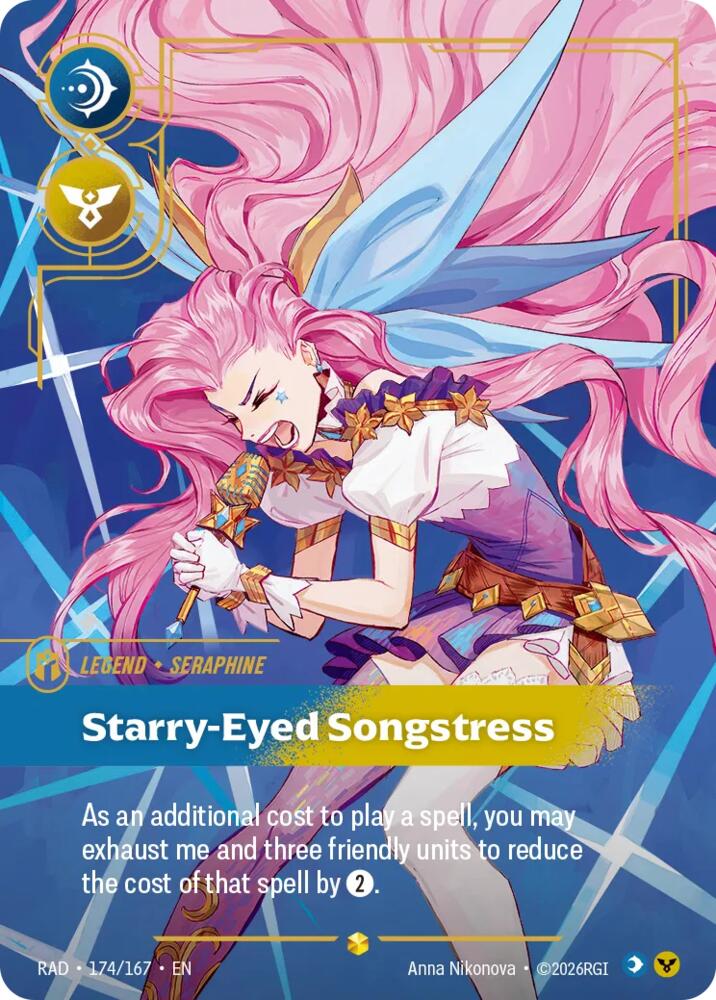
Radiance Masterset Calculator
Set what you’re paying per pack, then toggle which rarity tiers your masterset has to include. The headline shows the expected pack count and cost, plus a ~90%-confidence budget, and highlights which tier is holding you up. Every pull rate here is imported from the same data file behind our Radiance pull-rate page (54 packs) and pack odds calculator — nothing is re-measured or re-typed here, so when the sample is refreshed all three pages move together.
Recommended. Epic and Legend density are pulled back to the figures Vendetta and Unleashed both measured over much larger, non-promotional samples. Because higher pull rates mean FEWER packs to complete a tier, the Summit basis makes a masterset look cheaper than it is.
A $120 booster display across 24 packs is $5.00/pack at MSRP. Loose packs on recent Riftbound sets have traded above that, so the default is a little higher. Use your real cost — the total scales straight off it.
Toggle the tiers you want every card from. The three premium tiers are off by default — switch Overnumbered on for a “true” masterset and watch the number jump.
| Tier | Cards | Cards / pack | Packs to finish | Displays | Cost |
|---|---|---|---|---|---|
| Artist-signed Overnumbered ✦EstimatedBounded rate One artist-signed variant per Overnumbered, assumed. No rate has ever been measured for any Riftbound set, so the pack calculator treats this as a bound rather than a rate — which makes any completion figure here indicative only. Off by default. | 16 | 0.008 | 6,491 ~90%: 9,644 | 270 | $38,946 |
| Ultimate Rare — Packed AmphitheaterConfirmed Packed Amphitheater, 184/167. A single card, so coupon-collecting adds nothing — the figure collapses to Riot's stated 1-in-4,000 packs, which is a useful check that this model is wired correctly. Off by default. | 1 | 2.5e-4 | 4,000 ~90%: 9,001 | 167 | $23,998 |
| OvernumberedDerived RAD 168–183: all nine Legends plus key Epics such as Orianna, Lady of Clockwork. Off by default — at ~0.4 per display across 16 cards, this tier alone runs past a hundred displays. Toggle it on to see what a "true" masterset costs. | 16 | 0.017 | 3,168 ~90%: 4,707 | 132 | $19,010 |
| Showcase / alt-art EpicBottleneckDerived 51 Showcase printings minus the 16 Overnumbered, 6 alt-art Runes and 1 Ultimate. Radiance is the first Riftbound set with newly commissioned Showcase art, and at ~3 per display this is the tier that bottlenecks a core masterset. | 28 | 0.092 | 1,194 ~90%: 1,697 | 50 | $7,162 |
| Alt-art Rune (music-themed)Confirmed R01–R06, each with an "A" Showcase variant — the music-themed Runes. Only 6 distinct cards, but at ~1 per display they are slower than the card count suggests. Note these come from packs only; the Vault's 36 Runes are the basic set. | 6 | 0.025 | 588 ~90%: 970 | 25 | $3,528 |
| Epic (signature spells, epic units)Estimated Signature spells and premium champion units. The count is single-sourced from a community tracker, though it reconciles exactly against the confirmed 167-card base set. Verify at launch. | 26 | 0.291 | 344 ~90%: 492 | 14 | $2,065 |
| Regular Rare (units, spells, gear, battlefields)Derived 50 Rares in the set minus the 9 Legends, which sit at Rare themselves. Units, spells, gear and the battlefield cycle — including the ordinary non-Ultimate print of Packed Amphitheater. The largest rare+ tier, but also the fastest-filling one per card. | 41 | 1.1 | 165 ~90%: 229 | 6.9 | $993 |
| Commons & UncommonsEstimated 55 Commons + 42 Uncommons. The rate here is an estimate of ~7 non-foil cards per pack rather than a measured figure — the pull-rate sample only tracked the rare+ slots. It barely matters: this tier finishes long before any rare tier, and it is where Radiance's actually-good cards live (The Good Stuff, Portable Portal, Trifarian Captain). | 97 | 7.0 | 71 ~90%: 95 | 3.0 | $429 |
| Legend (Rare)Confirmed Seraphine, Evelynn, Ekko, Ziggs, Jarvan IV, Orianna, K'Sante, Mordekaiser and Riven — all nine named and revealed. At Rare and filling a quarter of every slot, this tier completes almost immediately. | 9 | 0.500 | 51 ~90%: 80 | 2.1 | $306 |
Each row is what that tier alone would take to complete. Your masterset finishes when the slowest included tier does, so the headline tracks the bottleneck row (highlighted) — the others fill in well before it. Cards / pack is the expected number of that tier’s cards in one pack, which for the rare+ tiers is the per-slot rate doubled, because every Radiance pack has two Rare-or-above slots.
The Confirmed / Derived / Estimated badge describes how firm the distinct-card count is, not the pull rate. Radiance’s checklist was not final when this tool was built — the base set is confirmed at 167 cards and the Runes at R01–R06, but the per-rarity split is single-sourced. A Bounded rate badge is a separate warning: that tier’s pull rate has never been measured for any Riftbound set, so its completion figure is indicative only.
How to Read the Number
With the default tiers on and the retail-adjusted basis selected, a Radiance masterset is about 1,194 packs — roughly 50 booster displays, or $5,968 at the $5.00-per-pack MSRP of a $120 display. That is the average. Coupon collecting has a long right tail, so to be about 90% confident of actually finishing you should budget 1,697 packs ($8,484) — around 42% more than the mean.
Three things to keep in mind when you quote the figure:
- It is a bottleneck, not a sum. The headline is whatever your slowest included tier takes, not the tiers added together. All tiers collect in parallel from the same two rare+ slots per pack, so the set finishes when the worst one does. This is a mild approximation — finishing the bottleneck does not strictly guarantee the faster tiers are complete — but their means sit far below it.
- The three premium tiers are off by default. Overnumbered, artist-signed Overnumbered and the Ultimate are each a different order of magnitude. Switch Overnumbered on and the figure jumps from 1,194 packs to 3,168 (132 displays). Signed takes about 6,491 packs, and that number is indicative only — no signed rate has ever been measured for any Riftbound set.
- The Summit basis makes it look cheaper. Higher pull rates mean fewer packs, so switching to the as-published Radiance sample lowers every completion figure. That is the optimistic read from promotional boxes, not what a shelf display should be expected to do. The retail basis is the default for exactly this reason.
The Bottleneck Explained
For a core Radiance masterset the bottleneck is the Showcase alt-art Epics — an estimated 28 distinct cards arriving at roughly 3 per booster display. That tier alone is 1,194 packs, or 50 displays. Here is how the rest of a core masterset stacks up against it on the retail basis:
| Tier | Distinct cards | Cards per pack | Packs to finish | Displays | In the default masterset? |
|---|---|---|---|---|---|
| Artist-signed Overnumbered ✦ | 16 | 0.008 | 6,491 | 270 | Off by default |
| Ultimate Rare — Packed Amphitheater | 1 | 2.5e-4 | 4,000 | 167 | Off by default |
| Overnumbered | 16 | 0.017 | 3,168 | 132 | Off by default |
| Showcase / alt-art Epic ← bottleneck | 28 | 0.092 | 1,194 | 50 | Yes |
| Alt-art Rune (music-themed) | 6 | 0.025 | 588 | 25 | Yes |
| Epic (signature spells, epic units) | 26 | 0.291 | 344 | 14 | Yes |
| Regular Rare (units, spells, gear, battlefields) | 41 | 1.1 | 165 | 7 | Yes |
| Commons & Uncommons | 97 | 7.0 | 71 | 3 | Yes |
| Legend (Rare) | 9 | 0.500 | 51 | 2 | Yes |
The instructive comparison is Showcase versus alt-art Rune. The Runes are only 6 distinct cards against the Showcase tier’s 28, yet they still take 588 packs because they arrive at roughly one per display. Card count alone does not tell you which tier is slow — what matters is cards ÷ rate, and a tiny tier at a punishing rate can outlast a large tier at a generous one. The Epic tier makes the point from the other direction: 26 cards, nearly as many as the Showcase tier, but it finishes in 344 packs because Epics arrive roughly 3.2× as often.
One number in that table is worth calling out as a self-check rather than a result. The Ultimate Rare row is a single card, so coupon collecting contributes nothing — H(1) = 1 — and its mean collapses to exactly 1 ÷ (cards per pack) = 4,000 packs. That is precisely Riot’s stated 0.025% per pack, i.e. 1 in 4,000. If that row ever stops reading 4,000, something upstream in the shared rate data has broken.
Why It Costs So Much
The intuition people start with is “28 Showcase cards at 3 per display, so about 10 displays.” The real answer is 50 displays — roughly 5.3× worse. The gap is entirely duplicates.
Early on, almost every Showcase you pull is new. Once you hold 20 of 28, though, only 29% of pulls can help you, so you need about 3.5 hits per new card. At 27 of 28 you need 28 hits for the last one. That is the coupon-collector problem, and it has a closed form:
- Mean packs =
(n ÷ λ) × H(n), wherenis the distinct cards in the tier,λis the expected cards of that tier per pack, andH(n) = 1 + 1/2 + … + 1/n - ~90% budget =
(n ÷ λ) × (ln n + 2.2504)— the Gumbel tail of the collector - For the Showcase tier that is
(28 ÷ 0.092) × H(28)= 304 × 3.93 = 1,194 packs
The H(n) factor is the whole story: for a 28-card tier it is 3.93, so it very nearly quadruples the naive estimate. And because λ appears in the denominator, a tier’s cost scales inversely with its pull rate — halve the rate and you double the packs.
Why Riftbound’s two slots matter here. Most masterset calculators assume one hit slot per pack. A Radiance pack has two independent rare+ slots, so it can deliver two cards of the same tier at once. This tool therefore feeds the formula λ = per-slot rate × 2 rather than a per-pack probability. That is a strict generalisation — it reduces to the classic formula when there is one slot — and getting it wrong would understate every count by roughly half. The pack odds calculator explains the two-slot model in full.
The practical conclusion is the one every masterset tool reaches: duplicates make opening the expensive way to finish. Open while the tier is empty and your hit rate on new cards is high; switch to buying singles once you are past the halfway mark, because from there each additional pack is mostly paying for cards you already own.
Where the Card Counts Come From
Pull rates and card counts are two different inputs, and they carry different confidence. The rates come from our 54-pack sample. The counts — how many distinct cards sit in each tier — come from the set checklist, which was not final when this tool was built: the page went up on October 12, 2026, eleven days before release. So every tier carries a badge saying how firm its count is.
Confirmed — the base numbered set runs 001–167; Overnumbered printings start at RAD 168 and the highest number is RAD 184, which is the Ultimate (Packed Amphitheater is numbered 184/167); the Runes are R01–R06, each with an “A” Showcase variant; there are nine Legends, all revealed. Riot states 180 cards including 66 Showcase treatments.
Derived — the 16 Overnumbered fall out of the 168–183 range once you remove 184 as the Ultimate. The 41 non-Legend Rares are the 50 Rares in the set minus the nine Legends, which sit at Rare themselves. The 28 Showcase alt arts are the 51 Showcase printings minus the 16 Overnumbered, 6 alt-art Runes and 1 Ultimate.
Estimated — the per-rarity split (55 Commons, 42 Uncommons, 50 Rares, 26 Epics, 51 Showcase) is single-sourced from a community tracker we could not independently verify. We build on it anyway for one reason: it reconciles exactly against the confirmed numbers. 55 + 42 + 50 + 26 = 173, which is precisely the 167-card base set plus the 6 basic Runes. On the Showcase side, 51 + 16 signed = 67 against Riot’s stated 66 — off by one. Nothing forced either of those to land, so the split is very probably right. Re-check both against the final checklist anyway.
The one rate on this page that is not from the pull-rate sample is the Commons and Uncommons row. Our sample only ever tracked the two rare+ slots, so the ~7 non-foil cards per pack is an estimate off the openings. It barely matters: that tier finishes in about 71 packs and is never the bottleneck. It is also, awkwardly for anyone opening for value, where Radiance’s best competitive cards live — The Good Stuff, Portable Portal and Trifarian Captain are all Commons or Uncommons.
Frequently Asked Questions
How many packs does it take to complete a Riftbound Radiance masterset?
On the retail-adjusted rates, a core masterset — Commons and Uncommons, Legends, regular Rares, Epics, Showcase alt arts and the alt-art Runes — takes about 1,194 packs, roughly 50 booster displays. For ~90% confidence, budget 1,697 packs. At $5.00/pack MSRP that is $5,968 average and $8,484 for the 90% budget. Adding the 16 Overnumbered cards pushes it to about 3,168 packs (132 displays).
What is the bottleneck tier in a Radiance masterset?
The Showcase alt-art Epics — an estimated 28 cards arriving at roughly 3 per display, so 1,194 packs (50 displays) for that tier alone. Everything else in a core masterset finishes earlier: Legends in ~51 packs, Commons and Uncommons in ~71, regular Rares in ~165, Epics in ~344, and the 6 alt-art Runes in ~588.
Why does the masterset cost so much more than the sum of the singles?
Coupon collecting. Early packs almost always give you something new; as a tier fills, most hits are duplicates, and the last few cards take an enormous number of packs each. The expected packs to collect all n cards in a tier is (n ÷ λ) × H(n), and that harmonic factor is 3.93 for a 28-card tier — it nearly quadruples the naive estimate. Buying the specific cards you are missing is almost always cheaper, and the gap widens the closer you get to done.
Is a full Radiance masterset even possible from booster packs?
No. A 100% masterset needs cards that never appear in boosters: the Pre-Rift promo (Heimerdinger, Academy Instructor) from the October 16–22 prerelease events, the Summoner Skirmish promo (Ahri, Confident) from store events, and the exclusives in the Seraphine vs Evelynn Showdown Decks and the Vault Bundle — including the basic 36-Rune set and the full-art foil tokens. The calculator models only the pack-pullable tiers and flags the rest.
How much does it cost to complete every Radiance Overnumbered?
About 3,168 packs — 132 displays, roughly $15,841 at MSRP. There are an estimated 16 Overnumbered (RAD 168–183: all nine Legends plus key Epics) arriving at roughly 0.4 per display. The artist-signed versions are worse again at about 6,491 packs, and that figure is indicative only because no signed rate has ever been measured for any Riftbound set. For scale, the Packed Amphitheater Ultimate on its own is 4,000 packs — simply Riot’s stated 1-in-4,000.
How accurate are the Radiance card counts in this calculator?
Mixed, and every tier is labelled. See Where the Card Counts Come From for the full provenance — the short version is that the 167-card base set, the RAD 168–184 numbering and the six Runes are confirmed; the Overnumbered, non-Legend Rare and Showcase counts are derived from those; and the per-rarity split is single-sourced but reconciles exactly against the confirmed totals. Radiance released October 23, 2026, so re-check against the final checklist.
Should I open packs or buy singles to complete Radiance?
Buy singles for anything specific. At 1,194 packs (50 displays) for a core masterset and 3,168 once Overnumbered is included, opening is the expensive route to any named card — and Radiance’s strongest competitive cards are Commons and Uncommons that cost pocket change. The honest case for opening is the Showcase tier: about 3 alt-art Epics plus 1 alt-art Rune per display is the best Showcase density Riftbound has had, and Radiance is the first set with newly commissioned Showcase art. Open for those, fill the gaps from the singles market. Our pull-rate page has the full open-versus-buy breakdown.
Disclaimer: Pull rates come from 54 Riftbound Radiance packs — two 24-pack booster displays plus one 6-pack Vault Bundle — promotional Radiance Summit product, opened at the October 12 embargo lift, 11 days before retail launch — and the Epic and Legend figures rest on a single display tallied card by card. Distinct-card counts are taken from the set checklist as it stood before the October 23, 2026 release and each is labelled Confirmed, Derived or Estimated in the tool. Coupon-collector figures assume each card within a tier is equally likely and that packs are independent draws; real collation clusters hits and some cards within a tier are short-printed, so a live run can over- or under-shoot substantially. Costs scale directly off whatever you enter per pack. Riot Games does not publish official pull rates beyond the Ultimate figure. Not affiliated with Riot Games. This is not financial advice.